Introduction
Software testing has changed a lot in the last decade. Companies now release software faster than ever. They also expect testers to deliver reliable results in less time. Automation helps teams meet this demand. Many QA professionals now move from manual testing to automation tools to grow their careers.
One tool that stands out in enterprise automation is Tricentis Tosca. Many organizations use it because it supports model based testing and reduces the need for complex coding. Because of this demand, many beginners search for a clear TOSCA Learning Path to understand how to start and what skills they should learn first. Many learners also explore Tricentis TOSCA Training programs to gain structured knowledge and hands on practice with the tool. Some learners also explore structured programs and communities such as H2K Infosys to understand industry expectations and job roles before starting formal training.
This guide explains the learning journey step by step. It covers the skills you need, the tools you should practice, and the certifications that help you grow in automation testing.
By the end of this guide, you will understand how to build a strong foundation in Tosca automation and move toward professional level expertise.
What Is Tosca Automation?
Tricentis Tosca is an enterprise level test automation platform. It allows teams to automate functional testing, regression testing, and API testing without heavy coding.
Unlike traditional automation tools, Tosca uses a model based testing approach. Testers create reusable modules that represent elements of an application. These modules help teams build tests quickly and maintain them easily.
Key features of Tosca include
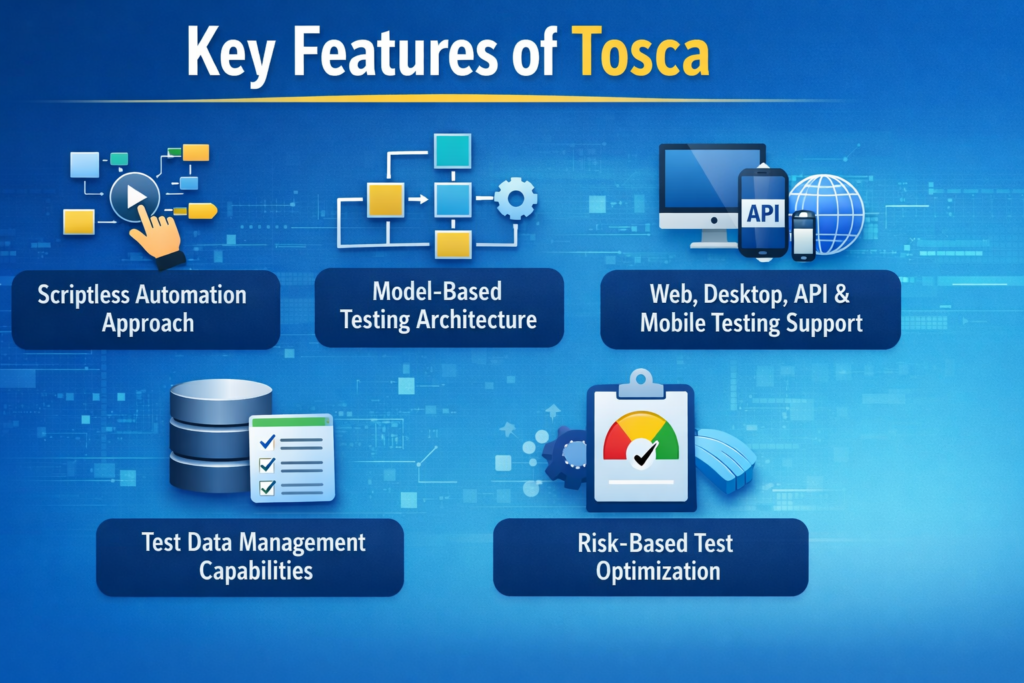
- Scriptless automation approach
- Model based testing architecture
- Support for web, desktop, API, and mobile testing
- Test data management capabilities
- Risk based test optimization
Large companies prefer Tosca because it reduces maintenance work. When the application changes, testers update the module instead of rewriting many scripts.
For beginners, understanding these concepts is the first step in the TOSCA Learning Path.
Why Tosca Is Important in Modern Test Automation
Automation testing tools help companies release software faster. However, many traditional tools require programming knowledge. This creates a barrier for manual testers.
Tosca solves this problem because it focuses on model based testing and reusable components.
Industry studies show that automation can reduce testing time by more than 40 percent in many projects. Enterprises adopt tools like Tosca to achieve faster release cycles.
Some major benefits of Tosca include
Faster Test Creation
Testers can create automated tests using modules. This reduces scripting work.
Easier Maintenance
When the application changes, testers update modules instead of rewriting tests.
Better Collaboration
Business analysts, testers, and developers can work together using the same test models.
Because of these benefits, many professionals follow a structured TOSCA Learning Path to move from manual testing to automation roles.
Understanding the Complete Learning Journey
Automation testing requires both technical knowledge and practical practice. Beginners often feel confused about where to start.
A structured TOSCA Learning Path helps learners build skills step by step.
The learning journey usually includes
- Understanding software testing basics
- Learning Tosca architecture
- Practicing module creation
- Automating test cases
- Working with test data
- Preparing for certification
Each stage builds on the previous one.
Let us explore each stage in detail.
Step 1: Learn Software Testing Fundamentals
Before starting automation, you must understand testing fundamentals.
Testing basics help you design better automation tests.
Important concepts include
Software Testing Life Cycle
The testing life cycle includes stages such as
- Requirement analysis
- Test planning
- Test case design
- Test execution
- Defect reporting
Automation tools support these activities but they do not replace testing knowledge.
Types of Testing
You should understand
- Functional testing
- Regression testing
- Integration testing
- System testing
- User acceptance testing
These concepts form the base of the TOSCA Learning Path.
Step 2: Understand Tosca Architecture
The next stage focuses on learning how Tosca works.
Tosca uses a modular structure. Testers create components called modules and reuse them across test cases.
Important elements include
Tosca Commander
Tosca Commander is the main interface used to manage test assets.
Inside this interface you will find
- Modules
- Test cases
- Test data
- Execution lists
Modules
Modules represent elements of the application.
For example
- Login fields
- Buttons
- Navigation menus
Once you scan the application, Tosca creates modules that represent these elements.
Learning modules is a critical part of the TOSCA Learning Path.
Step 3: Learn Module Creation and Scanning
Modules are the building blocks of Tosca automation.
Testers create modules by scanning the application interface.
The scanning process captures elements such as
- Text fields
- Buttons
- Drop down menus
- Tables
After scanning, Tosca stores these elements in reusable modules.
Example workflow
- Scan the application screen
- Identify UI elements
- Save them as modules
- Reuse them in test cases
This step helps beginners understand how Tosca builds automation without heavy coding. It also strengthens your TOSCA Learning Path foundation.
Step 4: Create Automated Test Cases
After learning modules, the next step is test case creation.
Tosca allows testers to build test cases using drag and drop modules.
Example scenario
Login Test Case
Steps may include
- Open application
- Enter username
- Enter password
- Click login button
- Verify dashboard page
Testers connect modules to represent each step.
Example structure
Login Module
Input Username
Input Password
Click Login
Verify Dashboard
This approach makes automation simple for beginners who follow the TOSCA Learning Path.
Step 5: Work With Test Data Management
Automation testing often requires multiple data combinations.
For example
- Different user roles
- Different product inputs
- Multiple payment methods
Tosca provides built in test data management features.
Testers can create test data sets and connect them with test cases.
Example
Test Case: Login Test
Data sets may include
| Username | Password |
| User1 | Pass123 |
| User2 | Pass456 |
| User3 | Pass789 |
Each data set runs the same test case automatically.
Data driven testing improves coverage and efficiency.
Learning this skill strengthens the TOSCA Learning Path for automation professionals.
Step 6: Learn Test Execution and Reporting
Once tests are created, testers must run them and analyze results.
Tosca provides execution lists that manage automated test runs.
Execution process
- Add test cases to execution list
- Run the automation suite
- Monitor results
- Analyze failed tests
Reports help teams identify defects quickly.
Important reporting features include
- Pass and fail results
- Execution logs
- Screenshot capture
Understanding execution and reporting helps learners complete the TOSCA Learning Path effectively.
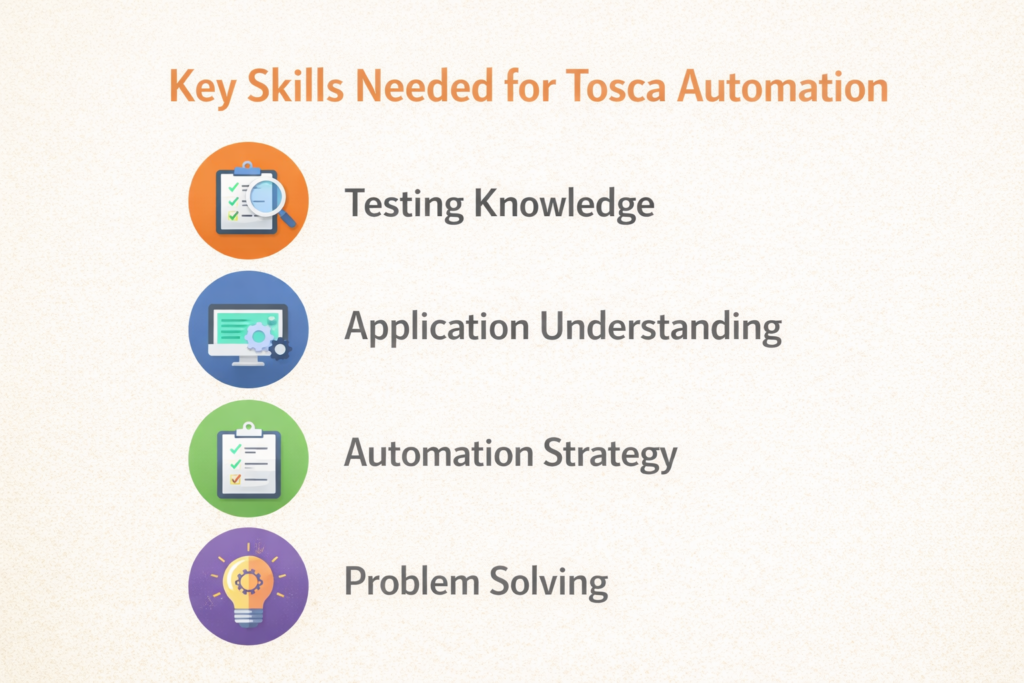
Key Skills Needed for Tosca Automation
Automation professionals need both technical and analytical skills.
Important skills include
Testing Knowledge
Understanding testing concepts helps create meaningful test cases.
Application Understanding
Testers must understand how the application works.
Automation Strategy
Automation requires planning.
Testers must decide which tests should be automated.
Problem Solving
Automation failures often require investigation.
Developing these skills improves your success along the TOSCA Learning Path.
Understanding Tricentis Tosca Certification
Certification helps professionals prove their knowledge to employers.
Many organizations prefer candidates who hold Tricentis TOSCA Certification because it shows structured learning and practical understanding.
Certification programs usually evaluate
- Tosca architecture knowledge
- Module creation
- Test case design
- Test execution
- Automation best practices
Professionals often pursue TOSCA Automation Certification after gaining practical experience with real test scenarios.
These certifications validate progress in the TOSCA Learning Path and help candidates stand out in competitive job markets.
Practical Projects to Build Real Skills
Practice is the most important part of automation learning.
Beginners should work on real testing scenarios.
Example practice projects
Project 1: Login Automation
Automate a login workflow
Steps include
- Scan login screen
- Create modules
- Build test cases
- Run execution tests
Project 2: E Commerce Checkout Test
Automate a product purchase scenario
Steps include
- Add product to cart
- Enter shipping details
- Complete payment process
Project 3: API Testing Workflow
Test API responses using Tosca API modules.
Projects like these help learners apply knowledge from the TOSCA Learning Path in practical situations.
Career Opportunities in Tosca Automation
Automation testing offers many career opportunities.
Common job roles include
Automation Test Engineer
Engineers design and execute automation scripts.
QA Automation Specialist
Specialists build automation frameworks and improve testing efficiency.
Test Architect
Architects design automation strategies across multiple teams.
Enterprises in banking, healthcare, and retail often use Tosca automation tools. This demand increases the need for professionals who follow the TOSCA Learning Path and develop strong automation skills.
Challenges Beginners May Face
Automation learning can be challenging at first.
Common challenges include
Understanding Application Structure
Applications may have complex user interfaces.
Handling Dynamic Elements
Some UI elements change during runtime.
Test Maintenance
Automation tests require updates when applications change.
Beginners can overcome these challenges through practice and structured learning. A clear TOSCA Learning Path helps learners build confidence step by step.
Best Practices for Tosca Automation
Following best practices improves automation quality.
Important practices include
Create Reusable Modules
Reusable modules reduce duplication.
Keep Test Cases Simple
Simple test cases improve readability.
Use Data Driven Testing
Data driven tests improve coverage.
Maintain Clear Test Documentation
Documentation helps teams understand automation logic.
These practices help professionals master the TOSCA Learning Path and work efficiently in real projects.
Future of Automation Testing With Tosca
Automation testing continues to grow as software delivery speeds increase.
Organizations now integrate automation into continuous delivery pipelines.
Tosca supports this trend through
- Continuous testing integration
- Risk based test optimization
- Cloud test execution
Automation professionals who complete the TOSCA Learning Path gain skills that align with modern DevOps and agile development practices.
Key Takeaways
- Tosca is a model based test automation platform used by many enterprises.
- Beginners should start with testing fundamentals before automation tools.
- Learning modules and test case creation is essential.
- Practice projects build real automation experience.
- Certification helps validate professional skills.
- A structured TOSCA Learning Path helps beginners progress from basic concepts to advanced automation roles.
Conclusion
Automation testing continues to grow across industries. Start building your skills today and practice real automation scenarios. Follow a structured learning approach and commit to continuous improvement to succeed in Tosca automation.
FAQs for “TOSCA Learning Path
1. What is a TOSCA learning path?
A TOSCA learning path is a structured way to learn Tricentis Tosca, from basic concepts to advanced test automation.
2. Is TOSCA easy to learn for beginners?
Yes. TOSCA is a codeless automation tool, so beginners can start learning without strong programming skills.
3. How long does it take to learn TOSCA?
With regular practice, beginners can learn the fundamentals in a few weeks and build more advanced skills with continued hands-on experience.
4. Do I need coding knowledge to learn TOSCA?
No. Basic TOSCA automation can be performed without traditional programming, although understanding testing concepts and some scripting can be helpful.
5. What should I learn first in TOSCA?
Start with TOSCA fundamentals, modules, scanning, test cases, test execution, test data, and basic automation workflows.