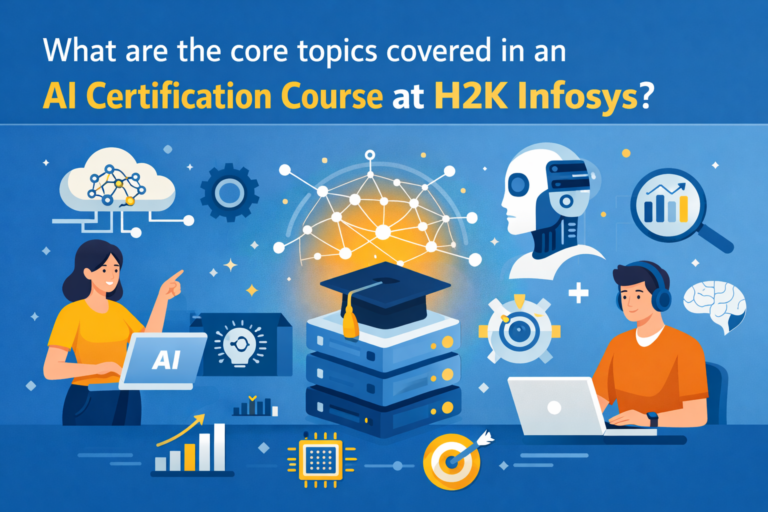
If you’re wondering what’s actually taught in an AI certification course at H2K Infosys, it covers everything from the fundamentals of artificial intelligence and machine learning to hands-on tools like Python, real-world projects, and even interview preparation, so you can confidently step into an AI role.
Now, let’s unpack that a bit, because honestly, most course outlines look similar on paper, but the way topics are taught and applied makes all the difference.
What You Really Learn in an AI certification course
When I first looked into any ai certification program, I expected a lot of theory. You know… algorithms, definitions, maybe some math-heavy lectures. But what stood out in structured programs like the one at H2K Infosys is how they blend practical exposure with core concepts.
Here’s how the learning usually unfolds.
1. AI & Machine Learning Foundations (Where Everything Starts)
This is where you get comfortable with the “why” behind AI.
- What exactly is artificial intelligence?
- How machine learning differs from traditional programming
- Supervised vs. unsupervised learning
- Real-world use cases (think Netflix recommendations, fraud detection, chatbots)
A small but important detail good courses don’t just explain these concepts. They tie them to actual business scenarios. For example, instead of just explaining classification, they might show how banks detect suspicious transactions.
That’s when things start to click.
2. Python for AI (Your Main Tool)
You can’t really survive in AI without Python it’s like trying to cook without a stove.
In a solid ai certificate course, Python is taught from a practical angle:
- Data handling with Pandas
- Numerical computing using NumPy
- Visualization with Matplotlib or Seaborn
- Writing clean, reusable code
What I liked seeing in modern programs is the shift toward project-based learning. Instead of just “learning syntax,” you build mini applications like predicting housing prices or analyzing customer churn.
3. Data Preprocessing & Feature Engineering
This part doesn’t sound exciting… but it’s where most real-world AI work actually happens.
You’ll learn:
- How to clean messy datasets (missing values, duplicates)
- Feature selection techniques
- Data transformation and normalization
And honestly? This is the part many beginners underestimate. In real jobs, 70–80% of your time goes here not in building fancy models.
4. Machine Learning Algorithms (The Core Engine)
Here’s where things get interesting.
A typical artificial intelligence certification online course covers:
- Linear & Logistic Regression
- Decision Trees & Random Forest
- Support Vector Machines
- Clustering (K-Means, Hierarchical)
But the good programs don’t stop at “how it works.” They dig into:
- When to use which algorithm
- Trade-offs (accuracy vs. interpretability)
- Real business implications
For example, why a healthcare company might prefer a simpler model they can explain over a complex one they can’t.
5. Deep Learning & Neural Networks
This is the “wow” section the part that powers things like voice assistants and image recognition.
You’ll explore:
- Neural network basics
- Activation functions
- CNNs (for image processing)
- RNNs or Transformers (for text and sequences)
With everything happening in AI lately especially the explosion of generative AI tools this module has become way more relevant than it was even a couple of years ago.
6. Working with Real-World AI Tools
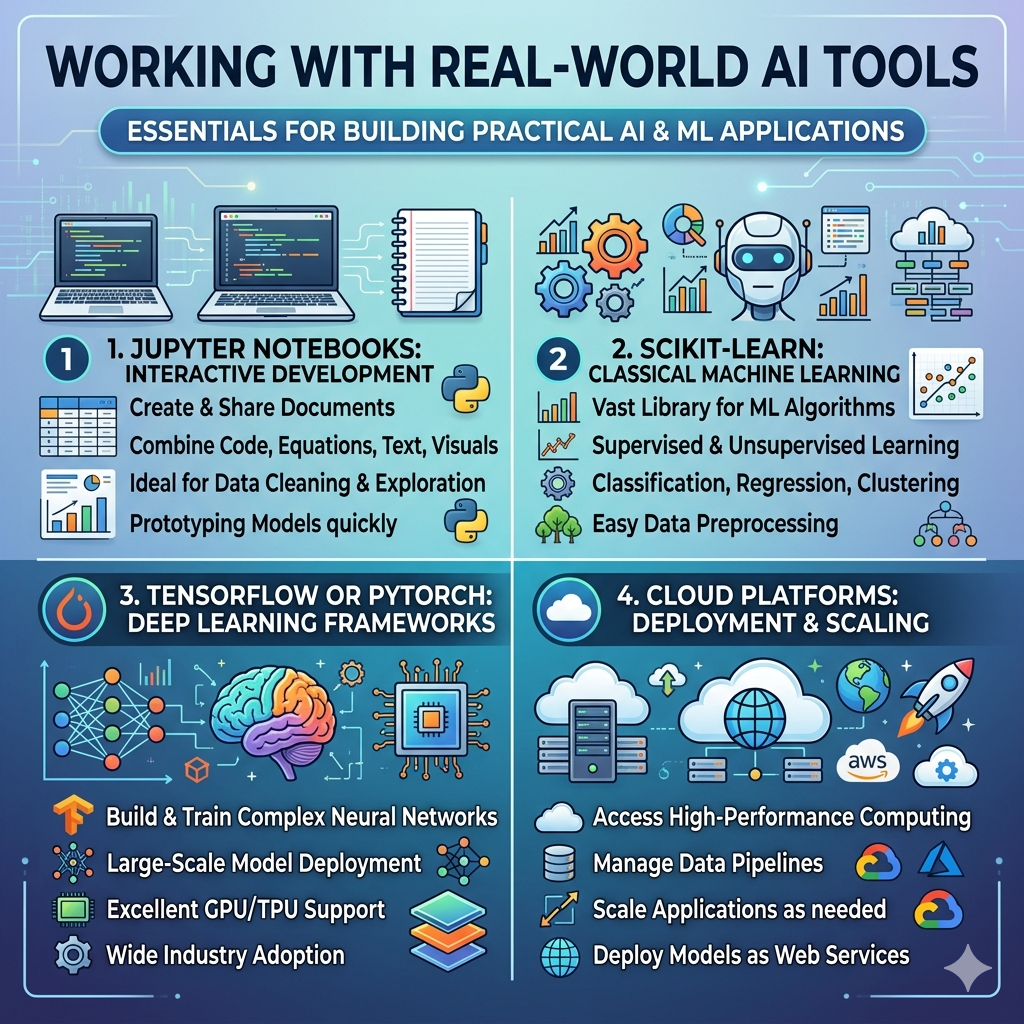
Modern AI learning isn’t just about theory anymore. You’ll likely get hands-on with:
- Jupyter Notebooks
- Scikit-learn
- TensorFlow or PyTorch
- Basic exposure to cloud platforms
Some courses even introduce concepts around deploying models because building a model is one thing, but actually using it in production is a whole different challenge.
7. Capstone Projects (Where It All Comes Together)
This is usually my favorite part.
Instead of following instructions, you solve a real problem, like:
- Predicting customer churn for a telecom company
- Building a recommendation system
- Detecting spam or fraud
And here’s the thing these projects aren’t just for learning. They become part of your portfolio, which matters a lot when you’re job hunting.
8. AI in Today’s Industry (Keeping It Relevant)
Good programs stay current. And that’s crucial right now because AI is evolving fast.
You’ll often see discussions around:
- Generative AI trends (like large language models)
- Ethical AI and bias in algorithms
- Automation in industries like healthcare, finance, and retail
This is where courses start to feel less like “study material” and more like real-world preparation.
9. Resume Building & Interview Preparation
This part is often overlooked but it shouldn’t be.
Many learners struggle not because they lack skills, but because they don’t know how to present them.
So courses usually include:
- Resume optimization for AI roles
- Mock interviews
- Real-world scenario questions
And honestly, having that guidance can save months of trial and error.
Final Thoughts
If I had to sum it up, a well-structured ai certification program like the one at H2K Infosys doesn’t just teach AI it walks you through thinking like an AI professional.
It starts with basics, builds up to real tools, and then pushes you into solving actual problems.
And that’s the key difference.
Because in today’s job market especially with how quickly AI is evolving knowing concepts isn’t enough. You need to show that you can apply them, adapt, and keep learning.
If you’re exploring an ai certificate course or considering an artificial intelligence certification online, look for one that feels less like a lecture series… and more like a guided, hands-on journey.
That’s where the real value is.