
Investing in a cybersecurity training with job placement program that includes job placement support is definitely worthwhile if your goal is to enter the field quickly and, with options like h2kinfosys, avoid months or even years of trial-and-error job hunting. The right program doesn’t just teach concepts; it actively connects learning to real job opportunities in cybersecurity.
Why This cybersecurity training Question Matters More in 2026
Cybersecurity training with job placement isn’t just growing, it’s booming. With AI-driven threats, ransomware-as-a-service, and constant data breaches dominating headlines, companies aren’t just hiring, they’re urgently trying to fill roles.
A hiring manager I spoke with recently put it well:
“We don’t struggle to find people who’ve studied cyber security training online, we struggle to find people who can actually do the work.”
That gap is exactly what placement-focused training aims to close.
What “cybersecurity training with Job Placement Support” Really Means (And What It Should Mean)
Not all placement support is equal and this is where many people get misled.
Some programs only:
- Share job boards
- Provide generic resume templates
- Offer one or two mock interviews
That’s simply not enough anymore.
Strong cybersecurity training with job placement programs especially top-tier ones in the U.S. usually include:
- Hands-on labs simulating real-world attacks (SOC environments, penetration testing, etc.)
- Resume building tailored specifically to cybersecurity roles
- Live interview prep with industry professionals
- Direct recruiter connections or hiring pipelines
- Internship or real project experience
If a program doesn’t offer at least 3–4 of these, it’s worth reconsidering.
Real-World Example: Why Placement Support Makes a Difference
Consider two candidates:
- Candidate A: Completes a self-paced online cyber security course in usa, earns a certification, and applies to jobs independently.
- Candidate B: Completes a structured cybersecurity training with job placement program with labs, builds a portfolio, receives resume and interview coaching, and gets introduced to recruiters.
Who gets hired faster?
In most cases, Candidate B is often within 2–4 months.
Candidate A may take 6–12 months or longer not due to lack of ability, but because they’re navigating the process alone.
The Hidden Value: Confidence
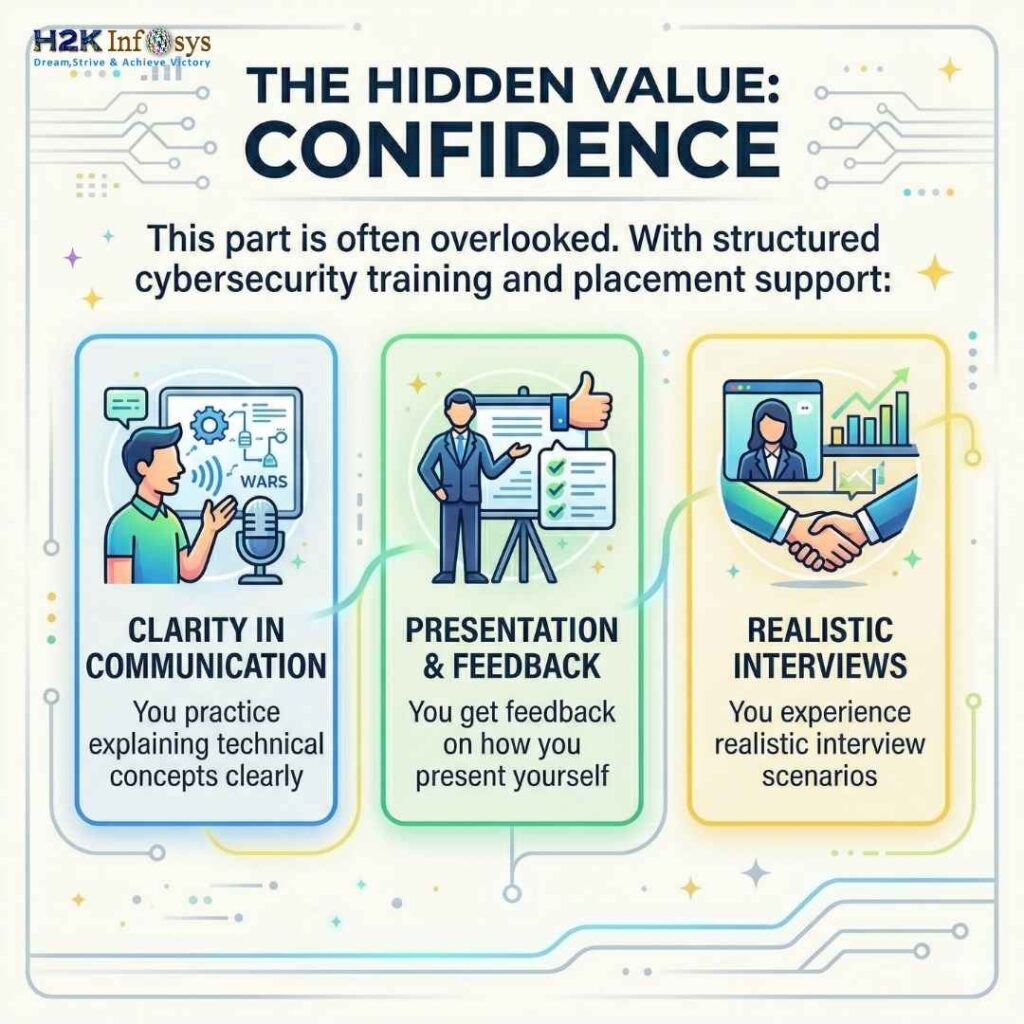
This part is often overlooked.
With structured cybersecurity training with job placement support:
- You practice explaining technical concepts clearly
- You get feedback on how you present yourself
- You experience realistic interview scenarios
That confidence boost is huge. Many people go from “I’m not ready” to confidently handle SOC analyst interviews simply because they were guided properly.
Industry Trends Reinforcing This (2025–2026)
- Skills-based hiring is rising: Employers care more about what you can do than your degree.
- AI in cybersecurity is evolving fast: Programs that stay current, especially online cybersecurity training ones give you a competitive edge.
- Entry-level roles are competitive: There are many openings, but also many applicants. Positioning matters.
When It’s Not Worth It
There are cases where investing doesn’t make sense:
- The program is mostly theoretical with little or no hands-on work
- Placement support is vague or poorly structured
- There’s no transparency about student outcomes
- It feels more like a sales pitch than a real learning system
A useful gut check:
“Would this still be valuable without the placement support?”
If the answer is no, that’s a warning sign.
A Practical Perspective
If starting from scratch today, the smartest approach isn’t just finding the “best course” it’s finding the fastest path to employability. That usually involves:
- Learning by doing
- Getting feedback from experienced professionals
- Being guided into the job market rather than left to figure it out alone
That’s where structured programs with placement support tend to outperform traditional paths.
Final Thought
Cybersecurity training with job placement alone teaches you the concepts.
Cybersecurity training with placement support teaches you how to turn those concepts into a job.
In today’s market, that distinction makes all the difference.