AI and Machine Learning Course isn’t a “future skill” anymore it’s becoming a workplace must-have. What’s the use of an AI and ML course in 2026? Because companies in healthcare, finance, retail, manufacturing, cybersecurity, software development, and beyond are actively seeking people who know how to create, use, and work side-by-side with AI systems.
The Growing Importance of AI Skills in 2026
A few years back, AI knowledge was limited to researchers and data scientists. Things are very different today.
Businesses are embedding generative AI into customer support, software development, marketing, HR and even everyday decision making. The demand for practical AI skills has gone beyond traditional tech roles, from AI coding assistants helping developers write better code to companies building their own AI-powered products.
I’ve noticed a strange pattern in conversations with hiring managers and professionals attending AI workshops. They seldom ask, “Do you know AI?” Instead, the conversation has turned to, “Can you actually use AI to solve business problems?” It is that small difference that makes structured learning so valuable.
If you want to have a long-term career in technology, then an AI and machine learning course with placement support can help you with the technical knowledge and the right way to get into employment.
AI Job Market Continues to Grow
The reason so many professionals are signing up for AI programs is not hype. It’s opportunity.
Companies aren’t just hiring AI engineers now. They want:
- Machine Learning Engineers
- AI Developers
- Data Scientists
- Prompt Engineers
- AI Product Managers
- Business Intelligence Analysts
- AI Consultants
- Automation Specialists
Even the professionals from non-programming backgrounds are learning AI to stay relevant in their industries.
For instance, a digital marketer familiar with AI-based analytics can automate campaign optimisation, and a finance professional can leverage machine learning models to detect fraud or predict market trends more accurately.
AI is transitioning from a niche speciality to a general productivity skill.
Why It Makes Sense to Study AI in a Structured Course
Can you learn everything from Youtube, blogs and free tutorials?
“Technically, yes.
Many learners will find the same roadblocks to be realistic:
- Too many different resources
- Lack of clear learning path
- Little practical experience
- No help from mentors
- No real-world projects
- No interview prep
A structured learning environment keeps everything in a network. You will skip the “What do I learn next?” phase and go straight from Python basics to data, ML algorithms, deep learning, generative AI and deployment.
This is very important for beginners who want confidence, not confusion.
What You Actually Learn
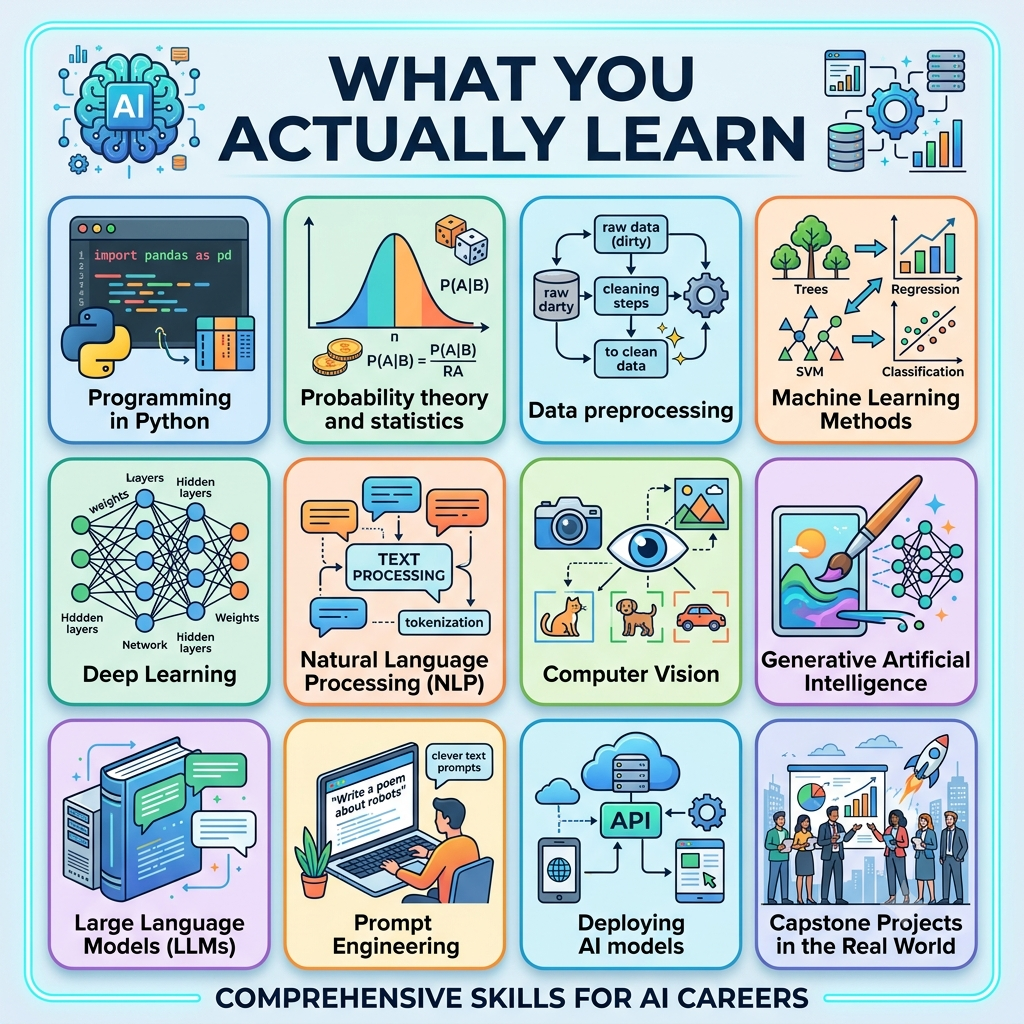
A good beginner AI and Machine Learning Course usually starts with the fundamentals and builds up to advanced topics.
Generally you will deal with such topics as:
- Programming in Python
- Probability theory and statistics
- Data preprocessing
- Machine Learning Methods
- Deep Learning
- Natural Language Processing (NLP)
- Computer Vision
- Generative Artificial Intelligence
- Large Language Models (LLMs)
- Prompt Engineering Deploying AI models
- Capstone Projects in the Real World
Reading about machine learning is one thing; building a recommendation engine is another. Employers are way more interested in what you built than what you memorised.
AI in the Real World Is Ubiquitous
Some people believe that AI only belongs inside of big tech companies.
That’s not the case anymore.
Medical professionals are using machine learning to help in diagnostics. Banks utilise AI for fraud detection. E-commerce platforms personalise shopping experiences on the fly. Manufacturers are using predictive maintenance to avoid equipment failures. Educational platforms create adaptive learning experiences that react to the student’s progress.
Even small businesses are now leveraging AI tools for customer service, marketing automation, inventory prediction and content creation.
AI education today is about preparing for industries that are rapidly turning into AI-driven industries.
Why Now is the Time for Beginners
One concern I hear quite frequently is:
I am not a computer science dude. Can I still learn AI?
Oh, yeah.
A lot of successful learners start out with no programming experience at all.
The trick is to select one of the best AI and Machine Learning Courses for beginners that introduce concepts in a step-by-step manner, rather than requiring prior knowledge.
A curriculum for beginners needs to explain not just how algorithms work, but also why they matter. Once those basics fall into place, advanced topics don’t seem so scary.
What Employers Really Want to Know
In the last couple of years, recruiters have gotten pickier.
Certificates help, but they are seldom enough by themselves.
Hiring teams tend to gravitate towards candidates who can show:
- Hands-on AI projects
- GitHub portfolios
- Excellent Python skills
- Understanding of the machine learning workflows
- problem solving skills
- Communication skills
- Experience in the industry relevant
And that’s why project-based learning has become one of the biggest differentiators.
The Importance of Placement Assistance
Learning AI is one thing.
Another is getting your first AI job.
This is where an AI and machine learning course with placement assistance can help.
Good placement support often includes:
- Resume writing
- Optimising LinkedIn profiles
- Interview practice
- Technical interview prep
- Training Aptitude
- Soft skills training
- Managing Partner Relationships
It offers structured career guidance which can greatly reduce the uncertainty of entering a competitive job market for fresh graduates and career changers.
What Sets H2K Infosys Apart
H2K Infosys is one of the names that always gets noticed when it comes to the best AI/ML courses for beginners.
It’s not only the course content that makes H2K Infosys attractive, it’s the entire learning ecosystem, built to prepare students for jobs in the real world.
Among the advantages that stand out:
Beginner-Friendly Learning Path
The curriculum is designed for learners with different educational backgrounds and it is designed even for people who are starting from scratch.
Hands-On Projects
Students spend less time on theory and more time on practical projects that replicate industry scenarios.
Trainers with experience
Learning from professionals who have real experience in the field helps to bridge the gap between classroom concepts and workplace expectations.
Job Placement Assistance
H2K Infosys provides practical career-oriented support such as interview preparation, resume writing and job placement assistance making it an ideal choice for learners who want to switch to a new career.
Flexible online teaching
Whether you are a student, working professional or career switcher, online live classes make learning easier without disrupting your schedule.
This mix of structured education, mentorship, practical exposure and placement support has far more value for many learners than self-learning alone.
AI Trends Every Learner Should Watch Out For In 2026
The AI landscape is rapidly changing and it’s important to keep up to date.
Here are some of the biggest trends shaping the industry:
- Generative AI is integrating into daily business operations
- AI agents that can solve more and more complex tasks
- The call for responsible and ethical AI practice is growing
- Smaller, more efficient language models on local devices
- More enterprise adoption of Retrieval-Augmented Generation (RAG)
- AI-powered automation across customer service, healthcare, finance and manufacturing
These trends are generating a need not just for AI researchers, but for professionals who can translate practical AI into real business settings.
Is an AI Course Worth the Money?
For the majority of tech hopefuls, the answer is yes.
A good AI program isn’t just teaching algorithms. It builds problem solving skills, adds to your portfolio, prepares you for interviews and helps you understand how AI creates value in different industries.
The return on investment is even more powerful when the course combines:
- Curriculum relevant to industry
- hands-on projects
- Expert guidance
- Career advice
- Support for placement
This is why many learners prefer programs that are as much about employability as they are about technical skills.
Is an AI and Machine Learning course worth taking in 2026?
Yes. AI has become a core technology across industries such as healthcare, finance, retail, manufacturing, and cybersecurity. A quality AI and Machine Learning course equips you with practical skills in Python, machine learning, deep learning, and generative AI, helping you stay competitive in today’s job market.
Which are the best AI/ML courses for beginners?
The best AI/ML courses for beginners are those that offer a structured curriculum, hands-on projects, live instructor support, and career guidance. Programs like H2K Infosys are designed for beginners by covering fundamentals first before moving into advanced AI concepts and real-world applications.
Can I learn machine learning without a programming background?
Absolutely. Many beginners start with little or no coding experience. A beginner-friendly machine learning course for beginners typically starts with Python basics, statistics, and data analysis before introducing machine learning algorithms, making the learning process manageable.
Is AI a good career choice for the future?
Yes. As businesses continue adopting AI-driven solutions, demand for AI professionals is expected to remain strong. Learning AI today can open opportunities in multiple industries and prepare you for emerging technologies such as generative AI and intelligent automation.
How do I choose the right AI and Machine Learning course?
When selecting a course, consider:
A beginner-friendly curriculum
Live instructor-led training
Industry-relevant projects
Updated content covering Generative AI and LLMs
Mentorship from experienced professionals
Placement assistance and interview preparation
Choosing a program like H2K Infosys that combines practical learning with career support can help you gain both technical expertise and job readiness.
Final Thoughts
AI isn’t going to replace all the jobs but it is definitely changing how a lot of jobs are done. People who get machine learning, data and the latest AI tools will probably be at a big advantage for the next few years.
If you are a beginner, taking one of the best AI/ML courses for beginners can provide the structure and confidence you need. And if you want to make the transition to the industry as smooth as possible, an AI and Machine Learning course with placement support such as the career-oriented programs offered by H2K Infosys can help you gain hands-on experience, build a job-ready portfolio, and prepare for interviews with more confidence.
Learning AI in 2026 is not just about keeping up with technology. This is about building skills that are fast becoming part of modern careers in nearly every industry.