The role of AI in Salesforce has moved from being a smart addition to being the very backbone of how a business interacts with customers, predicts results, and makes decisions. However, the truth remains that it’s just the beginning. H2K Infosys just happens to be right in the middle of all this and helping professionals understand the concept of AI in Salesforce in real-life scenarios, not hypothetical ones.
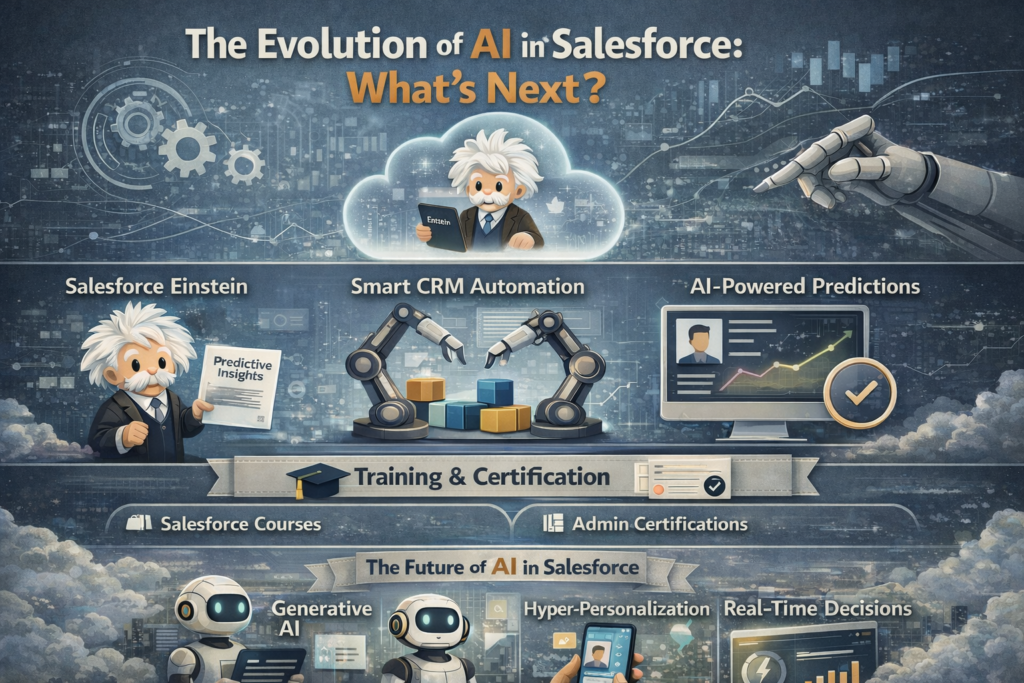
The Shift: From CRM to Intelligent CRM
If you are a Salesforce professional, even if it’s just been a few years, you are most likely aware of the fact that when Salesforce first came into existence, it was all about managing leads, managing contacts, and creating reports. While it was certainly a great tool, it was not intelligent.
However, when AI in Salesforce started to come alive through Salesforce Einstein, it was as if the very system had come to life. It was no longer just a system for storing data, but a system for interpreting data.
The one thing that most people fail to understand or even grasp about AI in Salesforce is that it’s not actually AI in the way you might think. It’s more like having an extremely intelligent personal assistant that’s always suggesting what the next step should be.
For example:
Sales representatives are given lead scores even before making a call
Customer support agents are given sentiment analysis even before responding to a ticket.
Marketing teams are given predictive results even before launching a marketing campaign.
While it’s not necessarily in your face, it’s not necessarily something you can ignore either. It’s actually the backbone of decision-making in business.
Salesforce Einstein: The Real Game Changer
When Salesforce first came out with Einstein, it wasn’t just another feature, it wasn’t just another addition to the platform. It was a philosophical change.
While most business systems are built to ask:
“What happened last quarter?”
“What were the results?”
“What were the profits and losses?”
Etc.
With the introduction of AI in Salesforce, however, the entire attitude and approach changed to:
“What’s likely to happen next?”
“What are the results?”
“What are the profits and losses?”
Etc.
What Einstein Actually Does (Beyond the Buzzwords)
Now, let’s actually talk about what Einstein does, shall we? And not just give you the buzzwords, but actually give you the details in a more tangible way.
Predictive Lead Scoring
Not all leads are created equal, and Einstein helps you determine which ones are worth your time based on past conversions.
Opportunity Insights
It helps you determine which ones are going to fall through before you even realize what’s going on.
Automated Data Capture
No more manual logging of emails and meetings, because Einstein takes care of all that for you.
Next Best Action
And then there’s the part that’s arguably the most interesting: AI-powered recommendations from Salesforce. Now, this is where things get really interesting:
Why AI in Salesforce Matters More Now Than Ever
Now, let’s take a step back and really look at what’s going on here.
The customers of today expect three things from you: speed, personalization, and accuracy. And they expect all three at the same time.
That’s just not something that a human can accomplish on their own. Period.
This is where AI in Salesforce comes in. And let me tell you, it’s not optional anymore.
A Quick Real-World Scenario
Let’s say we have a retail company that uses AI in Salesforce for the following:
- Predict when customers will churn
- Send out discounts
- Send out notifications for support
Voila! They improve customer retention without having to do more work. And this is not just a retail company; I’ve seen this implemented in finance and healthcare too. The idea is that AI in Salesforce just quietly does its thing and helps out.
The Learning Curve: Why Training Matters
Something that people tend to forget about is the fact that just because AI in Salesforce is incredibly powerful does not mean that it can be utilized simply by default. There is a need to understand the following:
- How data functions
- What’s really going on behind the scenes
- When to believe what’s being told to you and when not to believe it.
This is why taking a Salesforce course or Salesforce training classes can really help out.
I’m not talking about watching videos and reading books; I’m talking about learning from actual hands-on experiences that involve:
- Creating workflows
- Utilizing Einstein
- Analyzing the insights generated by AI
If not, then AI in Salesforce can be overwhelming or even underutilized.
Certifications: Are They Still Worth It in the AI Era?
The short answer is: Yes, more than ever.
The only difference now is the reasoning for it.
In the past, it was to prove that you knew the platform. Now it is to prove that you know how to use the intelligence within the platform.
Popular Paths to Consider
- Salesforce Admin Certification Classes
- Salesforce Certification Course with a focus on AI tools
- Advanced Einstein Analytics Training
They are not just for padding your resume, but for actually learning.
And it seems like more and more people are taking notice.
I have noticed a trend in the jobs that have been coming out recently that say:
“Experience with AI in Salesforce preferred.”
This was not a term that was commonly used a few years ago.
The Human Side of AI in Salesforce
Take a deep breath.
There is a great deal of fear going around about the future of AI in Salesforce and how it is going to replace human jobs. This just isn’t the case.
What’s Changing?
- Salespeople aren’t spending time entering data.
- Marketers aren’t guessing about what to do next
- Support teams aren’t answering the same questions repeatedly
It’s less about replacement, more about elevation.
That said, there’s a catch: you need to adapt.
Common Mistakes People Make with AI in Salesforce
I have seen it time and time again: a company gets excited about the prospect of AI in Salesforce and then completely misses the mark.
What are the common mistakes that people make with AI in Salesforce?
1. Trusting AI Blindly
AI in Salesforce is intelligent, but it is not magic. If your data is a mess, your predictions will be a mess too.
2. Ignoring Data Quality
Data quality is a huge problem and AI is only as good as the data it is given.
3. Overcomplicating Implementation
Simple automation can be more valuable than AI.
4. Not Investing in Training
Tools don’t create value; people using them do.
Where AI in Salesforce Is Headed Next
And then comes the exciting part.
The evolution of AI in Salesforce is not limited only to predictions but also includes generation and autonomy.
Emerging Trends
1. Generative AI Integration
Salesforce is integrating generative AI into workflows.
- Writing emails
- Summarizing customer interactions
- Creating reports
2. AI Agents
We’re seeing AI integrate into Salesforce to handle entire workflows.
- Resolving customer queries
- Managing schedules
- Triggering workflows without human intervention
3. Hyper-Personalization
It’s not just saying, “Hello, First Name.” It’s hyper-personalization.
4. Real-Time Decision Making
No more looking at a dashboard to figure out what to do next. AI in Salesforce is becoming a real-time decision engine.
A Personal Observation (That Might Surprise You)
The biggest change is not necessarily a change in the technology but a change in people.
People are gradually moving from:
“I need to analyze this data.”
To:
“Let me check what AI suggests first.”
That’s a huge change.
To be honest, it even took me a little time to get used to it.
Why Businesses Are Investing Heavily Now
If you look at the trends, businesses are not only experimenting with AI in Salesforce but also building strategies around it.
Why?
Well, because it directly impacts:
- Revenue Growth
- Customer Retention
- Operational Efficiency
And in a competitive market, those aren’t “nice-to-have” features.
Choosing The Right Learning Path
Now, if you’re considering getting into this space, here’s a learning path you might want to follow:
Step 1: Start with the basics
Take a Salesforce course that covers the basics of CRM.
Step 2: Add AI Understanding
Take a course on how AI in Salesforce works, focusing on Einstein features.
Step 3: Get Certified
Take Salesforce admin certification classes to get certified.
Step 4: Practice Real Scenarios
Now, this is where actual learning happens.
The Skills That Will Matter Most
Looking ahead, the skills that will make you successful in this space are:
- Data Interpretation
- AI-Based Decision Making
- Workflow Automation
- Customer Experience Design
Wait a minute.
You might have noticed something.
It’s not just about technology; it’s about strategy.
Final Thoughts: What’s Next?
The future of AI in Salesforce isn’t looking any slower; it’s looking a whole lot faster.
In fact, we’re heading towards a future where:
- Our CRM systems think ahead
- Our decisions are made quicker than ever
- Our customer experiences are almost intuitive
But, you see, there’s one thing that’s really important to note:
The future isn’t about AI in Salesforce; it’s about people who know how to use AI in Salesforce. And that’s where learning, training, and experiences come in.