Artificial Intelligence (AI) training online, including programs offered by H2K Infosys, refers to structured learning programs that teach concepts such as machine learning, data analysis, neural networks, and AI-driven applications using digital platforms. For beginners and working professionals, the best starting point typically includes foundational courses in Python, statistics, and machine learning, followed by hands-on projects using industry tools.
Choosing the right path depends on your background, career goals, and the specific domain of AI you want to specialize in, such as data science, automation, or deep learning.
What Is AI Training Online?
AI Training Online includes courses of artificial intelligence delivered through digital platforms that cover both theoretical concepts and practical applications. These courses range from beginner-level introductions to advanced topics like deep learning and natural language processing.
Key Components of AI Training
- Programming Fundamentals (Python, R)
- Mathematics for AI (linear algebra, probability, statistics)
- Machine Learning Algorithms
- Deep Learning Architectures
- Data Processing & Visualization
- Model Deployment & Monitoring
Online AI learning environments typically combine:
- Video lectures
- Interactive coding exercises
- Real-world datasets
- Capstone projects
Why Are the Best AI Courses Online Important for Working Professionals?
AI is increasingly integrated into enterprise systems, making it relevant across multiple IT roles. Professionals need structured learning to understand how AI fits into business workflows.
Practical Reasons AI Skills Matter
- Automation of repetitive tasks
- Data-driven decision-making
- Improved system efficiency
- Enhanced customer experiences (e.g., chatbots, recommendation systems)
Workplace Context
In enterprise environments, AI is not used in isolation. It integrates with:
- Cloud platforms (AWS, Azure, GCP)
- Data pipelines (ETL processes)
- DevOps workflows (CI/CD for ML models)
How Does AI Work in Real-World IT Projects?
AI systems operate through a structured pipeline that transforms raw data into actionable insights.
Typical AI Workflow in Enterprise Projects
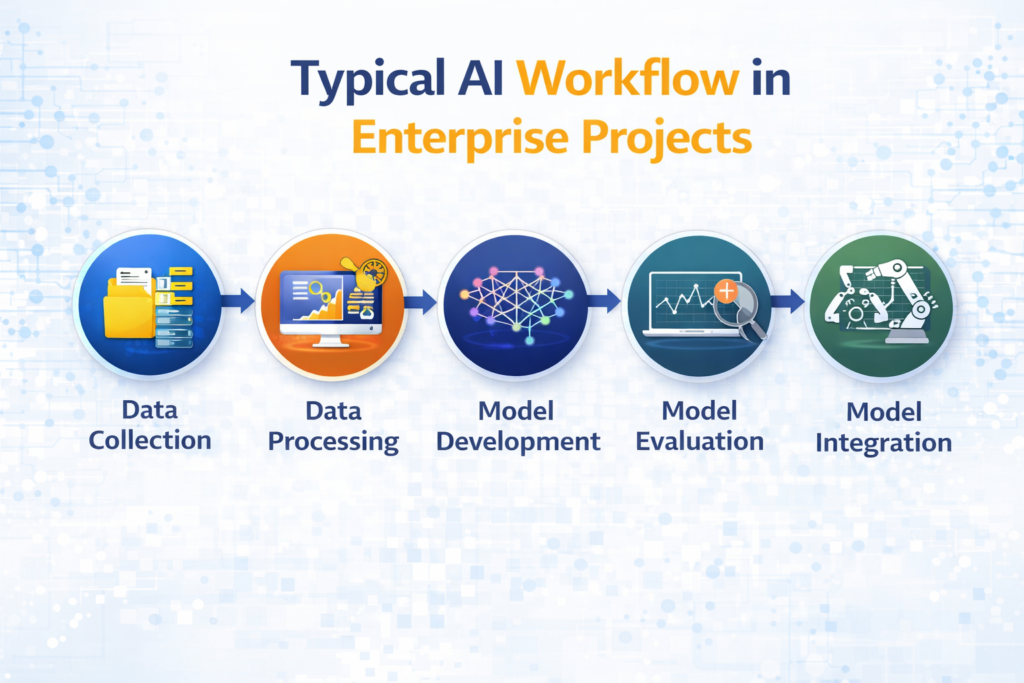
| Step | Description | Tools Commonly Used |
|---|---|---|
| Data Collection | Gather structured/unstructured data | SQL, APIs, Data Lakes |
| Data Preprocessing | Clean and transform data | Pandas, NumPy |
| Model Training | Apply ML algorithms | Scikit-learn, TensorFlow |
| Evaluation | Measure model performance | Metrics (Accuracy, F1 Score) |
| Deployment | Integrate into applications | Docker, REST APIs |
| Monitoring | Track model performance in production | MLflow, Prometheus |
Example Scenario
A retail company uses AI to forecast demand:
- Historical sales data is collected
- Data is cleaned and normalized
- A regression model is trained
- Predictions are deployed via an API
- Business dashboards consume predictions for planning
Where Should Beginners Start with AI Courses Online?
Starting AI training requires a layered approach. Jumping directly into advanced topics often leads to confusion.
Recommended Learning Path
| Stage | Focus Area | Key Topics |
|---|---|---|
| Beginner | Programming + Math | Python, Statistics |
| Intermediate | Machine Learning | Regression, Classification |
| Advanced | Deep Learning | Neural Networks, NLP |
| Applied | Projects | Real-world datasets, deployment |
Step-by-Step Approach
- Learn Python basics (data structures, functions)
- Understand statistics and probability
- Study core machine learning algorithms
- Work with datasets and build models
- Learn deployment basics (APIs, cloud integration)
What Skills Are Required to Learn AI?
AI is interdisciplinary, requiring both technical and analytical skills.
Core Technical Skills
- Programming (Python preferred)
- Data manipulation (Pandas, NumPy)
- Machine learning frameworks (Scikit-learn, TensorFlow, PyTorch)
- SQL for data querying
Supporting Skills
- Problem-solving
- Analytical thinking
- Understanding of business context
- Communication of insights
Common Challenge
Many learners struggle with:
- Mathematical concepts behind algorithms
- Translating theory into practical models
- Debugging model performance issues
How Is AI Used in Enterprise Environments?
AI adoption in enterprises focuses on solving specific business problems rather than building experimental models.
Common Use Cases
- Fraud detection in finance
- Predictive maintenance in manufacturing
- Customer segmentation in marketing
- Chatbots in customer support
Enterprise Constraints
- Data privacy regulations
- Model explainability requirements
- Scalability and performance
- Integration with legacy systems
Example Workflow in Production
- Data is ingested from multiple sources
- Pipelines process and store data
- Models are trained periodically
- APIs serve predictions
- Monitoring systems track drift and accuracy
What Job Roles Use AI Daily?
AI skills are relevant across a variety of roles, not just data scientists.
Role vs Skill Mapping
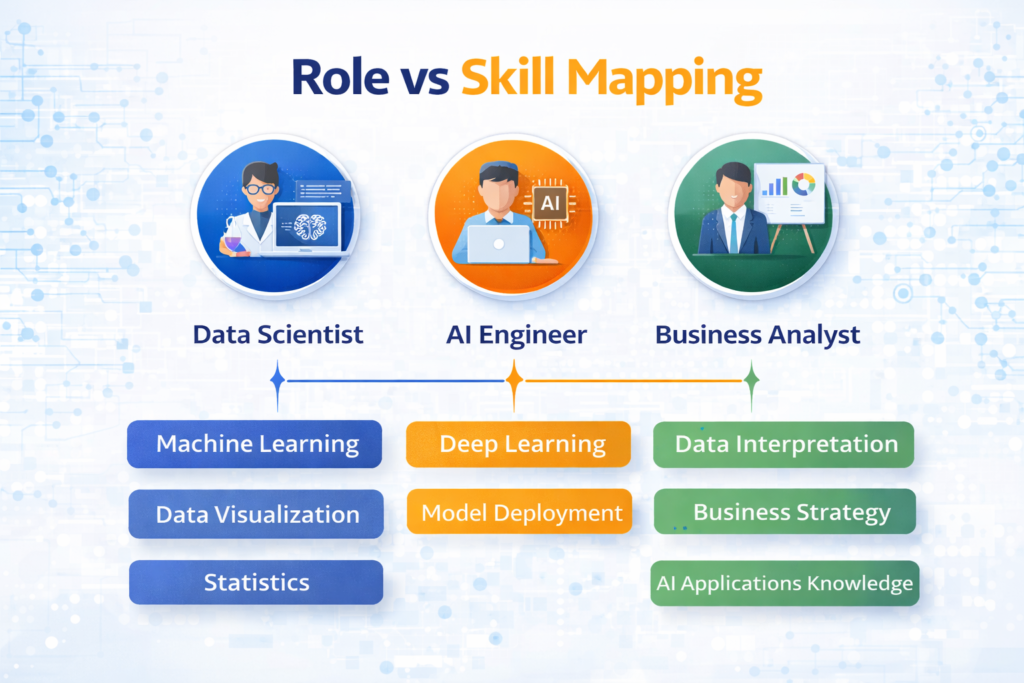
| Role | AI Skills Used | Tools |
|---|---|---|
| Data Scientist | Model building, analysis | Python, TensorFlow |
| Machine Learning Engineer | Deployment, scaling | Docker, Kubernetes |
| Data Analyst | Data interpretation | SQL, Power BI |
| AI Engineer | End-to-end AI systems | PyTorch, APIs |
| Business Analyst | Insight generation | Excel, dashboards |
What Careers Are Possible After Learning AI?
AI training opens multiple career pathways depending on specialization.
Common Career Paths
- Data Scientist
- Machine Learning Engineer
- AI Engineer
- Data Analyst
- Business Intelligence Developer
Career Progression Example
- Entry-level: Data Analyst
- Mid-level: Machine Learning Engineer
- Advanced: AI Architect or Lead Data Scientist
What Should You Look for in the Best AI Courses Online?
Not all Courses of Artificial Intelligence provide practical value. Evaluating course quality is critical.
Key Evaluation Criteria
- Hands-on projects with real datasets
- Coverage of end-to-end workflows
- Exposure to industry tools
- Guidance on deployment and production use
Comparison Table
| Feature | Basic Courses | Advanced/Professional Courses |
|---|---|---|
| Theory Coverage | High | Moderate |
| Practical Projects | Limited | Extensive |
| Industry Tools | Minimal | Comprehensive |
| Deployment Focus | Rare | Included |
What Tools Are Commonly Used in AI Training?
Understanding tools helps learners align training with real-world requirements.
Popular AI Tools
- Programming: Python
- Libraries: NumPy, Pandas, Scikit-learn
- Deep Learning: TensorFlow, PyTorch
- Visualization: Matplotlib, Seaborn
- Deployment: Flask, Docker
- Cloud Platforms: AWS, Azure, Google Cloud
How Do Professionals Apply AI Skills in Projects?
Learning AI is effective only when applied in real-world scenarios.
Example: Predictive Analytics Project
Objective: Predict customer churn
Steps:
- Load customer dataset
- Clean missing values
- Encode categorical variables
- Train classification model
- Evaluate using accuracy and ROC curve
- Deploy model as REST API
Conceptual Pseudo-Code
load_data()
clean_data()
split_train_test()
train_model()
evaluate_model()
deploy_model()
What Challenges Do Learners Face in AI Training?
Understanding challenges helps set realistic expectations.
Common Issues
- Difficulty understanding math concepts
- Lack of practical exposure
- Over-reliance on tutorials
- Confusion between tools and frameworks
Best Practices
- Focus on projects early
- Practice coding regularly
- Use real datasets
- Understand concepts before tools
Frequently Asked Questions (FAQ)
1. What is the best way to start AI training online?
Start with Python and basic statistics, then move to machine learning concepts and hands-on projects.
2. Are AI courses online suitable for non-programmers?
Yes, but basic programming knowledge significantly improves learning efficiency.
3. How long does it take to learn AI?
Typically:
- 3–6 months for fundamentals
- 6–12 months for intermediate proficiency with projects
4. Do AI courses include real-world projects?
Many professional-level courses include projects such as:
- Predictive modeling
- Image classification
- NLP applications
5. What is the difference between AI and machine learning?
- AI: Broad concept of intelligent systems
- Machine Learning: Subset of AI focused on data-driven learning
6. Can AI skills be applied without deep math knowledge?
Basic understanding is sufficient initially, but advanced roles require deeper mathematical knowledge.
Key Takeaways
- AI training online includes structured learning in programming, machine learning, and deployment.
- The best AI courses online emphasize hands-on projects and real-world workflows.
- A step-by-step learning path improves retention and practical application.
- Enterprise AI focuses on scalability, integration, and business value.
- Career opportunities include data science, machine learning engineering, and analytics roles.