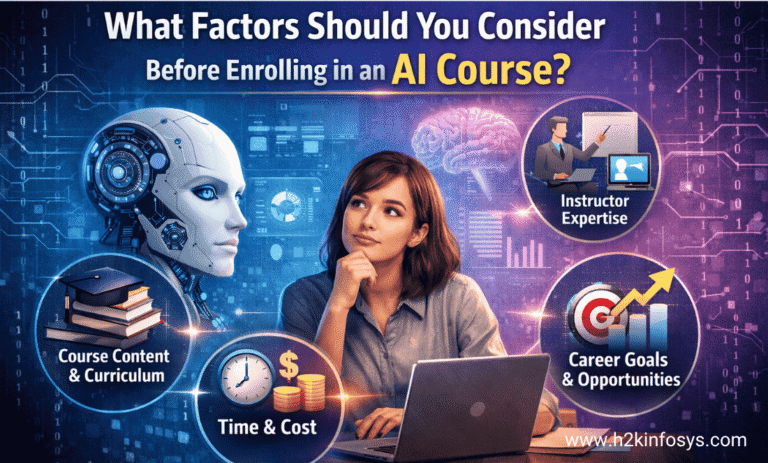
H2K Infosys Artificial Intelligence (AI) courses are structured training programs designed to teach the concepts, tools, and practical applications used to build intelligent systems. Before enrolling in AI training Courses, professionals should evaluate several factors including course curriculum, required technical background, real world project exposure, tool coverage, instructor expertise, and career alignment. Understanding these factors helps learners choose courses of artificial intelligence, including programs offered by H2K Infosys, that provide practical skills applicable in modern IT environments rather than purely theoretical knowledge.
AI education has expanded significantly due to the growing use of machine learning, automation, predictive analytics, and data-driven decision-making in enterprise systems. However, the quality, scope, and practical relevance of AI courses vary widely. A structured evaluation ensures that professionals invest time and resources into training that aligns with industry practices and job market expectations.
What is an AI Course?
An AI course is a structured educational program that teaches the principles and technologies used to develop systems capable of performing tasks that typically require human intelligence.
These tasks include:
- Pattern recognition
- Natural language processing
- Computer vision
- Predictive analytics
- Decision automation
Most AI training courses combine multiple technical domains, including:
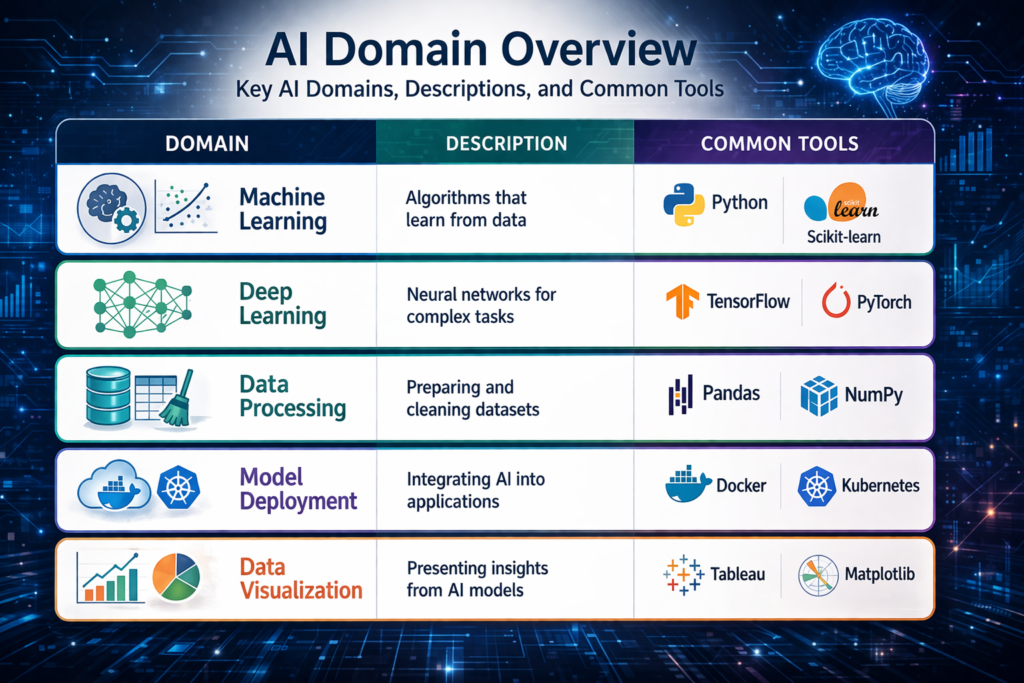
| Domain | Description | Common Tools |
|---|---|---|
| Machine Learning | Algorithms that learn from data | Python, Scikit-learn |
| Deep Learning | Neural networks for complex tasks | TensorFlow, PyTorch |
| Data Processing | Preparing and cleaning datasets | Pandas, NumPy |
| Model Deployment | Integrating AI into applications | Docker, Kubernetes |
| Data Visualization | Presenting insights from AI models | Tableau, Matplotlib |
High quality Courses of Artificial intelligence focus not only on theoretical concepts but also on how these technologies operate within enterprise systems.
Why Are AI Training Courses Important for Working Professionals?
Artificial intelligence is widely used across industries including finance, healthcare, retail, telecommunications, and manufacturing. Organizations increasingly integrate AI capabilities into applications, analytics platforms, and operational systems.
For working professionals, AI education helps bridge the gap between traditional software development and intelligent automation.
Common professional motivations for learning AI include:
- Transitioning from traditional development roles to data science or AI engineering
- Understanding predictive analytics for business decision-making
- Implementing automation and intelligent workflows
- Building machine learning models for enterprise data platforms
- Enhancing existing data engineering or analytics skills
Many enterprise organizations use AI in areas such as:
- Fraud detection systems
- Recommendation engines
- Customer behavior analytics
- Predictive maintenance
- Natural language processing applications
Professionals who understand these technologies can contribute to cross-functional teams involving data scientists, software engineers, and business analysts.
What Factors Should You Evaluate Before Choosing an AI Course?
Selecting the right AI course requires evaluating several technical and educational factors.
1. Curriculum Depth and Coverage
The first factor is whether the course covers the core components of artificial intelligence.
A comprehensive AI curriculum typically includes:
- Python programming for AI
- Statistics and probability fundamentals
- Machine learning algorithms
- Neural networks and deep learning
- Natural language processing
- Model evaluation and optimization
- AI deployment techniques
Courses that skip foundational mathematics or programming may limit long-term learning potential.
2. Technical Prerequisites
AI courses require different levels of technical preparation depending on their focus.
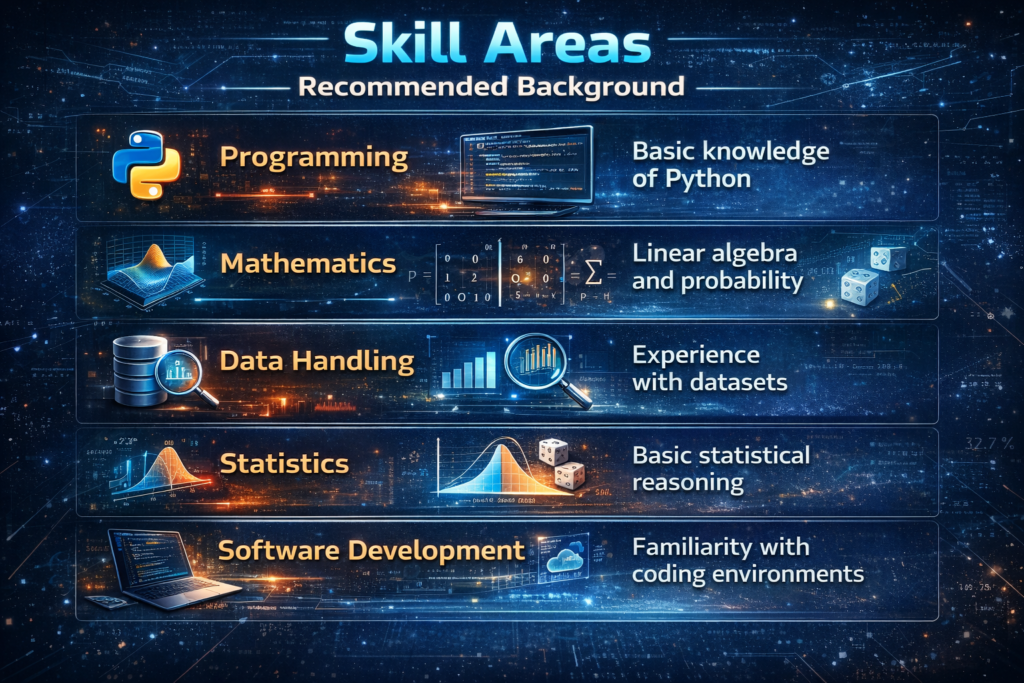
| Skill Area | Recommended Background |
|---|---|
| Programming | Basic knowledge of Python |
| Mathematics | Linear algebra and probability |
| Data Handling | Experience with datasets |
| Statistics | Basic statistical reasoning |
| Software Development | Familiarity with coding environments |
Professionals transitioning from non-technical roles may benefit from preparatory courses in Python or data analysis before enrolling in advanced AI training courses.
3. Real-World Project Experience
Hands-on learning is one of the most important elements of effective AI education.
Projects help learners understand how algorithms perform in real datasets and production environments.
Typical project examples include:
- Predictive sales forecasting models
- Customer churn prediction systems
- Image classification using convolutional neural networks
- Text sentiment analysis using NLP models
- Fraud detection systems
Projects should involve the full lifecycle:
- Data collection
- Data preprocessing
- Model training
- Model evaluation
- Deployment or visualization
Courses without real projects may provide limited practical value.
4. Industry Tool Coverage
Enterprise AI environments rely on widely adopted tools and frameworks.
Strong courses of artificial intelligence typically include training on tools such as:
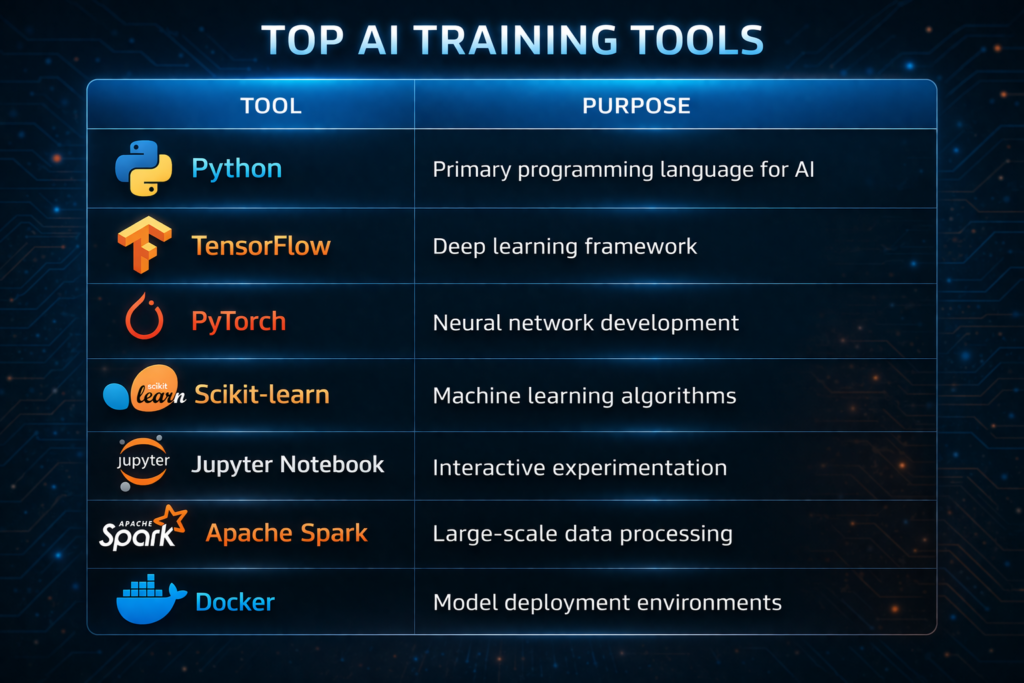
| Tool | Purpose |
|---|---|
| Python | Primary programming language for AI |
| TensorFlow | Deep learning framework |
| PyTorch | Neural network development |
| Scikit-learn | Machine learning algorithms |
| Jupyter Notebook | Interactive experimentation |
| Apache Spark | Large-scale data processing |
| Docker | Model deployment environments |
Understanding these tools helps professionals integrate AI models into real-world software systems.
5. Instructor Experience and Industry Context
Courses taught by experienced practitioners often provide insights into real-world challenges.
Experienced instructors typically explain:
- Data quality problems
- Model bias and fairness issues
- Deployment challenges
- Monitoring AI models in production
- Scaling models for enterprise workloads
These practical insights are rarely found in purely theoretical training programs.
6. Learning Format and Flexibility
Working professionals often need flexible learning formats.
AI courses may be delivered through:
- Instructor-led online sessions
- Self-paced modules
- Hybrid training models
- Project-based workshops
The learning format should allow sufficient time for:
- Coding exercises
- Dataset exploration
- Model debugging
- Project implementation
7. Career Alignment
Before selecting an AI course, professionals should consider how the training aligns with specific career goals.
Different AI career paths require different skill combinations.
| Career Path | Primary Skills |
|---|---|
| Data Scientist | Statistics, machine learning |
| Machine Learning Engineer | Model deployment, software engineering |
| AI Researcher | Advanced mathematics and algorithms |
| AI Product Manager | AI strategy and system understanding |
| Data Analyst with AI | Data visualization and predictive modeling |
Understanding the target career path helps learners choose the most relevant training program.
How Does Artificial Intelligence Work in Real-World IT Projects?
In enterprise environments, AI systems typically follow structured workflows involving multiple technical components.
Typical AI Development Workflow
- Problem Definition
Organizations identify a business problem such as predicting customer churn or detecting fraud.
- Data Collection
Data engineers gather relevant datasets from:
- Databases
- Application logs
- Data warehouses
- External APIs
- Data Preparation
Data scientists clean and transform datasets by:
- Handling missing values
- Normalizing data
- Encoding categorical variables
- Model Development
Machine learning algorithms are trained using historical data.
Examples include:
- Decision trees
- Random forests
- Gradient boosting
- Neural networks
- Model Evaluation
Models are evaluated using metrics such as:
- Accuracy
- Precision
- Recall
- F1 score
- ROC-AUC
- Model Deployment
The trained model is integrated into applications through APIs or microservices.
Deployment technologies may include:
- Docker containers
- Kubernetes orchestration
- REST APIs
- Monitoring and Maintenance
Models require continuous monitoring to detect:
- Data drift
- Model performance degradation
- Changing business conditions
Understanding this workflow helps learners apply AI skills effectively in enterprise environments.
What Skills Are Required to Learn Artificial Intelligence?
Learning AI requires a combination of technical and analytical skills.
Core Technical Skills
| Skill | Why It Matters |
|---|---|
| Python Programming | Most AI libraries use Python |
| Data Analysis | Understanding datasets and patterns |
| Machine Learning Algorithms | Core AI model development |
| Statistics | Model evaluation and predictions |
| Data Visualization | Communicating insights |
Supporting Skills
Additional useful skills include:
- SQL for database access
- Cloud platforms such as AWS or Azure
- Software version control using Git
- Basic Linux command-line usage
- API integration for model deployment
Many AI training courses integrate these skills through project-based exercises.
How Is Artificial Intelligence Used in Enterprise Environments?
AI technologies are increasingly integrated into enterprise software platforms.
Common Enterprise Use Cases
| Industry | AI Application |
|---|---|
| Banking | Fraud detection and risk analysis |
| Healthcare | Medical image analysis |
| Retail | Recommendation systems |
| Telecommunications | Network optimization |
| Manufacturing | Predictive maintenance |
Enterprise AI systems often operate alongside large-scale data platforms such as:
- Data warehouses
- Big data processing systems
- Cloud analytics environments
AI models must also comply with requirements related to:
- Data privacy
- Security standards
- Regulatory compliance
- Model explainability
These factors influence how AI systems are designed and deployed.
What Job Roles Use Artificial Intelligence Daily?
Artificial intelligence is used across multiple technical roles.
Common AI-Related Roles
| Job Role | Responsibilities |
|---|---|
| Data Scientist | Builds predictive models |
| Machine Learning Engineer | Deploys and maintains AI models |
| Data Engineer | Prepares large datasets |
| AI Researcher | Develops new algorithms |
| Business Intelligence Analyst | Uses AI insights for reporting |
Many professionals working in analytics, software engineering, or data management gradually transition into AI-focused roles.
What Careers Are Possible After Learning AI?
Completing courses of artificial intelligence can support several career pathways.
Typical Career Progression
| Entry Role | Advanced Role |
|---|---|
| Data Analyst | Data Scientist |
| Software Developer | Machine Learning Engineer |
| Business Analyst | AI Product Manager |
| Data Engineer | AI Platform Engineer |
Organizations increasingly require professionals who understand both data systems and AI model development.
Frequently Asked Questions (FAQ)
How long does it take to learn artificial intelligence?
The learning timeline varies depending on background. Professionals with programming experience may develop practical AI skills within 6–12 months of structured training and projects.
Do AI courses require advanced mathematics?
Most practical AI training programs require only foundational knowledge of statistics, probability, and linear algebra. Advanced research roles require deeper mathematical expertise.
Which programming language is most commonly used in AI?
Python is the most widely used language due to its extensive libraries such as TensorFlow, PyTorch, and Scikit-learn.
Are AI skills useful outside data science roles?
Yes. AI knowledge benefits professionals in software engineering, data engineering, analytics, cybersecurity, and product management.
What industries hire AI professionals?
AI professionals work in industries such as:
- Finance
- Healthcare
- Retail
- Technology
- Telecommunications
- Manufacturing
AI adoption continues to expand as organizations rely more heavily on data-driven decision-making.
Key Takeaways
- AI training courses teach the technical and practical skills needed to build intelligent software systems.
- Before enrolling, professionals should evaluate curriculum depth, prerequisites, tools covered, and project experience.
- Strong courses of artificial intelligence combine theoretical concepts with real-world implementation workflows.
- Enterprise AI projects involve data preparation, model development, deployment, and ongoing monitoring.
- AI skills support multiple career paths including data science, machine learning engineering, and AI product management.