If you’re checking out the AI Training Online at H2K Infosys , the first thing you’ll notice is that it’s not just theory piled on top of you. It’s actually a mix some fundamentals, a lot of hands-on work, and bits of real world context sprinkled throughout.
The AI Training Syllabus at H2K Infosys is designed to provide a comprehensive understanding of the subject.
Engaging with the AI Training Syllabus will make you a more competent AI practitioner.
The AI Training Syllabus will serve as a roadmap for your AI learning journey.
Referencing the AI Training Syllabus consistently is key to mastering AI concepts.
Utilizing the AI Training Syllabus can help streamline your learning process.
Knowing the AI Training Syllabus will guide you through complex AI concepts effectively.
The AI Training Syllabus encourages critical thinking and innovation in AI projects.
Participating in the AI Training Syllabus fosters collaboration and teamwork skills.
By adhering to the AI Training Syllabus, you ensure a comprehensive learning experience.
Focusing on the AI Training Syllabus will prepare you for a dynamic career trajectory.
Engaging with the AI Training Syllabus leads to a richer understanding of AI capabilities.
With the AI Training Syllabus, you can build strong foundations for advanced studies.
The AI Training Syllabus combines both theory and practical applications for effective learning.
Many find the AI Training Syllabus to be an invaluable resource throughout their learning journey.
Understanding the AI Training Syllabus helps in grasping AI’s role in future technologies.
If you follow the AI Training Syllabus closely, you can expect significant growth.
Each component of the AI Training Syllabus is crafted for maximum educational benefit.
Utilizing the AI Training Syllabus effectively can lead to mastery of AI principles.
The AI Training Syllabus ensures that you grasp fundamental and advanced concepts.
Following the AI Training Syllabus will enhance your problem-solving skills.
With the AI Training Syllabus, you’re equipped to tackle modern challenges in AI.
The AI Training Syllabus is continually updated to reflect current trends in technology.
Learning from the AI Training Syllabus can open doors to many career opportunities.
Incorporating the AI Training Syllabus into your studies ensures a well-rounded education.
The AI Training Syllabus represents a balanced approach to learning.
Mastering the AI Training Syllabus will significantly boost your confidence in AI applications.
Referencing the AI Training Syllabus throughout your studies is essential for success.
The AI Training Syllabus includes extensive hands-on projects to solidify your learning.
With the AI Training Syllabus as your guide, you can navigate the complexities of AI.
Understanding the AI Training Syllabus lets you better prepare for real-world challenges.
By following the AI Training Syllabus, you gain insights into the latest industry practices.
The AI Training Syllabus is structured to help beginners quickly grasp core concepts and build upon them.
You don’t jump straight into fancy models either. It usually starts with the basics programming, a bit of math and then gradually moves into machine learning, deep learning, NLP, and eventually deployment.
One thing that stands out (at least to me) is how much they emphasize how AI is used in actual companies. Not just “here’s a model,” but more like, “here’s how it lives inside a system.”
How the Learning Flow Works
The structure is pretty straightforward, and honestly, that helps.
You begin with:
- Programming basics
- Handling data
- Core math concepts
Then slowly move toward:
- Building models
- Evaluating them
- Deploying them
It’s paced in a way that even someone coming from, say, support roles can follow along without feeling completely lost.
What You Actually Study
Let me break it down a bit.
Programming Foundations
A lot of time goes into Python no surprise there.
- Python for AI (NumPy, Pandas)
- Basic data structures
- Working with APIs, JSON, CSV
It’s not super intense, but enough to get you comfortable writing and reading code.
The AI Training Syllabus at H2K Infosys ensures comprehensive coverage of critical topics.
This course follows the AI Training Syllabus that covers essential topics and hands-on practices.
Mathematics for AI
This part… yeah, it can feel a little heavy at first.
- Linear algebra (vectors, matrices the usual stuff)
- Probability and statistics
- Optimization (like gradient descent)
You don’t need to be amazing at math, but you can’t completely ignore it either.
Machine Learning
This is where things start clicking.
- Supervised learning (regression, classification)
- Unsupervised learning (clustering, dimensionality reduction)
- Metrics like accuracy, precision, recall, F1
You’ll also start using real datasets here, which makes a big difference compared to just theory.
Deep Learning
Now it starts to feel more like “AI.”
- Neural networks (ANN, CNN, RNN)
- TensorFlow, PyTorch
- Transfer learning and fine-tuning
It can get a bit complex, but also pretty interesting once you get the hang of it.
NLP (Natural Language Processing)
If you’ve ever wondered how chatbots or text models work this is that part.
- Text preprocessing
- Tokenization and embeddings
- Transformer-based models (BERT-style)
A lot of people enjoy this section the most, actually.
Data Engineering Basics
Not the flashiest topic, but super important.
- Data pipelines
- ETL processes
- Working with structured and unstructured data
Because in real life, data is messy. Almost always.
Model Deployment
This is where many courses stop short, but here they don’t.
The AI Training Syllabus ensures a focus on both theoretical knowledge and practical skills.
- Serving models via APIs
- Docker basics
- Intro to cloud platforms
So you actually learn how to use your model in a real application.
Capstone Projects
Probably the part that sticks with you the most.
- Real datasets
- End-to-end solutions
- Evaluation + deployment
It can feel messy and frustrating at times but that’s honestly how real projects are too.
How Online AI Training Feels in Practice
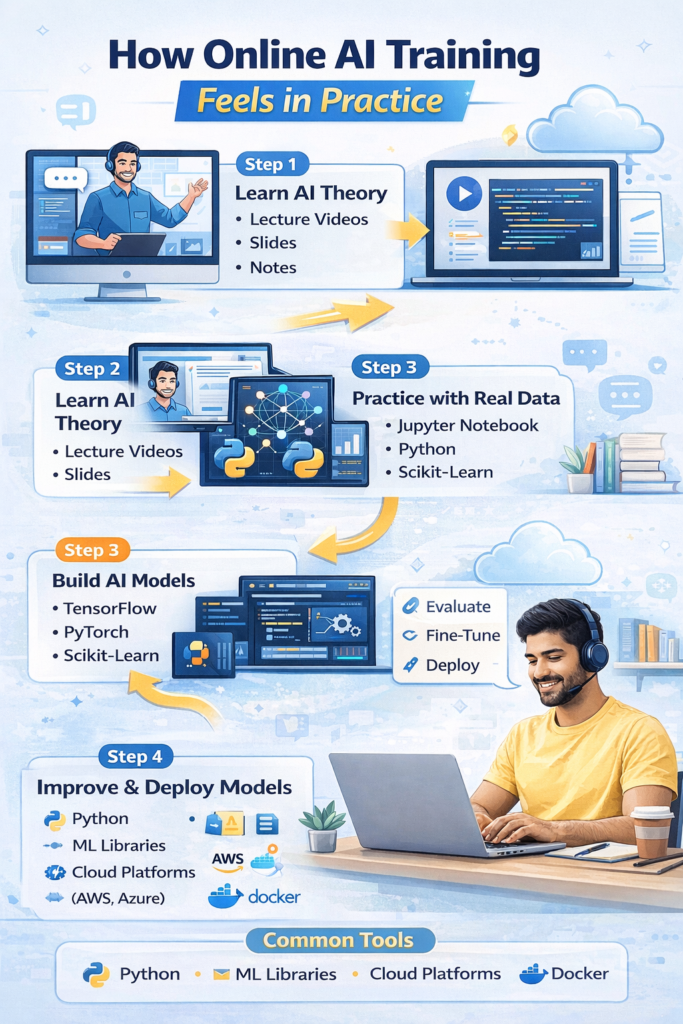
Most Ai Learning Courses programs aren’t just one format. It’s usually a mix:
- Live sessions
- Recorded videos (useful when you miss something or need to rewatch)
- Hands-on labs
- Assignments and projects
The general flow is something like:
- Learn a concept
- Try it on data
- Build something
- Evaluate it
- Deploy it
Sounds simple… but it takes time to really get comfortable.
Tools You’ll Work With
You’ll end up using the usual stack:
- Python
- Jupyter Notebook
- Scikit-learn
- TensorFlow / PyTorch
- Git
- Cloud basics (AWS, Azure, or GCP)
Nothing too surprising here these are pretty standard in the industry.
Why This Kind of Training Matters
AI isn’t limited to data scientists anymore.
You’ll see it in:
- Automation
- Recommendation systems
- Chatbots
- Predictive analytics
Even roles like QA or business analysis are starting to overlap with AI in some way.
Take retail, for example:
- Predicting what customers will buy
- Managing inventory
- Powering customer support bots
So yeah, having at least a basic understanding is becoming more of a necessity than a bonus.
Skills You’ll Need
You don’t need to know everything before starting.
Basics that help:
- Some programming (Python is ideal)
- Logical thinking
- Comfort working with data
Nice to have:
- SQL
- Basic stats
- Familiarity with development workflows
Skill Progression (Roughly)
- Beginner → Python, data basics
- Intermediate → Machine learning
- Advanced → Deep learning + deployment
It’s a gradual process no shortcuts really.
How AI Projects Work in Real Life
In companies, it’s not just “train a model and done.”
It’s more like:
- Define the problem (e.g., predict churn)
- Collect data
- Clean and prepare it
- Train a model
- Evaluate it
- Deploy it
- Monitor and update
And honestly… things break. More often than you’d expect.
Common Challenges
- Poor data quality
- Bias in models
- Scaling issues
- Integrating with older systems
This is where theory stops being neat and starts getting messy.
Where AI Is Used
Pretty much everywhere now:
- Finance → Fraud detection
- Healthcare → Medical imaging
- E-commerce → Recommendations
- IT → Predictive maintenance
Roles That Use AI
Not just one type of job:
- Machine Learning Engineer
- Data Scientist
- AI Engineer
- Data Analyst
- Software Engineer (AI-integrated work)
There’s a lot of overlap between these roles now.
Career Paths After Training
You’ve got a few directions you can go.
Entry-level:
- Junior Data Analyst
- AI Support Engineer
Mid-level:
- Machine Learning Engineer
- Data Scientist
Advanced:
- AI Architect
- AI Product Manager
And demand is still growing across industries.
Typical Projects You’ll Build
You’ll likely work on things like:
- Customer churn prediction
- Sentiment analysis
- Image classification
- Recommendation systems
And the process usually looks like:
- Load data
- Explore it
- Clean it
- Train a model
- Evaluate
- Deploy
It’s repetitive, yeah but that repetition is what makes it stick.
Quick Tool Summary
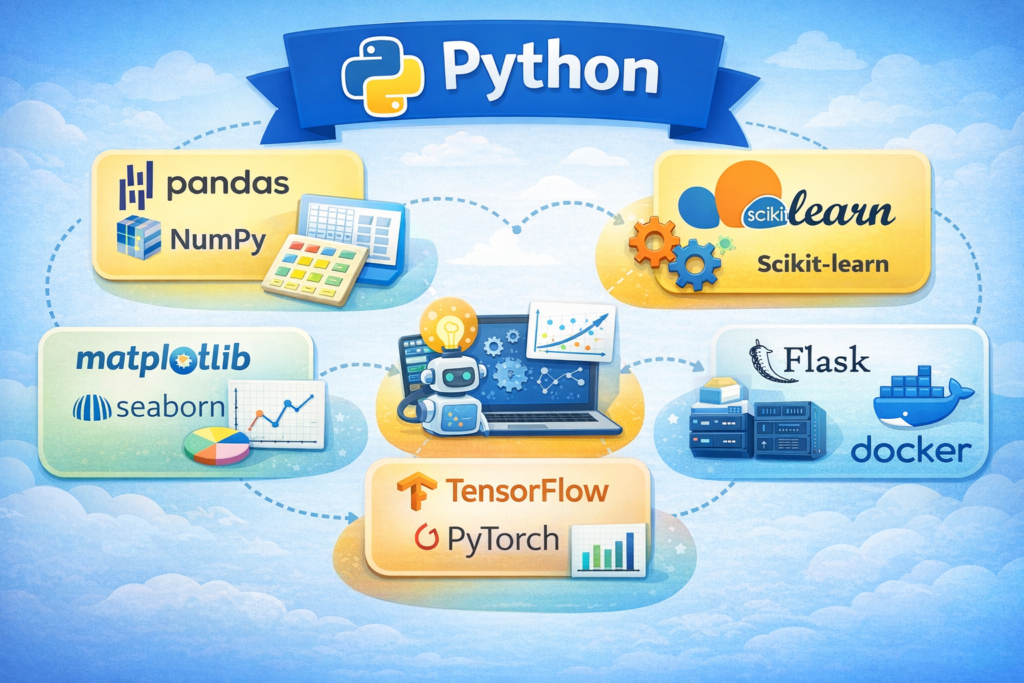
- Python
- Pandas, NumPy
- Scikit-learn
- TensorFlow, PyTorch
- Matplotlib, Seaborn
- Flask, Docker
A Few Common Questions
Do you need coding experience?
Not really. It helps, but many programs start from the basics.
How long does it take?
Around 3–6 months, depending on pace.
Are there projects?
Yes and they’re a big part of the learning.
Do they cover deployment?
Yes, including basic MLOps ideas.
What is the structure of the AI training syllabus?
The syllabus consists of a blend of theoretical knowledge and hands-on projects designed to reinforce learning through practical application.
Are there any prerequisites for enrolment?
While prior experience in coding is beneficial, it is not mandatory, as the program accommodates beginners.
What types of projects can I expect to work on?
Participants will engage in a variety of projects, including data analysis, model building, and algorithm implementation, providing a comprehensive learning experience.
How is the training delivered?
The training is delivered through a combination of lectures, interactive sessions, and collaborative projects to ensure an engaging learning environment.
Is there support for career placement after completion?
Yes, H2K Infosys offers career services, including resume workshops and interview preparation, to assist graduates in securing employment in the AI field.
Final Thought
This kind of AI syllabus isn’t just about learning algorithms. It’s about understanding how everything fits together in real systems.
You go from writing simple Python scripts…
to building and deploying actual AI solutions.
Somewhere in the middle, things will feel confusing. That’s normal. Happens to pretty much everyone.