AI is kind of everywhere right now you’ve probably noticed it creeping into tools, apps, even everyday business decisions. It’s not just hype either. Do Companies across industries are actively using it, which is why AI courses online, especially those offered by H2K Infosys, have become such a popular choice for professionals trying to stay relevant or get ahead.
Most of these courses don’t just skim the surface. They go into things like machine learning, deep learning, and other core technologies that are quietly becoming the backbone of modern business systems. And honestly, once you complete one, you’re not just “learning AI” you’re opening doors to roles like data scientist, AI engineer, or machine learning specialist. Those roles are in demand for a reason.
So… what exactly is AI, and why does it matter?
At a basic level, AI is about building systems that can do things we usually associate with human thinking making decisions, spotting patterns, solving problems, even learning over time. Sounds big, and it is.
It’s also a broad space. You’ve got machine learning, natural language processing (NLP), computer vision, robotics… all kinds of areas feeding into it.
And here’s the thing AI isn’t just a “tech industry” topic anymore. It’s showing up in healthcare, finance, retail, manufacturing… pretty much everywhere. If you understand how it works (even at a practical level), you can start contributing to things like automation, predictive analytics, and smarter decision-making.
It almost feels like having an extra layer of problem-solving ability like you’re not just working harder, you’re working smarter.
How do AI online courses actually work?
Most Machine learning Training Courses are designed to take you from basics to something more practical, step by step. Not always easy but definitely structured.
Here’s the general flow you’ll see:
Getting the basics right
You’ll start with core ideas supervised vs. unsupervised learning, regression, classification. It might feel a bit theoretical at first, but this is your foundation.
Understanding algorithms
This is where things get interesting. Decision trees, neural networks, deep learning models… these are the tools that actually make AI “work.”
Hands-on projects
This is usually the best part. You’ll work on real examples using tools like Python, TensorFlow, or Keras. It’s messy sometimes but that’s how you actually learn.
Ethics (yes, this matters more than people think)
Bias, fairness, responsible AI… these aren’t just buzzwords. They’re real concerns, and good courses don’t skip them.
Evaluation and deployment
Eventually, you’ll learn how to test models and push them into real-world environments because building something is one thing, making it work reliably is another.
By the end, you’re not just familiar with AI you’ve actually used it.
What skills help when learning AI?
You don’t need to know everything upfront, but having a few basics definitely makes things smoother.
- Programming (especially Python)
Python is everywhere in AI. Libraries like NumPy, Pandas, and Scikit-learn make life a lot easier. - Math (yes, some of it)
Linear algebra, probability, a bit of calculus it helps you understand what’s happening under the hood. - Data handling
AI runs on data. Cleaning it, analyzing it, making sense of it that’s a big part of the job. - Thinking in algorithms
Not just coding, but thinking through problems logically. - Core AI concepts
Terms like supervised learning or deep learning will come up constantly you’ll get used to them. - Cloud platforms (optional but useful)
AWS, Azure, Google Cloud… these are often used to deploy models.
You don’t have to master all of this before starting. A good course builds these skills as you go.
Why should professionals actually care about AI?
Because it’s not optional anymore in many roles.
AI helps automate repetitive work, analyze large datasets quickly, and support better decision-making. That applies whether you’re in IT, finance, healthcare, or even operations.
A few real advantages:
- It saves time by handling routine tasks
- It improves decision-making with better data insights
- It encourages innovation (you start solving problems differently)
- It boosts career options and yes, often salary too
And with more companies investing in AI, people who understand it tend to stand out.
What jobs actually use AI regularly?
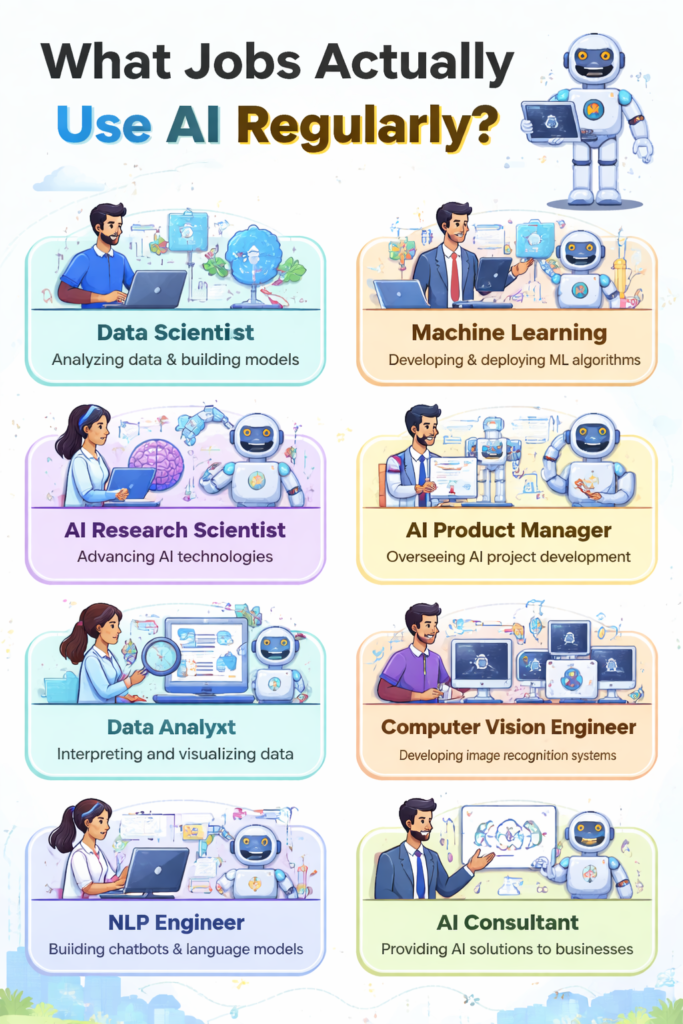
Quite a few, and not just in big tech companies.
- Data Scientist – builds models, finds patterns in data
- Machine Learning Engineer – designs and deploys ML systems
- AI Researcher – works on new algorithms and advancements
- AI Developer – builds applications powered by AI
- AI Solutions Architect – designs scalable AI systems
- Business Intelligence Analyst – uses AI for insights and reporting
Each role uses AI differently, but the core skills overlap.
Where can AI take your career?
Once you’ve got a solid foundation, you can move in different directions depending on what you enjoy.
- AI Engineer
- Data Scientist
- Machine Learning Engineer
- AI Researcher
- Robotics Engineer
- AI Consultant
Some people go deep into technical roles, others move toward strategy or consulting. There’s no single path, which is actually part of the appeal.
How does AI show up in real IT projects?
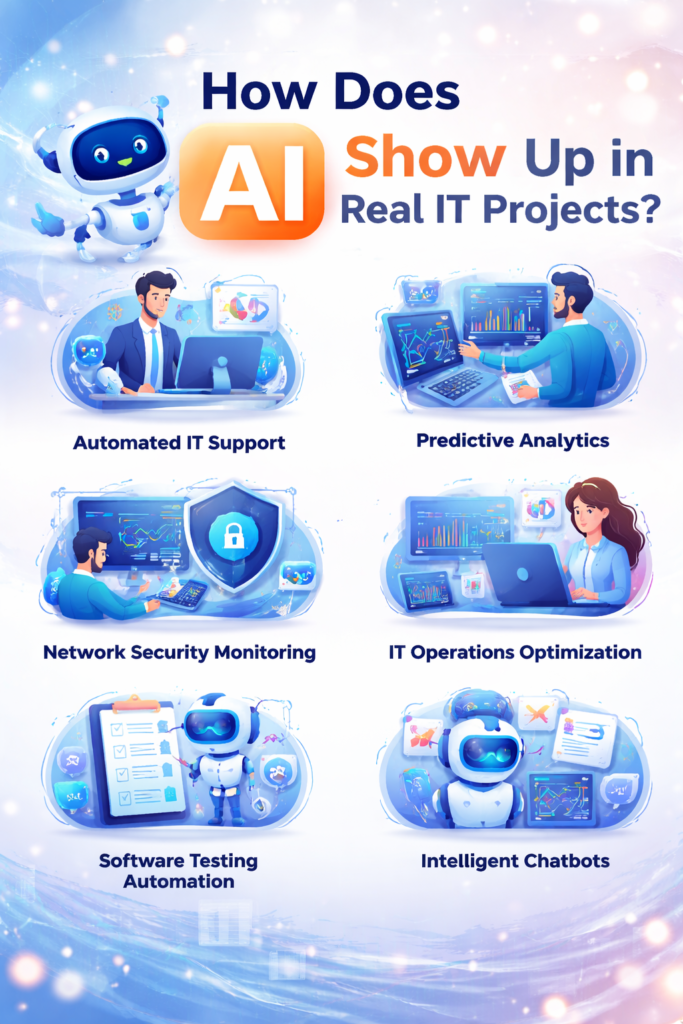
In practice, it’s less “futuristic robot” and more “solving specific business problems.”
A typical workflow looks something like this:
- A problem is identified (say, customer churn)
- Relevant data is collected
- A model is built using algorithms
- The model is trained on past data
- It’s deployed into a real system
- Then monitored and improved over time
It’s iterative. Rarely perfect on the first try.
Quick FAQs
How should I start learning AI?
Start simple. Pick a course that covers basics + hands-on work. Don’t just watch build things.
Which industries use AI the most?
Healthcare, finance, e-commerce, manufacturing, automotive… honestly, the list keeps growing.
How long does it take to get good at it?
If you’re consistent, maybe 6–12 months to feel comfortable. Faster if you already know programming.
Are AI skills really in demand?
Yes and not slowing down anytime soon.
AI vs. Machine Learning?
AI is the bigger concept. Machine learning is one way to achieve it (learning from data).
Wrapping it up
Courses of Artificial Intelligence aren’t just another trend they’re a practical way to build skills that are already shaping how businesses operate.
If you stick with it, you’ll likely:
- Work more efficiently
- Think differently about problems
- Open up better career opportunities
If you’re considering getting into AI, a structured, hands-on course like the ones from H2K Infosys can be a solid starting point. Not magic, not instant but definitely worth it if you put in the effort.