If you’re trying to learn Salesforce AI and feel stuck, the simplest answer is this: follow a structured, real-world roadmap that combines hands-on practice, guided mentorship, and the right Salesforce administrator classes and yes, platforms like H2K Infosys make that path far more practical than figuring it out alone.
Why Learning Salesforce AI Feels So Confusing (At First)
Let’s be honest when most people start trying to learn Salesforce AI, they expect something straightforward. Maybe a few tutorials, a certification, and done.
That’s not how it goes.
Salesforce AI (especially with tools like Einstein, Data Cloud, and generative AI features rolling out fast in 2025–2026) isn’t just one skill. It’s a mix of:
- CRM fundamentals
- Data handling
- Automation logic
- AI-driven decision-making
And here’s the part most beginners don’t realize you can’t skip the basics and jump straight into AI.
I’ve seen people try. They open Einstein GPT, get excited and then freeze because they don’t even understand objects, workflows, or reports.
So yeah, the struggle is real but it’s fixable.
Step 1: Build a Strong Foundation (Don’t Skip This)
Before you deeply learn Salesforce AI, you need to understand how Salesforce itself works.
Think of it like learning to drive before entering a Formula 1 race.
Start with:
- Objects and fields
- Record relationships
- Basic automation (flows, workflows)
- Reports and dashboards
This is where Salesforce administrator classes become extremely valuable. Not just random YouTube videos but structured learning.
A lot of people underestimate this step. Then later, when they try to build AI-powered workflows, nothing clicks.
Step 2: Choose the Right Training Path (This Is Where Most Go Wrong)
Here’s a mistake I made early on I jumped between free resources, blogs, random tutorials and honestly, it just wasted time.
If you’re serious about trying to learn Salesforce AI, you need:
- A guided curriculum
- Real-time projects
- Mentorship (this matters more than people admit)
This is exactly where Salesforce training certification programs come into play.
And not all programs are equal.
Some are just theory-heavy slides. Others like the ones offered by H2K Infosys actually simulate real-world scenarios. That’s a huge difference.
Because knowing what AI does is one thing.
Actually building something with it? Totally different story.
Step 3: Understanding the True Meaning of Salesforce AI in 2026
Let us be clear.
When someone says they want to learn Salesforce AI, they generally mean:
- Einstein AI
- Predictive analytics
- Generative AI (Einstein GPT)
- Automating CRM workflows with AI
However, things have changed significantly since then.
In 2026, organizations are leveraging Salesforce AI for:
- Customer churn prediction
- Generating automated sales emails
- Lead scoring
- Personalization in real-time
I just learned that a retail business lowered their customer response time by 40% through AI-driven automation on the Salesforce platform.
That’s not theory that’s happening right now.
Step 4: Practice With Real Scenarios (Not Just Theory)
This is the turning point.
You don’t truly learn Salesforce AI by watching videos. You learn by doing things like:
- Creating AI-driven lead scoring models
- Building flows triggered by predictive insights
- Using Einstein to automate recommendations
A good Salesforce certification course should include:
- Hands-on labs
- Real project simulations
- Case studies from industries
H2K Infosys stands out here because their approach leans heavily on practical exposure.
And honestly, that’s what employers care about now.
Nobody’s impressed by just certificates anymore they want proof you can build something.
Step 5: Get Certified (But Do It Smartly)
Certifications still matter but only if you understand what you’re doing.
When you Learn Salesforce AI, aim for:
- Salesforce Administrator Certification
- AI-related Salesforce credentials
- Advanced certifications later (if needed)
Here’s something people don’t say enough:
Don’t rush certifications just to add them to LinkedIn.
Take time to:
- Practice scenarios
- Understand use cases
- Apply knowledge
Otherwise, you’ll pass the exam and still struggle in real projects.
Step 6: Get Hands-On with Real-Time Projects
Finally, it all starts falling into place.
At first, when I started Learning Salesforce AI, I didn’t get it. But then, once I worked on projects that dealt with:
Customer segmentation
Recommendations through AI
Workflow automation
It became clear.
You see how it all comes together. You realize how AI actually improves business outcomes.
Good Salesforce admin training programs include:
- Capstone projects
- Real business case simulations
- Industry use cases
And again, this is where structured platforms like H2K Infosys really help bridge the gap.
Step 7: Stay Updated (Because Salesforce AI Changes Fast)
This part is non-negotiable.
If you want to truly Learn Salesforce AI, you have to stay updated.
In the last year alone:
- Einstein GPT evolved rapidly
- AI integrations expanded across modules
- Data Cloud became more central
What you learn today might slightly change in 6–12 months.
So:
- Follow Salesforce updates
- Join communities
- Watch release notes
It sounds like extra work but it keeps you relevant.
A Quick Reality Check (That Most Blogs Won’t Tell You)
Learning Salesforce AI is not:
- A weekend task
- A “watch and done” process
- Something you master without practice
It takes time. Some frustration. A bit of trial and error.
But the payoff? Worth it.
Companies are actively hiring professionals who can learn Salesforce AI and apply it.
Why H2K Infosys Makes This Journey Easier
Let’s talk practically.
If you’re trying to learn Salesforce AI, you need:
- Structure
- Support
- Real-world exposure
H2K Infosys offers:
- Comprehensive Salesforce training classes
- Guided Salesforce training certification programs
- Hands-on Salesforce administrator classes
- Real-time project-based Salesforce admin training
What I personally like about their approach is that it doesn’t feel overly academic.
It feels usable.
You are not merely acquiring knowledge; you are learning how to apply it.
Example from Real Life: How Salesforce AI Skills Are Currently Utilized
A recent fintech company incorporated AI in Salesforce for the following purposes:
- Prediction of loan approval risk
- Automation of document verification
- Personalization of customer communication
The outcomes were as follows:
- Increased processing speed
- Reduced manual labor
- Enhanced customer satisfaction
Exactly for this reason, people are interested in Learning Salesforce AI.
It is more than just a skill it is a career enhancement.
Typical Errors to Prevent
For beginners, beware of the following pitfalls:
1. Rushing into AI
First, learn the basics.
2. Using Solely Free Resources
These resources are scattered and often outdated.
3. Neglecting Hands-on Practice
It significantly prolongs the learning process.
4. Focusing on Certifications without Necessary Skills
Potential employers will easily recognize this.
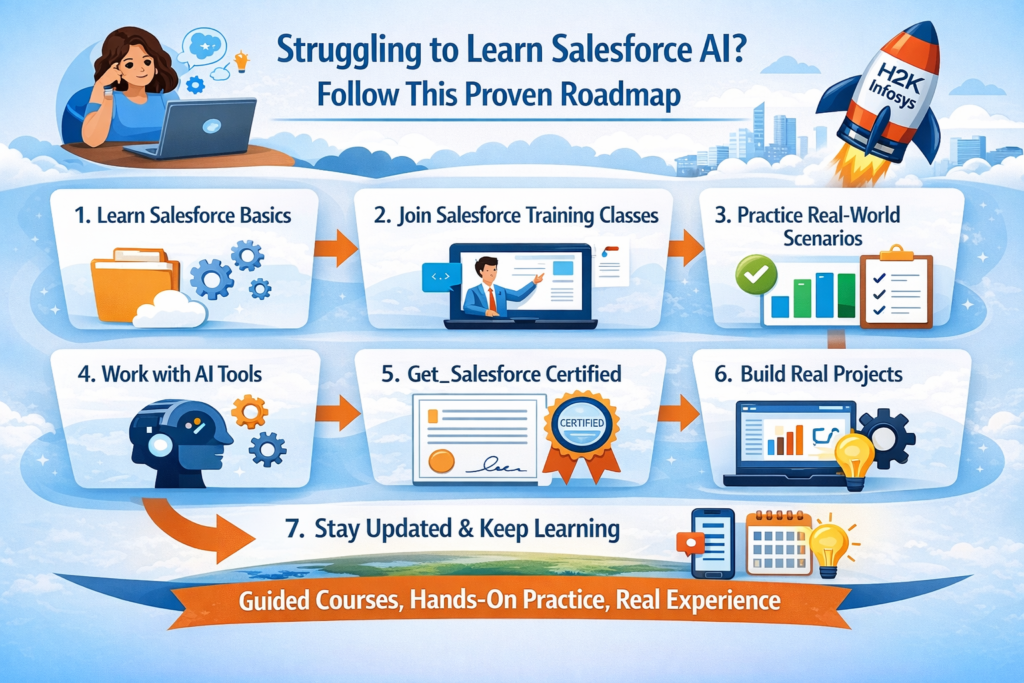
The Effective Plan of Action (Simplified Version)
To put it simply:
- Master Salesforce basics
- Enroll in structured Salesforce training classes
- Practice in realistic scenarios
- Start using AI tools
- Become certified with Salesforce certification course
- Continue project development
- Keep up-to-date
By following this, you will effectively Learn Salesforce AI without getting confused.
Conclusion
Efforts to Learn Salesforce AI may seem daunting at first yet there is no need to make them so.
With an effective plan, proper guidance, and practice, they become easier even enjoyable.
And honestly, choosing a structured platform like H2K Infosys can save you months of confusion.
Because at the end of the day, learning isn’t just about information it’s about direction.
If you’re serious about building a career in this space, now’s a great time to start.
Just don’t try to figure everything out alone.