Why Everyone’s Suddenly Talking About Salesforce AI
Not long ago, Salesforce was mostly about CRM tracking leads, managing contacts, keeping sales pipelines clean. Useful, yes. But now? It’s a whole different beast.
With tools like Einstein AI and generative AI integrations, Salesforce has quietly turned into something much more powerful. Businesses aren’t just storing data anymore they’re predicting customer behavior, automating decisions, and even generating content.
And if you’ve been browsing Salesforce online classes lately, you’ve probably noticed one thing: AI is everywhere.
That’s exactly where Salesforce AI Fundamentals comes in.
What Salesforce AI Fundamentals Really Means (and Why It’s Relevant Now)
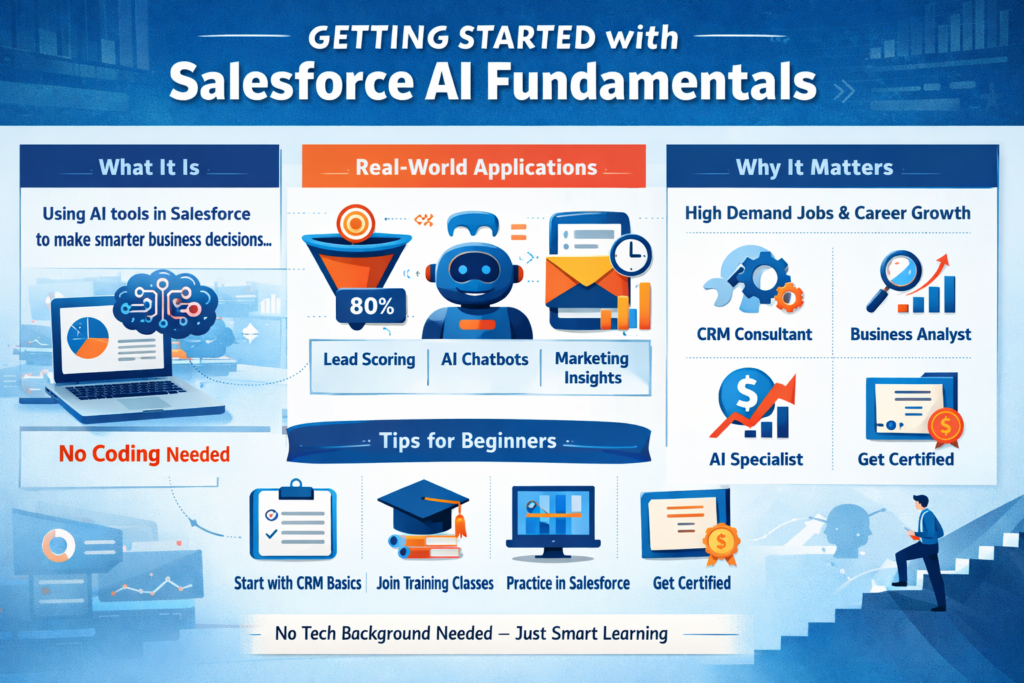
At a basic level, Salesforce AI Fundamentals is about understanding how AI fits into the Salesforce ecosystem to make decisions faster and, more importantly, better.
You’re not coding AI from scratch here. That’s a big misconception.
Instead, you’re learning how to use built-in capabilities things like predictive analytics, automation, and intelligent recommendations. It’s more like learning to drive a powerful car rather than building one.
Think about this for a second:
Instead of guessing which leads might convert, the system nudges you:
“Hey, this one looks promising maybe focus here.”
That shift alone can change how teams work.
And given how competitive the job market is right now especially in CRM-related roles, having this kind of understanding isn’t just a bonus anymore. It’s starting to feel like a baseline expectation.
Where You Actually See Salesforce AI in Action
Let’s skip the theory for a bit. This stuff makes more sense when you see how it plays out in real scenarios.
1. Sales Teams Getting Smarter About Leads
I once worked with a mid-sized company where the sales team was basically chasing every lead equally. No prioritization, just effort everywhere and results weren’t great.
After bringing in AI-powered lead scoring, the shift was hard to miss:
- High-potential leads quickly rose to the top
- Conversion rates began to improve
- Sales cycles became shorter (something the whole team appreciated)
And it didn’t require any heavy lifting, just a more intelligent use of the tools already available.
2. Customer Support That Doesn’t Feel Overwhelmed
Another team I worked with integrated AI into their support workflows.
Before that? Agents were typing the same responses over and over.
After AI suggestions came in:
- Replies were generated instantly
- Agents reviewed instead of starting from scratch
- Response times dropped significantly
Not perfect, but definitely more efficient.
3. Marketing That Actually Learns From Itself
This one’s kind of fascinating.
AI started analyzing past campaigns and suggesting things like:
- Best time to send emails
- Which audience segments respond better
- What kind of content clicks
Trying to do all of that manually? Almost impossible at scale.
Why Beginners Should Pay Attention to This
Here’s something that often gets overlooked:
You don’t need to be technical in the traditional sense to work with AI anymore.
And that’s exactly why Salesforce AI Fundamentals is getting so much attention. It opens doors for people who might’ve felt left out before:
- Fresh graduates
- Career switchers
- Non-technical professionals
If you’re already exploring Salesforce training, this is where things are heading.
Companies aren’t just looking for admins who manage data. They need interpreters, people who can add automated processes and incorporate learned insights into decision-making.
Simplifying the Concepts (So You Can Understand Them)
Let’s keep this simple.
Predictive Analytics
This is known as an AI that analyzes historical records and predicts the next move.
For example:
- Deals that are probably going to close
- Which customers might leave
This is one of those little features that seem insignificant until you actually use them.
Automation (But Smarter)
And we are not referring to simple workflows.
This is more like:
- Auto-assigning leads based on quality
- Going off when something needs addressing (alerts).
- Suggesting next steps
However, it intelligently reduces repetition.
Natural Language Processing (NLP)
This is what drives chatbots and auto-responses.
It allows systems to:
- Understand what customers are asking
- Suggest replies
- Summarize conversations
It is to this end– and yeah, it is surprisingly consistent.
Data Insights
That is where the pieces click together for many beginners.
Instead of staring at dashboards full of numbers, you begin to see patterns, trends, and actual meaning behind the data.
That aha moment? It usually happens here.
How This Connects to Your Career
Let’s be real this is what most people are trying to figure out.
Learning Salesforce AI Fundamentals doesn’t just add another skill. It changes how you’re positioned in the job market.
You’re no longer just managing a system you’re helping businesses make smarter decisions.
Roles that naturally align with this:
- Salesforce AI Administrator (with AI exposure)
- Business Analyst
- CRM Consultant
- Marketing Automation Specialist
And yes, roles that involve AI tend to come with better compensation. Not always immediately but the trend is pretty clear.
Where Most Beginners Trip Up
A lot of people try to piece everything together from random videos online.
Totally understandable it’s accessible and free.
But the downside?
- No structure
- No real-world projects
- No clear path forward
That’s where structured Salesforce AI training, especially Salesforce online classes, makes a noticeable difference. You’re not just learning bits and pieces; you’re building something cohesive.
A Quick Note on Learning Platforms
Not all training programs are created equal. Others sound great, but do not genuinely prepare you for real-life situations.
In good programs, what is often conspicuous is:
- Hands-on, project-based learning
- Real-world examples (not just theory)
- Step-by-step progression through AI concepts
Because at the end of the day, employers just don’t care whether you have watched the tutorial or not. They care if you can actually use what you’ve learned.
What You’ll Typically Learn
In a structured Salesforce AI Fundamentals course, you’ll likely cover:
- Basics of Salesforce AI
- Einstein AI tools
- Data preparation and handling
- Predictive modeling concepts
- AI-powered dashboards
- Real-world applications
The key is that everything connects it’s not just isolated topics.
Certifications (Yes, They Matter)
If you’re starting, certifications can really help build credibility.
After getting comfortable with the fundamentals, you can move toward:
- Salesforce Administrator Certification
- AI-focused Salesforce roles (emerging area)
- Advanced CRM certifications
More and more certification paths are starting to include AI elements, which says a lot about where things are going.
A Small Reality Check
Learning this isn’t hard but it’s also not instant.
There will be moments where:
- Concepts feel a bit unclear
- Things don’t click right away
That’s normal.
When I first got into Salesforce AI, I had to revisit certain topics multiple times before they made sense in real use cases. It’s part of the process.
Consistency matters more than speed here.
Why This Skill Is Growing Fast (Especially Now)
If you’ve been paying attention, AI is showing up everywhere.
But within Salesforce AI, it’s evolving fast.
Some current shifts include:
- Generative AI in CRM workflows
- AI-driven customer journeys
- Real-time predictive insights
Companies are actively looking for people who understand how to use these tools effectively not just theoretically.
Practical Tips to Get Started
If you’re serious about this, here’s a simple approach:
Start with the basics of CRM concepts and data handling. Don’t rush into advanced AI.
Then, join structured training that includes hands-on work. That part really speeds things up.
Spend time inside Salesforce AI environments. Experiment. Break things. Fix them.
And following a Salesforce certification path helps you stay focused and gives you milestones to aim for.
Common Mistakes to Avoid
A few patterns I’ve seen over and over:
- Trying to learn everything at once
- Ignoring practical application
- Skipping structured learning
- Underestimating how important AI is becoming
Taking it step by step works better. Always does.
The Bigger Picture
Salesforce isn’t just a CRM anymore.
It’s turning into something much bigger a platform that helps businesses make decisions using data and AI.
And understanding Salesforce AI Fundamentals puts you right at the center of that shift.
Final Thoughts
If you’re starting your Salesforce journey today, learning AI fundamentals is probably one of the smartest moves you can make.
It’s practical.
It’s in demand.
And it genuinely changes how businesses operate.
And if you approach it the right way with structure, real practice, and a bit of patience, you’re not just learning another tool.
You’re learning how to make an actual impact using Salesforce.
And that’s really what this is all about.