Why Learning Salesforce AI Is Suddenly Everywhere
A couple of years ago, Salesforce skills alone were enough to land a solid CRM job. Now? It’s a different game. With tools like Einstein AI built into Salesforce, companies are shifting toward automation, predictive insights, and personalized customer journeys at scale.
And honestly, I didn’t fully get the hype until I saw it in action.
A friend of mine working in a mid-sized retail company showed me how their sales forecasts once guesswork are now AI-driven and surprisingly accurate. That’s when it clicked Learning Salesforce AI isn’t just a skill it’s leverage.
If you’re exploring Salesforce training courses, you’re already on the right track. But the real question is what happens after you learn it?
Let’s get into that.
The Shift: From CRM User to AI-Driven Professional
Here’s the thing most people miss.
Traditional Salesforce roles were about managing data. Updating leads. Tracking opportunities.
Now? With Learning Salesforce AI, you’re expected to interpret that data, automate decisions, and sometimes even build intelligent workflows.
That’s a big jump.
And companies are actively looking for people who can bridge that gap.
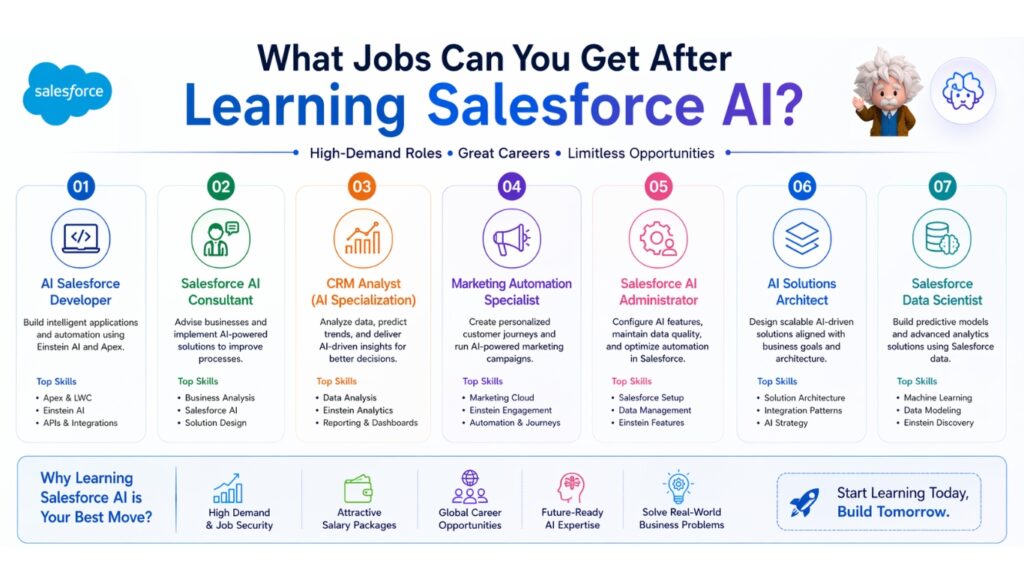
1. AI Salesforce Developer (One of the Most In-Demand Roles Right Now)
If you enjoy coding or even if you’re just curious about it this role is gold.
An AI Salesforce Developer builds intelligent applications using tools like:
- Apex (Salesforce’s programming language)
- Einstein AI
- APIs and integrations
With Learning Salesforce AI, developers are now creating systems that:
- Predict which leads are most likely to convert
- Automatically assign sales tasks
- Trigger smart recommendations
A real example? A fintech startup used Salesforce AI to auto-score loan applicants, cutting manual work by 60%.
That’s the kind of impact companies want.
If you’re taking a Salesforce certification course, this is one of the highest-paying paths you can aim for.
2. Salesforce AI Consultant (Problem-Solver + Strategist)
Not everyone wants to code and that’s totally fine.
Salesforce AI Consultants work closely with businesses to:
- Understand their processes
- Identify automation opportunities
- Implement AI-driven solutions
Think of it like this companies know they need AI, but they don’t always know how to use it.
That’s where Learning Salesforce AI becomes incredibly valuable.
I’ve seen consultants walk into organizations and completely redesign their sales funnel using AI predictions. It’s not just technical it’s strategic thinking.
This role is especially popular among those who’ve completed Salesforce training and placement programs and want client-facing careers.
3. CRM Analyst with AI Specialization
Now this one is interesting.
CRM Analysts used to spend hours building reports. Today, AI does a lot of that heavy lifting.
So what do analysts do now?
They interpret insights.
With Learning Salesforce AI a CRM Analyst can:
- Predict customer churn
- Analyze buying behavior
- Recommend next-best actions
One healthcare company used Salesforce AI to identify patients likely to miss appointmentsand reduced no-shows by 30%.
That’s not just data analysis. That’s real-world impact.
If you’re coming from a non-technical background, this is one of the easiest transitions after Salesforce classes.
4. Marketing Automation Specialist (AI Meets Creativity)
Marketing has changed a lot. Mass emails don’t work like they used to.
Now it’s all about personalization and AI makes that possible.
With Learning Salesforce AI, marketers can:
- Send personalized campaigns at scale
- Predict customer preferences
- Optimize ad spending automatically
A recent trend? AI-driven customer journeys that adapt in real-time.
I once tested a Salesforce-powered campaign where the system adjusted messaging based on user clicks. It felt almost human.
If you’ve taken a Salesforce certification training, this role is a fantastic blend of tech and creativity.
5. Salesforce AI Administrator (The Backbone Role)
Admins don’t usually get the spotlight in Salesforce but honestly, nothing works without them. They’re the ones quietly keeping everything together behind the scenes.
Now add AI into the mix, and their job isn’t just keeping things running anymore. It’s a bit more layered than that.
A Salesforce AI Admin typically:
- sets up and fine-tunes AI features
- keeps the data clean (which, let’s be real, is half the battle)
- makes sure automations don’t break at the worst possible moment
With Salesforce AI in play, admins aren’t just maintaining systems they’re kind of shaping how smart those systems actually are. Subtle shift, but a big one.
If you’re someone who enjoys configuring things, tweaking setups, and making systems behave just right without diving deep into code, this role tends to fit really well.
6. AI Solutions Architect (Big Picture Thinker)
This is where things start to feel bigger. More strategic.
AI Solutions Architects don’t just work within systems, they design how everything connects in the first place. Think of them as the ones sketching the blueprint before anything gets built.
They’re the ones asking (and answering):
- How does AI actually fit into this business?
- What tools make sense here and which don’t?
- How should data move between all these different platforms without turning into chaos?
With Salesforce AI, architects are essentially shaping how entire organizations operate going forward. Not in a small way, either it’s pretty foundational.
It’s not really a beginner-friendly role, to be honest. There’s a lot you need to understand before you get here. But as a long-term goal? Definitely worth aiming for.
7. Salesforce Data Scientist (Where AI Gets Deep)
If you love data, this one’s for you.
Salesforce Data Scientists:
- Build predictive models
- Analyze large datasets
- Improve AI algorithms
With Learning Salesforce AI, you can work on:
- Customer lifetime value prediction
- Fraud detection
- Sales forecasting
This role overlaps with broader AI careers but Salesforce gives it a business edge.
Why Companies Are Hiring Salesforce AI Professionals Like Crazy
Let’s talk reality.
Businesses are under pressure to:
- Reduce costs
- Improve customer experience
- Make faster decisions
AI helps with all three.
And Salesforce? It’s already used by thousands of companies globally.
So when you combine them through Learning Salesforce AI, you become exactly what companies need.
Real-World Trends You Should Know (2026 Perspective)
A few things are happening right now:
- AI-powered CRMs are pretty much becoming the norm at this point not really optional anymore
- Companies seem to be leaning more toward certified professionals rather than generalists
- There’s been a noticeable rise in demand for Learning Salesforce AI skills, both in India and globally
- Remote opportunities for Salesforce roles are continuing to grow
That’s exactly why investing in Salesforce training courses right now just makes sense.
Where H2K Infosys Fits Into All This
Here’s something worth mentioning.
A lot of people struggle not with learning, but with getting hired.
That’s where H2K Infosys stands out.
Their approach to Salesforce training and placement is practical:
- Real-time projects
- Hands-on AI use cases
- Mock interviews
- Resume building
I’ve come across learners who said the biggest difference was confidence. Not just knowledge.
And honestly, when you’re stepping into roles involving Learning Salesforce AI, confidence matters a lot.
How to Start (Without Feeling Overwhelmed)
If you’re thinking, “This sounds great, but where do I begin?” you’re not alone.
Here’s a simple path:
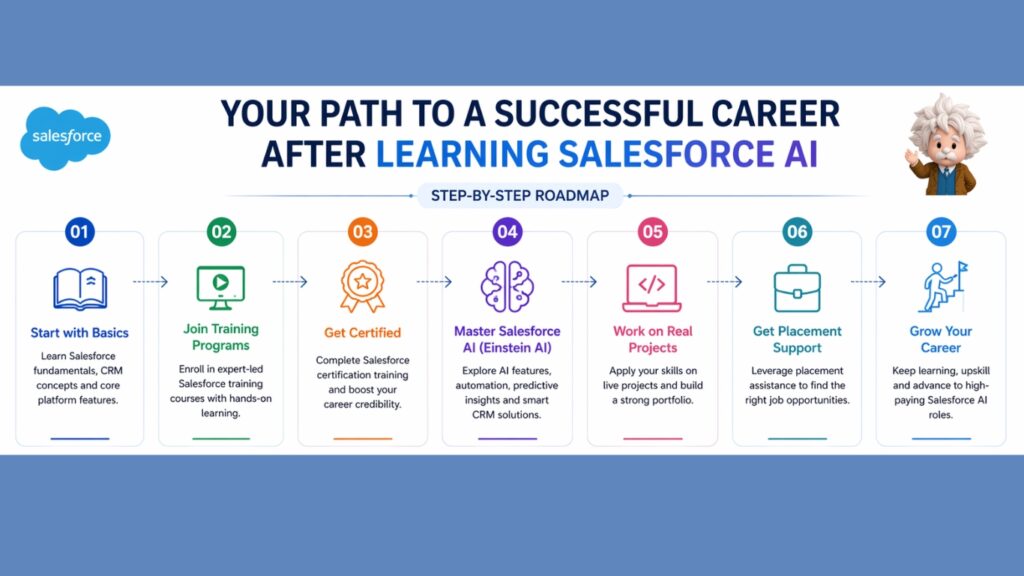
- Start with basic Salesforce classes
- Move into a Salesforce certification course
- Focus on AI features like Einstein
- Practice with real-world scenarios
- Apply through placement-supported programs
Consistency matters more than speed here.
Common Mistakes People Make
Let me save you some time.
People often:
- Focus only on theory
- Skip hands-on practice
- Ignore certification
- Don’t build real projects
With Learning Salesforce AI, practical experience is everything.
Is Learning Salesforce AI Worth It in 2026?
Short answer? Yes.
Long answer?
It’s one of the few skill paths that combines:
- High demand
- Strong salaries
- Long-term growth
And the best part is it’s still early enough to get ahead.
Final Thoughts (A Bit Personal)
I’ve seen tech trends come and go.
Some fade quickly. Some evolve.
Learning Salesforce AI feels different.
It’s not just a trend it’s becoming a standard skill set in modern businesses.
And if you approach it the right way through structured Salesforce training courses, proper certification, and hands-on practice, you’re not just learning a tool.
You’re building a career that adapts to the future.