Why This Decision Is Trickier Than It Looks
I’ve seen many people (including friends) pick data analytics courses based on the following:
- “This one has 5-star reviews.”
- “This one is cheap.”
- “This one says job guarantee.”
And then 3 months later… they’re stuck.
Because in real work, nobody asks you theory questions. They give you messy data analytics courses and expect results.
That’s where many courses fall apart.
Step-by-Step: How to Compare Data Analytics Courses
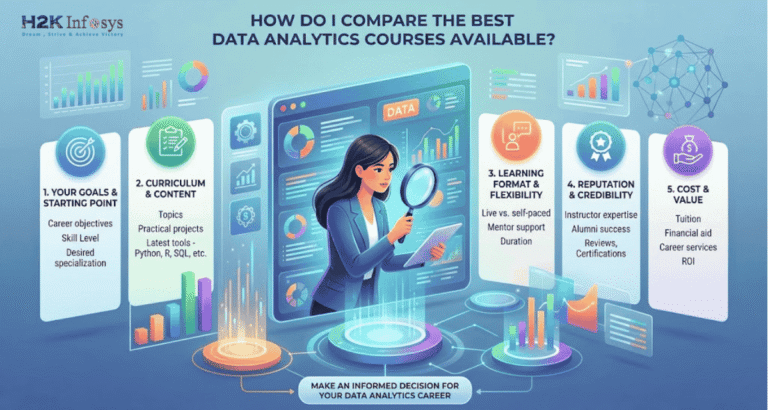
1. Start With the Curriculum (Don’t Skip This)
Open the syllabus. Actually read it.
You should see:
- Excel (not basic advanced stuff)
- SQL (very important, honestly)
- Some Python or at least data tools
- Visualization (Tableau or Power BI)
If it’s mostly theory or vague topics… I’d move on.
2. Check If There Are Real Projects
This is a big one.
Most beginners struggle here because the following are true:
Data Analytics Courses show clean, perfect examples.
But in real projects?
Data is messy. Missing values. Weird formats.
Good Data Analytics Courses will:
- Give you raw datasets
- Make you clean them
- Build dashboards or reports
If there are no proper projects, you’re not really learning.
3. Who Is Teaching It?
This part is underrated.
A competent instructor:
- Shows real workflows
- Talks about actual job scenarios
- Explains why things are done
Some courses feel like reading slides. That’s not helpful.
4. Look at Career Support (Seriously)
This is where things usually determine your outcome.
Ask:
- Do they help with resumes?
- Do they do mock interviews?
- Any real job assistance?
Because finishing a course is one thing…
Getting hired is a completely different game.
5. Understand the Format
You’ll usually see:
Beginner courses
- Slower
- More theory
- Less job-focused
Data Analytics Courses
- Faster
- More intense
- Focused on getting you job-ready
If you’re just exploring, beginner Data Analytics Courses are fine.
If you want a career switch, boot camps usually work better.
A Real Example (This Happens a Lot)
One guy I know working in support wanted to move into analytics.
He picked a cheap Data Analytics Courses first. Learned basics. No projects.
Then he realized:
He couldn’t answer interview questions.
So he switched to a more structured program that had:
- Real projects
- SQL + dashboards
- Interview prep
Took him longer overall… but that second course actually made a difference.
Honestly, this phenomenon is more common than people admit.
Quick Comparison: What Actually Matters
Instead of comparing 10 features, just focus on this:
| Tools covered | You need real skills |
| Projects | This is what employers look at |
| Career support | Helps you get hired |
| Teaching style | Makes learning easier |
Everything else is secondary.
Benefits of Learning Data Analytics (Right Now)

This field is still growing fast.
Companies need people who can:
- Understand data
- Explain it clearly
- Help make decisions
Roles you can aim for:
- Data Analyst
- Business Analyst
- Reporting Analyst
And yeah, salaries are pretty solid, especially once you get experience.
Where Structured Training Helps (Like H2K Infosys)
Here’s something I wish more people knew earlier:
Learning from random videos sounds easy… but it gets messy quickly.
You don’t know:
- What to learn next
- Whether you’re job-ready
- If your skills are enough
That’s where structured programs like H2K Infosys actually help.
They focus on:
- Step-by-step learning
- Real-time projects
- Job-oriented training
- Interview preparation
If your goal is just “learn basics,” you don’t need that.
But if your goal is “get a job,” it can save a lot of time.
Common Mistakes (Avoid These)
- Picking the cheapest course
- Ignoring projects
- Skipping SQL (big mistake)
- Thinking certificates = jobs
- Not checking career support
I’ve seen people redo everything just because of this.
TL;DR
- Focus on skills, not brand names
- Projects matter more than theory
- Bootcamps are better for job switching
- Career support is a big advantage
- Structured programs (like H2K Infosys) can speed things up
FAQs
1. Which Data Analytics Courses is best for beginners?
One that teaches Excel, SQL, and visualization with hands-on projects. Skip theory-heavy courses.
2. Are data analytics bootcamps worth it?
If they include projects and job support, yes. They’re more practical than basic courses.
3. How long does it take to become job-ready?
Around 3–6 months with consistent practice.
4. Do I need coding?
Some basics, yes, mainly SQL and maybe Python. Good courses teach from the ground up.
5. Can I get a job after a course?
Yes, but only if you have the following:
- Projects
- Practical skills
- Interview preparation
What You Can Explore Next
If you’re going deeper into this, you might want to check the following:
- How to build a data analytics portfolio
- Best tools for data analysts in 2026
- SQL basics for beginners
Final Thought
Comparing data analytics courses isn’t about finding the “best” one online.
It’s about finding the one that actually gets you from
“I understand concepts.” → “I can do the job.”
Take your time with this decision; it really does matter more than people think.