AI training in 2026 doesn’t really look like it did a few years ago. It’s not just about learning algorithms anymore it’s about actually using them in environments that resemble real companies. Most Ai Training Program now lean heavily toward applied, enterprise-ready skills. AI trends You’ll see a lot more focus on things like generative AI, MLOps, responsible AI, and systems that work with real-time data.
At places like H2K Infosys, the structure usually reflects what companies are already doing in production automation pipelines, deployed models, integrations with business tools. Not just notebooks and theory.
What’s Actually Included in AI Training Programs in 2026?
At a high level, these programs are built like a journey. You don’t just learn concepts—you move toward building something usable.
Core Areas You’ll Cover
Machine Learning Fundamentals
You still start here, of course. Supervised vs. unsupervised learning, model evaluation, validation—it’s the base layer. Nothing fancy, but essential.
Deep Learning
This is where it gets more interesting. Neural networks, CNNs, RNNs, transformers. Not always in extreme depth, but enough to understand how modern AI models actually work.
Generative AI
This is a big one now.
- Large Language Models (LLMs)
- Prompt engineering (a skill on its own now)
- Some exposure to fine-tuning or adapting models
Data Engineering Basics
People underestimate this part.
- Data pipelines
- ETL processes
Because honestly, bad data breaks everything.
Model Deployment
This is where older courses used to fall short. Now it’s central.
- APIs
- Containerization
- Cloud deployment
The Big Shift (and it’s pretty obvious)
If you compare with older programs, the change is clear:
- Less theory, more doing
- Less “build a model,” more “ship a system”
- Less offline experimentation, more real-time pipelines
It’s closer to how actual teams work.
What AI Certified Courses Are Covering Right Now
A few AI trends show up almost everywhere.
1. Generative AI & LLMs
This isn’t optional anymore it’s everywhere.
You’ll typically learn:
- Prompt engineering techniques (trial-and-error is part of it)
- Fine-tuning pre-trained models (sometimes lightly covered)
- Retrieval-Augmented Generation (RAG)
- Working with LLM APIs
Where it shows up in real life:
- Chatbots that actually understand context
- Document summarization tools
- Even code assistants
2. MLOps (Machine Learning Operations)
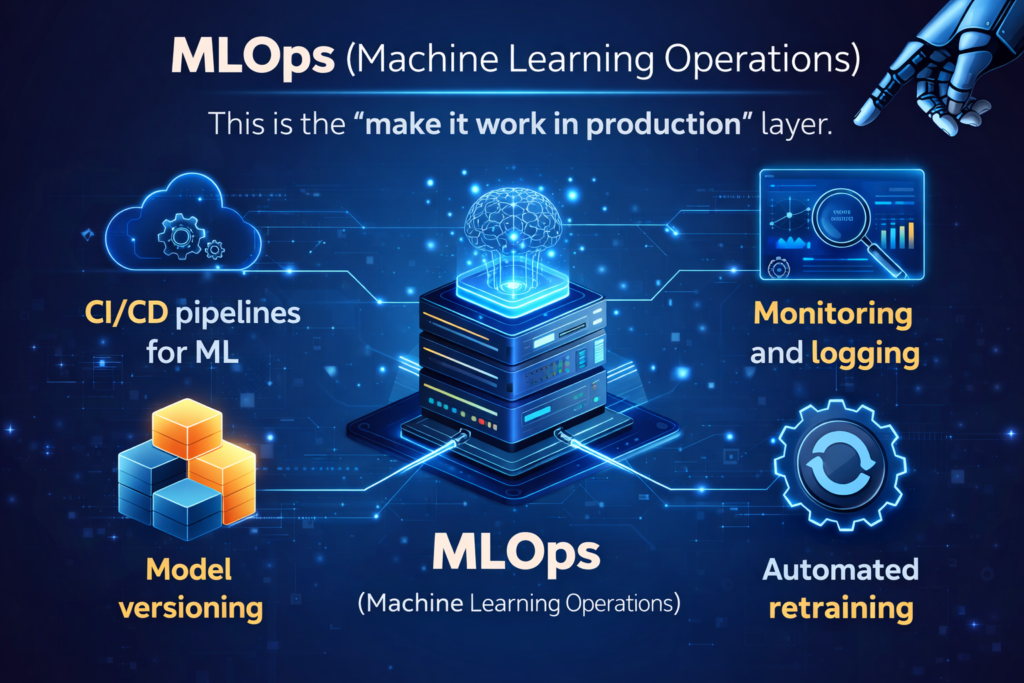
This is the “make it work in production” layer.
You’ll run into:
- CI/CD pipelines for ML
- Model versioning
- Monitoring and logging
- Automated retraining
Tools often include:
- MLflow
- Kubeflow
- Docker
- Kubernetes
A typical workflow looks AI trends something like:
Train → Package → Deploy → Monitor → Retrain
Simple in theory… messy in practice.
3. Responsible AI & Governance
This part is getting more attention lately, and for good reason.
Training usually touches on:
- Bias detection and mitigation
- Explainable AI (XAI)
- Data privacy basics
- Model transparency
Also, there’s growing awareness around compliance—think GDPR-style regulations, audits, risk controls. Not always exciting, but very real in enterprise setups.
4. Cloud-Based AI
Almost everything runs on the cloud now.
You’ll likely work with:
- AWS (SageMaker, Bedrock)
- Azure (Azure ML, OpenAI services)
- GCP (Vertex AI)
Skills here include:
- Deploying models
- Managing infrastructure
- Using managed AI services
5. Real-Time AI Systems
Batch processing isn’t enough anymore.
Modern training includes:
- Apache Kafka
- Spark Streaming
- Real-time inference APIs
Example: fraud detection systems that react instantly, not hours later.
6. AI in Business Workflows
This is where AI trends meets actual business value.
Common use cases:
- Document processing automation
- Workflow automation via APIs
- Predictive dashboards
It’s less about “cool models” and more about solving specific problems.
How AI trends Actually Works in Real Projects
In real-world scenarios, AI isn’t just “train a model and done.” It’s a loop.
A typical workflow:
- Define the problem (churn prediction, fraud detection, etc.)
- Collect data (often messy, scattered)
- Clean and preprocess
- Train and validate models
- Deploy via APIs
- Monitor performance (this part never stops)
- Retrain when things drift
Honestly, monitoring and maintenance take more effort than people expect.
Why This Matters for Working Professionals
AI trends is now embedded across industries finance, healthcare, retail, IT services. It’s not a niche skill anymore.
People usually come into AI training because:
- They want to automate repetitive tasks
- They need better data insights
- They’re trying to shift roles or grow into new ones
And yeah, there are common struggles:
- Not enough hands-on experience
- Confusion around deployment
- Tools changing too fast
Good training programs try to close that gap with practical exposure.
Skills You’ll Need (and build along the way)
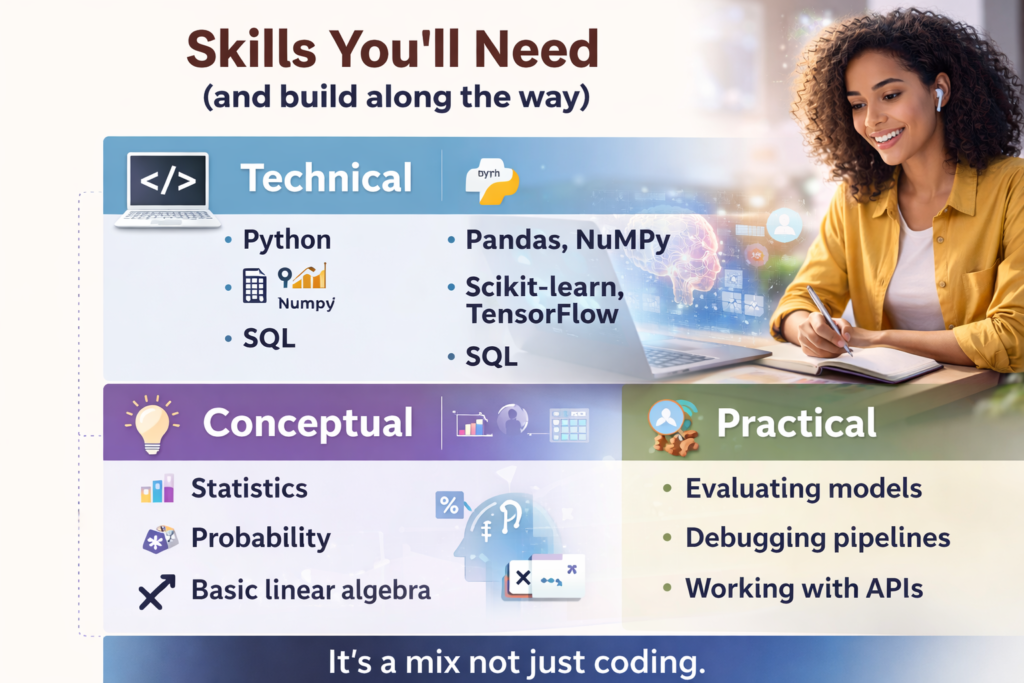
Technical:
Conceptual:
- Statistics
- Probability
- Basic linear algebra
Practical:
- Evaluating models
- Debugging pipelines
- Working with APIs
It’s a mix not just coding.
How AI trends Fits Into Enterprise Systems
AI rarely stands alone in companies.
A typical setup might include:
- Frontend app
- Backend APIs
- AI model service
- Database + logging systems
And then come the constraints:
- Scalability
- Security policies
- Legacy system integration
That’s where things get… complicated.
Job Roles That Use AI Daily
AI skills show up in different roles:
- Data Scientist – builds models, analyzes data
- ML Engineer – handles deployment and pipelines
- Data Analyst – extracts insights, builds dashboards
- AI Engineer – works end-to-end on AI systems
- DevOps Engineer – manages CI/CD for ML
Different focus, same ecosystem.
Career Paths After AI Training
You’ll typically see progression like this:
Entry-level:
- Junior Data Analyst
- AI Support Engineer
- Associate Data Scientist
Mid-level:
- Machine Learning Engineer
- AI Developer
- Data Engineer
Advanced:
- AI Architect
- MLOps Specialist
- Research Engineer
It’s not strictly linear, but that’s the general idea.
A Simple Real-World Example
Customer Churn Prediction:
- Gather customer data
- Clean and prepare it
- Train a classification model
- Evaluate performance
- Deploy as an API
- Connect to CRM
- Monitor predictions over time
Sounds straightforward but each step has its own challenges.
Quick FAQ
What are the biggest AI trends in 2026?
Generative AI, MLOps, responsible AI, and real-time systems are the main ones.
Are courses more practical now?
Yes, definitely. Most focus on deployment and real-world workflows.
Do they include AI trends cloud platforms?
Almost always AWS, Azure, and GCP are standard.
Is coding required?
Basic Python knowledge is usually expected.
How long do programs take?
Typically 3 to 9 months, depending on depth.
Key Takeaways
An Ai Certified Courses today is less about “learning AI” and more AI trends about working with it. You’re expected to build, deploy, and maintain systems not just understand them.
Generative AI and MLOps sit at the center of most programs. AI trends Cloud skills are no longer optional. And maybe most importantly, everything is tied back to real business use.