
Preparing for a Business Analyst Job interview is not about memorising definitions or listing the tools you have used. It’s about showing how you think, how you solve problems, and how you work with people. Interviewers want to hear that you can take a business problem, break it down and help create a practical solution.
Most beginners spend most of their time learning technical skills and forget that business analysis is also about understanding people and processes. Business Analyst Job involves working with different teams, asking the right questions, managing requirements and leading everyone towards a common path. Clearly articulating your thoughts can be a real differentiator in an interview.
If you want to kick-start or grow your career in this field, getting trained through a structured business analyst course with practical examples can give you more confidence. H2K Infosys’s Business Analyst Job Training involves real-time scenarios, hands-on project experience and interview preparation so that learners get to know what companies expect from a business analyst today.
Know What Interviewers Really Want From a Business Analyst
A Business Analyst Job interview often tests more than your knowledge of documents, diagrams or software tools.
Hiring managers want to know, often:
- Can you spot the real business problem?
- Are you able to liaise with different stakeholders?
- Can you adapt to changing requirements?
- Are you able to look at the data and suggest improvements?
- Can you explain complex things in a simple way?
A company might say, for example, “Our customer support process is too slow.”
A novice might just dive in and recommend more staff.
A good business analyst would want to know first:
- When will the delay be?
- Are customers waiting due to system problems, unclear processes, or a lack of information?
- What do the data tell us?
That problem-solving mindset is what differentiates an average candidate from a strong candidate.
Prepare Your Introduction: The First Impression Matters
One of the first questions you’ll likely hear is:
“Tell me about yourself.”
A common mistake for many candidates is to provide a long personal history. Instead, concentrate on your journey to becoming a business analyst.
A good answer typically covers:
- Employment history
- Interest in business analysis
- Your tools and your skills
- Your problem-solving experience
For example:
I have gained an interest in the Business Analyst Job because I like to understand how businesses work and find ways to improve processes. “I have experience in requirement gathering, documentation, data analysis, and stakeholder communication, and I am constantly upgrading my skills through structured Business Analyst Training.”
Do it naturally. No need to sound like you’re reading a script.
Typical Business Analyst Interview Questions to Prepare For
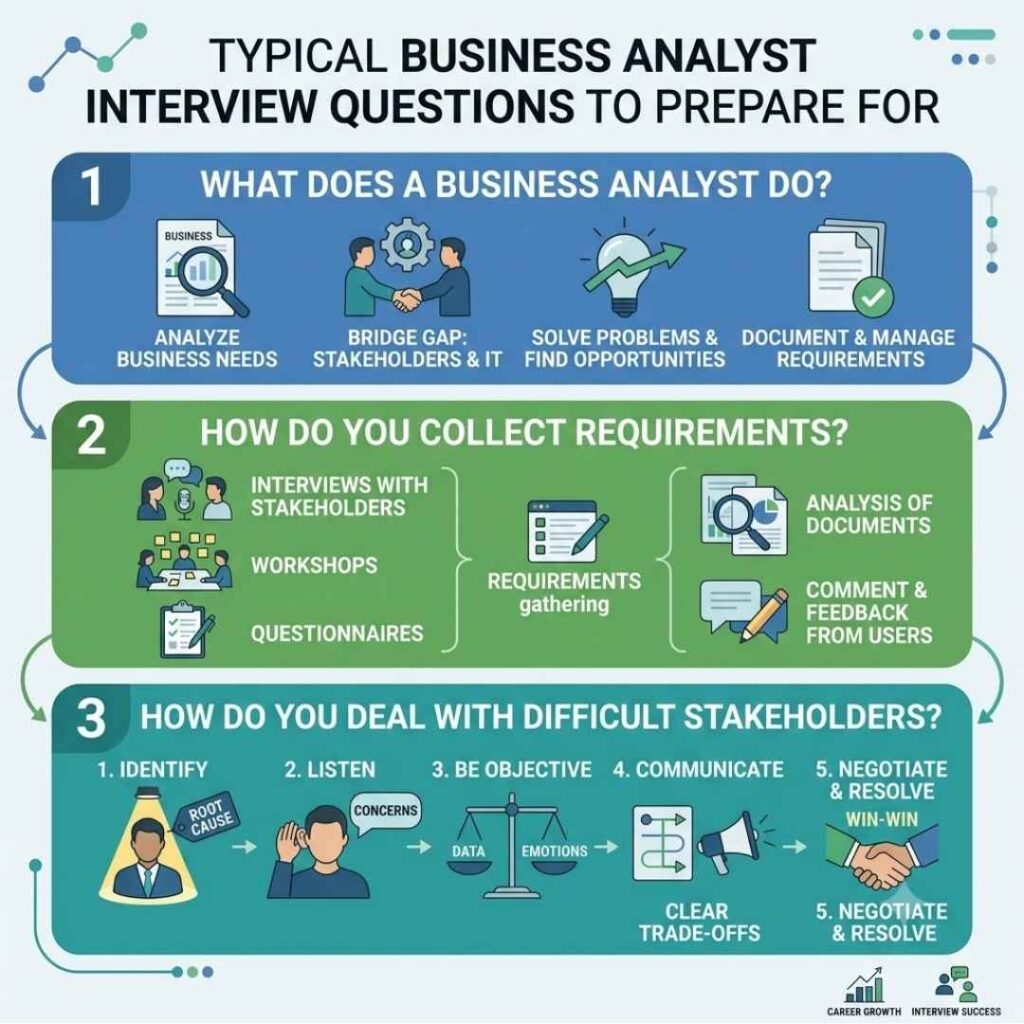
Most interviews will include a combination of technical, scenario and behavioural questions.
1. What Does a Business Analyst Do?
A simple yet powerful answer:
“A business analyst identifies business needs, gathers requirements, analyses processes and collaborates with teams to deliver solutions that deliver business value.”
You can make it better by giving an example from your experience or project work.
2. How Do You Collect Requirements?
The reason interviewers ask this question is that requirement gathering is a core of the job.
Talk about stuff like:
- Interviews with stakeholders
- Workshops
- Questionaires
- analysis of documents
- Comment
- Feedback from users
Tell the reader that requirements change, and it’s part of the job to manage those changes.
3. How do you deal with difficult stakeholders?
This is a very common situation in the real world.
A good Business Analyst Job does not debate with stakeholders. Instead, they hear concerns, ask questions and find common ground.
For example, if a stakeholder keeps adding new requirements, walk me through how you’d discuss priorities, business impact, timeline, and resources.
Get to Know More About BA Tools and Techniques
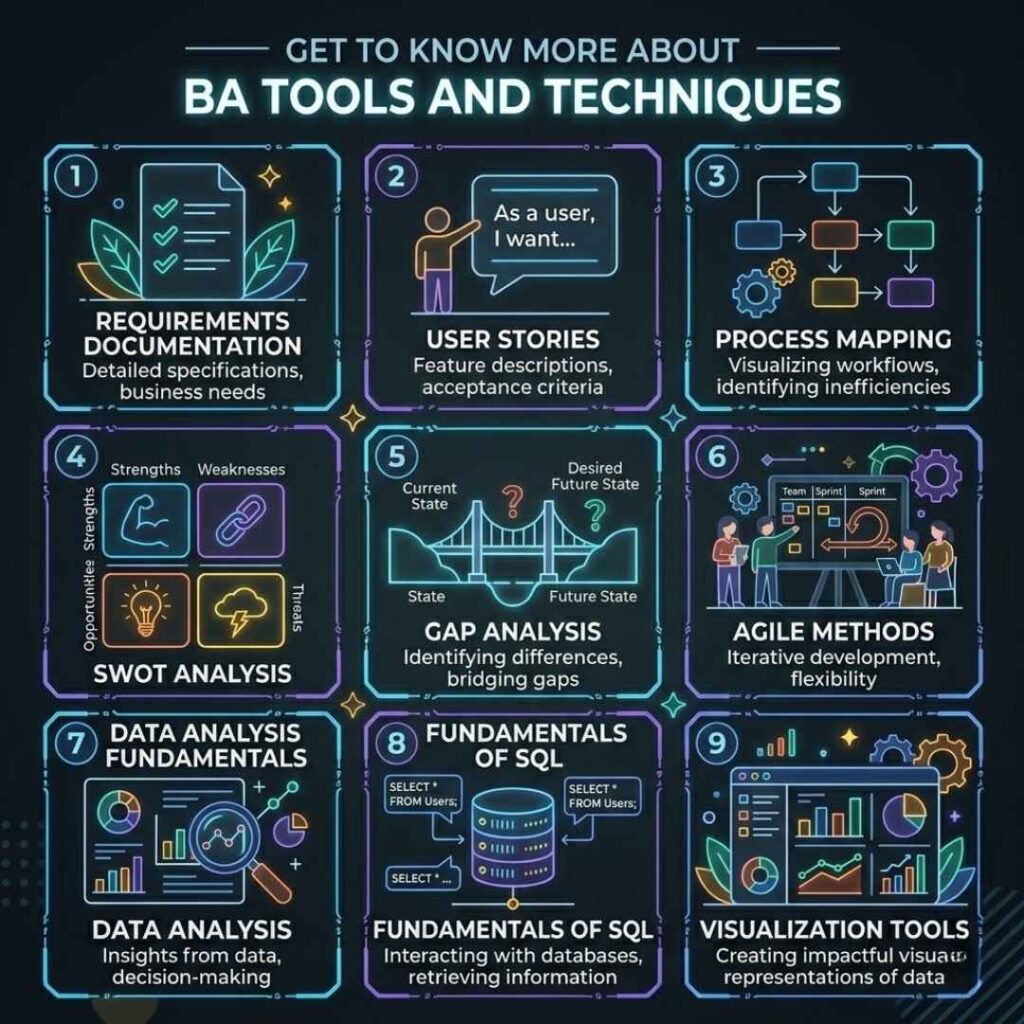
The modern analyst needs to understand business as well as technology.
Some of the common areas discussed are :
- Requirements documentation
- User stories
- Process mapping
- SWOT analysis
- Gap analysis
- Agile Methods
- Data analysis fundamentals
- Fundamentals of SQL
- Visualisation tools
Practical experience counts. Candidates who have practised writing requirements documents, process flows, and real project scenarios often feel much more confident during interviews.
This is where the practical learning programs from the likes of H2K Infosys can prove handy. Their approach is job-oriented training, real-life scenarios, and helping learners understand how business analysts work on real projects.
Learn Agile Because Companies Use It Everywhere
Business Analyst Job Many organisations are now using Agile practices in order to deliver products faster and to respond to customer needs.
In the interview, you may be asked questions about:
- Scrum roles
- Planning sprint
- User stories
- Backlog
- Criteria for acceptance
A simple example:
Such a user story might be:
As a customer, I would like to reset my password to access my account securely.
As a Business Analyst, your job is to help clarify the business needs and ensure the development team understands what the outcome should be.
Build a Strong Project Story
If you are new to the field, you may even need examples.
Business Analyst Job Interviewers generally don’t care if the project was from a company or a training environment. They want to know what you think.
Prepare stories on:
- An issue you addressed
- Where did you get the information?
- Problems that you had
- The solution you propose
- The bottom line
Example of a simple project:
“I studied an online ordering process, pinpointed bottlenecks in the checkout process, recorded the current workflow, and suggested modifications that eliminated needless steps.”
This is an example of a practical answer.
Certification Can Make You Stand Out
A recognised business analyst certification can give your resume a boost, especially if you are entering the field or changing careers.
Business Analyst Job Certification alone won’t get you a job, but it can show:
- Professional dedication
- Knowledge of BA concepts
- Organised learning experience
Best combo: Certification + Practical Projects + Interview Preparation.
Stay Updated on Business Analyst Trends
The business analyst role is changing rapidly.
Today, analysts are increasingly confronted with:
- Artificial intelligence tools
- Automated platforms
- Data-driven decision making
- Customer experience analytics
- Projects for digital transformation
AI is not replacing business analysts it is changing the way analysts work. Now, many teams are leveraging AI tools to speed up documentation, synthesise conversations, and identify patterns in data. There is still a need for human judgment to understand the business objectives and make recommendations.
Final Interview Tips That Are Actually Useful
Prior to your interview:
- Explore the company’s products and issues.
- Make Your Own Examples Instead Of Memorising Answers
- Practice explaining technology ideas in simple terms
- Review of fundamental BA concepts
- Prepare to ask thoughtful questions.
A good interview is a dialogue. The Business Analyst Job interviewer is looking to understand how you think about problems, not just whether you know a definition.
If you are beginning to build your career from scratch, then a mix of structured learning, practical exposure and interview preparation can make the process much smoother. Courses such as H2K Infosys Business Analyst Training are designed around these career-centric skills, helping students move from theory to real-time project-based work.
The trick is simple: Think like a Business Analyst Job before you walk into the interview. Ask why. Understand the business need. Demonstrate that you can create value.
Conclusion
Knowing what to focus on makes it that much easier to prepare for a business analyst interview. It’s not simply about rote learning of tools or definitions. Interviewers want to see your thought process, your problem-solving skills, and your ability to work with different people.
Practice real-life scenarios, improve your communication skills and learn how business analysts help organisations make better decisions. Practice real-life situations. Having examples of projects and a good understanding of Business Analyst Job concepts can help you answer questions more confidently.
If you’re new to this, a Business Analyst Job course + hands-on experience + interview preparation can help you get started on the right foot. H2K Infosys Business Analyst Training program is designed to train students by using practical project situations and industry-oriented education, which will help them to gain job-ready skills.
A good Business Analyst Job at the end of the day is curious, asks good questions and finds better ways to solve problems. Go into your interview with that attitude and you will be able to show your true potential.