
If you’re looking for a cyber security course that actually includes placement assistance, the short answer is this: choose a program that combines hands-on labs, real-world projects, and dedicated job support services (resume prep, mock interviews, recruiter connections) because that’s what employers care about in 2026.
Now, let me explain it the way I’d tell a friend who’s serious about getting hired, not just collecting certificates because in my experience, platforms like H2K Infosys and similar structured training providers focus exactly on this blend of practical learning and career support, which is what really makes a difference when you start applying for jobs.
So, which cyber security course really offers placement assistance?
There isn’t just one “best” course. What matters is how the program is structured around getting you job-ready, not just teaching theory.
From what I’ve seen (and honestly, after tracking hiring trends over the past couple of years), the cyber security courses that actually help with placement usually include:
- Hands-on SOC (Security Operations Center) simulations
- Real-time tools like SIEM, threat detection, and log analysis
- Resume building tailored to cybersecurity roles
- Mock interviews based on real hiring scenarios
- Direct or indirect recruiter/networking support
That’s the difference between a regular course and a true cybersecurity training and placement program.
What makes a cybersecurity course “placement-focused”?
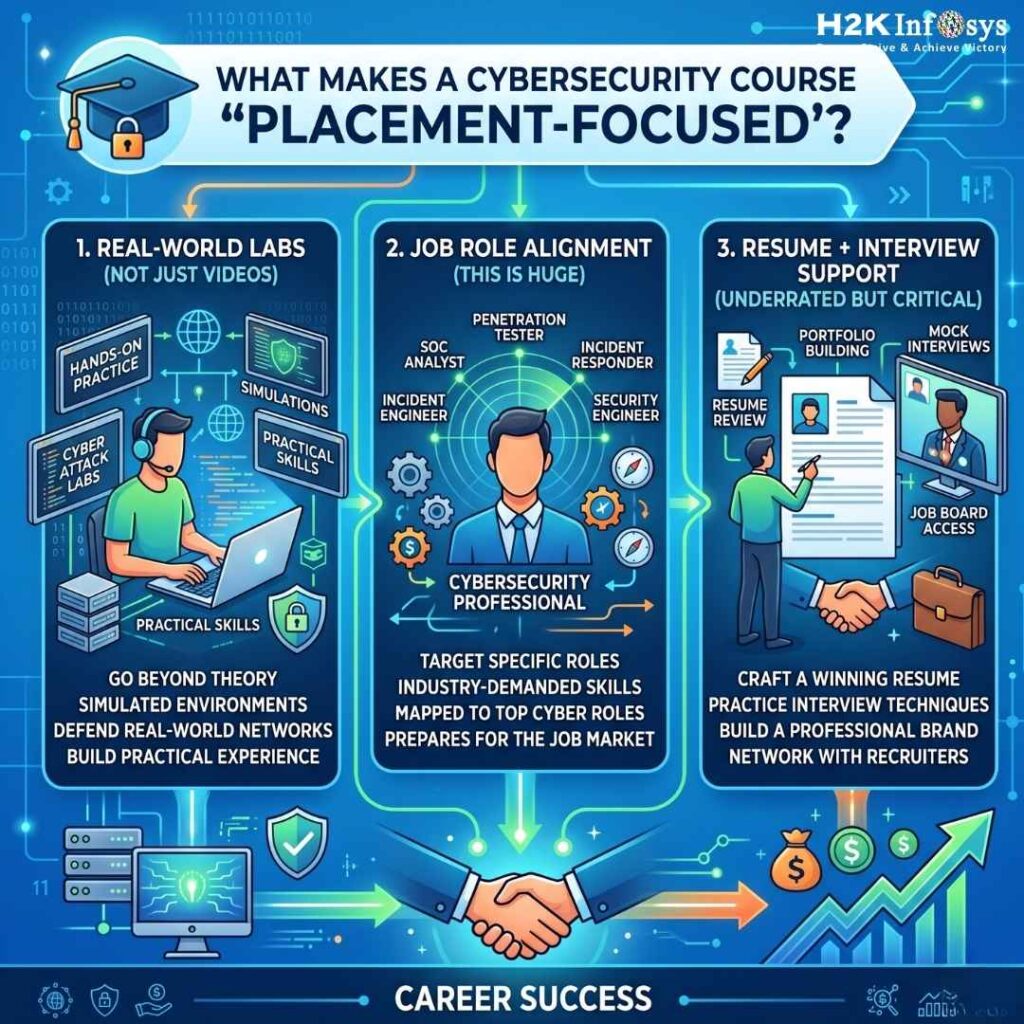
Here’s where most people get it wrong. They assume “placement assistance” means guaranteed jobs. It doesn’t.
Instead, good cyber security course training with job placement programs focus on making you hireable.
Let me break that down.
1. Real-world labs (not just videos)
I still remember trying to learn cyber security course through YouTube alone. It felt like watching someone else drive a car and expecting to pass a driving test.
Good programs simulate:
- Security incidents
- Network attacks
- Log analysis scenarios
You actually practice what a SOC analyst does daily.
2. Job role alignment (this is huge)
cyber security Course that help with placement don’t try to teach everything. They focus on specific roles like:
- SOC Analyst
- Cybersecurity Analyst
- Incident Response Analyst
And that focus matters because hiring managers don’t ask, “Do you know cybersecurity?”
They ask, “Can you do this job from day one?”
3. Resume + interview support (underrated but critical)
This is where many learners struggle.
A strong cyber security training and job placement program will:
- Help you build a cybersecurity-specific resume
- Train you on scenario-based interview questions
- Run mock interviews that feel uncomfortably real (which is a good thing)
I’ve seen candidates improve drastically just from this phase alone.
A practical example (what actually works)
Let’s say you enroll in a structured program like H2K Infosys (just one example among many in the U.S. training space).
Midway through the cyber security course, you’re not just learning concepts you’re:
- Working on SIEM tools
- Investigating simulated security alerts
- Documenting incidents like a real analyst
By the time you finish, your resume doesn’t say “completed course.”
It says:
“Analyzed real-time security logs and responded to simulated threats using industry tools.”
That small shift? It’s what gets interviews.
What’s trending in 2026 and why placement support feels more important than ever
Here’s something I’ve been noticing lately… and it’s kind of a shift from how things used to work.
Companies aren’t relying only on certifications anymore. Sure, names like CompTIA Security+ or CEH still carry weight; they haven’t become irrelevant overnight but they’re no longer the main deciding factor.
What’s taking center stage instead? Actual, hands-on ability.
With AI-powered attacks getting smarter, cloud environments getting messier, and threats happening in real time (sometimes faster than teams can react), employers are starting to ask a different kind of question. Not “What have you studied?” but more like, “Can you handle this situation if it shows up on your screen right now?”
They’re looking for people who can think through a messy incident without freezing, who’ve actually used security tools before not just reading about them and who can stay calm when things get a bit chaotic. Because, honestly, that’s what the job feels like some days.
That’s also why cyber security course training and placement programs are getting a lot more attention lately. They’re not perfect, but they do something important: they connect the dots between learning concepts and doing the job for real. And that gap? It’s bigger than most beginners expect.
How to choose the right course (without overthinking it)
If you’re comparing options, don’t just look at course names. Ask these instead:
- Does it include hands-on labs or just theory?
- Are there real tools involved (like SIEM platforms)?
- Is there structured interview preparation?
- Do they guide you until you land a job or stop after training?
If the answer to most of these is yes, you’re on the right track.
A quick reality check
No course can guarantee a job and honestly, if someone promises that, I’d be cautious.
But the right cyber security training with job placement program can:
- Cut your learning curve in half
- Give you real experience before your first job
- Help you confidently face interviews
And that’s often enough to get your foot in the door.
Final thought
If you’re serious about entering cyber security course, don’t just pick a course, pick a path that includes learning + practice + placement support.
That combination is what turns beginners into professionals.
If you want, I can break down specific programs based on your location or budget and help you shortlist the best ones.