Salesforce Einstein AI brings artificial intelligence right into the Salesforce ecosystem to change how businesses manage customer relationships. Salesforce Einstein AI provides smarter sales forecasting, powered by big data techniques, personalized customer support to help automate decisions so your company can have higher productivity and improved overall customer experience, all without needing a full data science team.
Right in the middle of this AI-driven shift, companies like H2K Infosys are helping professionals build practical AI and CRM skills through industry-focused Salesforce certification programs and hands-on certification training.
If you’ve been around the CRM space lately, you’ve probably noticed one thing: AI is no longer a “future trend.” It’s already baked into the tools companies use every day. And honestly, Salesforce didn’t waste time jumping into the AI race. While many platforms are still figuring out practical AI adoption, Salesforce Einstein AI has quietly become one of the most useful enterprise AI solutions available today.
What makes it interesting isn’t just the technology. It’s the fact that regular business users not just developers can actually use it.
That’s a big deal.
What Is Salesforce Einstein AI?
Salesforce introduced Salesforce Einstein AI as an integrated artificial intelligence layer built directly into the Salesforce platform. Salesforce went from an AI software seller to embedding predictive analytics, automation, machine learning and generative AI into your day-to-day workflows (instead of making you buy separate AI software).
Consider the approach as if an AI were working inside your CRM to deliver intelligence.
- Sales teams get lead scoring.
- Support agents get AI-generated replies.
- Marketers receive customer behavior predictions.
- Managers get forecasting insights.
And all of it happens inside the tools teams are already using daily.
What’s interesting is how quickly Salesforce Einstein AI evolved after the explosion of generative AI in 2023 and 2024. Salesforce expanded Einstein with GPT integrations, conversational AI, and AI-powered automation that now compete directly with enterprise tools from companies like Microsoft and Google.
A lot of businesses originally viewed AI as something experimental. Now? It’s tied directly to revenue and customer retention.
Why Salesforce Einstein AI Matters in 2026
Businesses today are overwhelmed with customer data.
- Emails.
- Support tickets.
- Sales calls.
- Purchase histories.
- Social engagement.
Most companies collect huge amounts of information but struggle to actually use it effectively. Salesforce Einstein AI solves part of that problem by converting raw CRM data into actionable insights.
And honestly, this is where companies either gain a competitive edge or fall behind.
A sales rep manually reviewing 5,000 leads? Not realistic.
An AI engine prioritizing high-conversion leads instantly? Very realistic.
That’s why demand for professionals skilled in Salesforce AI tools has exploded. Companies are looking for employees who not only know how to use a CRM system but also the AI workflows needed for applications. Salesforce training certification searches, Salesforce certification courses, and Salesforce admin certification classes have risen consistently.
Core Functions of Salesforce Einstein AI
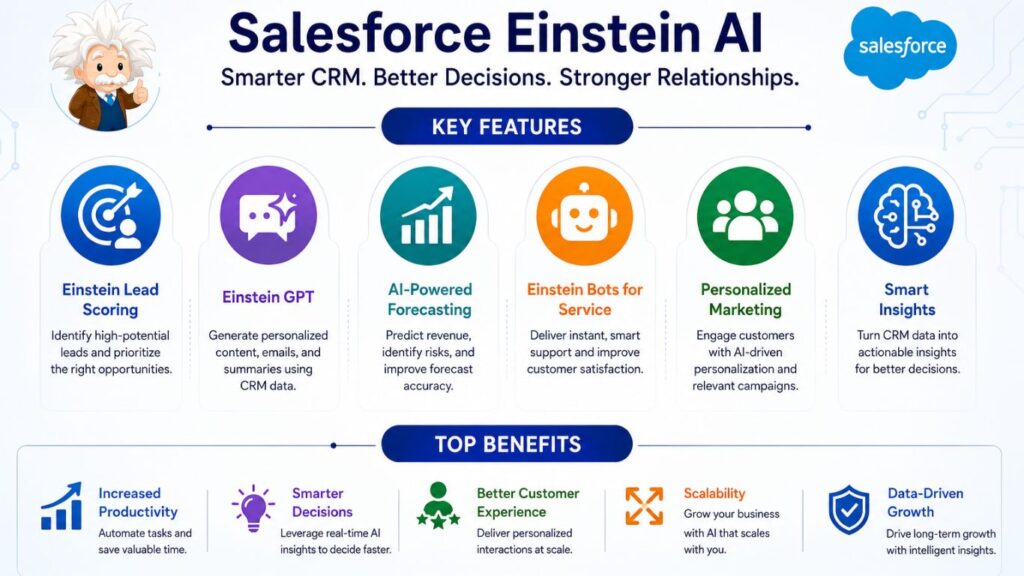
1. Einstein Lead Scoring
Predictive lead scoring is one of the most popular Salesforce Einstein AI capabilities.
By studying the past customer data, the system recognizes which leads are more prone to convert. Sales teams do not need to guess, but receive fully ranked opportunities based on AI predictions.
Let’s say you are a sales manager who has to go through hundreds of leads coming in every day. Without AI, prioritization becomes subjective. Salesforce Einstein AI flags high-value prospects automatically in the CRM.
That alone saves hours every week.
A SaaS startup I worked with recently implemented AI-based lead scoring and saw their sales response efficiency improve dramatically within two months. Reps stopped wasting time chasing low-quality prospects.
Simple change. Massive impact.
2. Einstein GPT
This became a major talking point after generative AI exploded globally.
Salesforce Einstein AI now includes Einstein GPT, which combines customer data with generative AI to create personalized content, emails, summaries, and responses.
Here’s what it can generate:
- Sales emails
- Customer support replies
- Meeting summaries
- Marketing campaigns
- Product recommendations
- CRM notes
And unlike generic AI chat tools, Einstein GPT uses CRM-specific customer data.
That contextual intelligence matters.
For example, a support agent handling a frustrated customer can instantly receive an AI-generated response tailored to the customer’s purchase history and previous support interactions.
That’s far more useful than generic chatbot responses.
3. AI-Powered Forecasting
Forecasting revenue has always been messy.
Sales executives commonly use spreadsheets, educated guesses and intuition. Salesforce Einstein AI uses past behaviors, trends in the pipeline and actual sales performance to improve forecasting.
The AI identifies risks early.
Managers learn ahead of the quarter-end panic if some deals are not likely to close.
This was crucial for companies during the periods of economic uncertainty when accurate forecasting is necessary to make hiring and budgeting decisions.
4. Einstein Bots for Customer Service
During the pandemic years, customer expectations changed dramatically.
People expect instant responses now.
Salesforce Einstein AI has smart chatbots that respond to requests for common support inquiries without human intervention.
These bots can:
- Answer FAQs
- Route tickets
- Schedule appointments
- Escalate urgent issues
- Track order statuses
And to be honest, customers are more likely to prefer the fast bot assistance rather than waiting 40 minutes for human help.
The smarter part is that Einstein Bots learn with each interaction and get better with time.
5. Personalized Marketing Automation
We hear this from marketing teams who love data, but often win a mini-pool tournament.
Salesforce Einstein AI has a massive role in helping marketers predict customer behavior by automatically personalizing campaigns.
Unlike millions of users where you might send emails that are all the same, AI divides audiences into segments according to:
- Purchase behavior
- Browsing patterns
- Engagement history
- Demographics
- Product interests
This creates more relevant communication.
One retail chain saw email click-through rates rocket after using AI-led personalization inside of Salesforce Marketing Cloud.
And frankly, customers can tell when recommendations are aligned with that.
Business Applications of Salesforce Einstein AI
Healthcare Industry
Many healthcare organizations now use Salesforce Einstein AI to boost patient engagement and automate scheduling workflows.
Hospitals can predict whether a patient might miss an appointment, who to reach out to prioritize for their appointments and use seamless communication with support.
Given the pressure healthcare systems face globally, efficiency driven by AI is no longer a good-to-have.
Financial Services
Salesforce Einstein AI powers fraud detection, customer segmentation and personalized financial recommendations for banks and other financial institutions.
Data supply chain, analytical functions that aggregate data to serve multiple clients. A financial advisor can infer clients’ needs for investment consultations faster based on life-stage indicators and transactional patterns.
That level of personalization improves customer retention significantly.
E-Commerce Businesses
Online retailers heavily rely on Salesforce Einstein AI for recommendation engines and customer targeting.
You’ve probably experienced this yourself.
You browse one product online and suddenly receive eerily accurate recommendations later.
That’s AI-powered predictive analysis at work behind the scenes.
Salesforce Einstein AI is the most popular AI among E-commerce brands for its usefulness in:
- Predict customer churn
- Recommend products
- Automate promotions
- Improve customer service
- Analyze shopping behavior
Manufacturing Sector
Manufacturing companies leverage Salesforce Einstein AI and predictive maintenance in supply chain forecasting.
AI drives predictive analytics for equipment failures before breakdowns occur.
That prevents expensive downtime.
It’s not the flashy side of AI people usually talk about, but operational efficiency is where companies often save millions.
Benefits of Salesforce Einstein AI
Increased Productivity
Probably the biggest immediate benefit.
Salesforce Einstein AI automates repetitive tasks like:
- Data entry
- Email drafting
- Lead prioritization
- Reporting
- Customer categorization
Employees spend more time on strategic work instead of admin tasks.
The valuable part is only reducing burnout.
Better Decision-Making
AI informs companies of important, actual, calm data rather than conjecture.
Managers get predictive insights on:
- Revenue trends
- Customer behavior
- Sales performance
- Service bottlenecks
By organizing data accurately, the ‘calm’ is really Smart Data.
Predictive insights lead to good decision-making.
Mo’s allows quick & easy segmentation of targets to create data-driven, predictive, and analytical advertising campaigns.
Improved Customer Experience
Modern customers expect personalization.
Salesforce Einstein AI helps companies respond faster and deliver more relevant communication.
And customers absolutely notice the difference between:
“Hello valued customer.”
vs.
“Hi Sarah, we noticed your subscription renewal is approaching.”
Small detail. Huge emotional impact.
Scalability
As businesses grow, managing customer relationships manually becomes impossible.
Salesforce Einstein AI scales operations without requiring massive hiring increases.
That’s one reason startups and enterprise companies alike continue adopting AI-powered CRM systems.
The Growing Demand for Salesforce AI Professionals
This is probably the part many professionals care about most.
The rise of Salesforce Einstein AI created massive demand for skilled Salesforce professionals who understand:
- CRM administration
- AI workflows
- Automation
- Analytics
- Cloud integrations
Companies now actively search for candidates with:
- Salesforce training certification
- Salesforce certification courses
- Salesforce admin certification classes
- AI CRM implementation experience
And honestly, certifications matter more now because businesses need proof that candidates can handle real-world Salesforce environments.
That’s where structured learning becomes important.
Why Learners Choose H2K Infosys for Salesforce Training
H2K Infosys has gained attention because its programs focus heavily on practical implementation instead of purely theoretical learning.
A lot of online courses teach concepts but skip real business workflows.
That’s frustrating.
Learners today want:
- Live projects
- Real CRM scenarios
- AI workflow examples
- Resume support
- Placement assistance
This explains why many professionals specifically search for Salesforce training and placement programs rather than standalone tutorials.
The platform offers:
- Flexible Salesforce course online options
- Instructor-led sessions
- Career guidance
- Hands-on labs
- Interview preparation
- Certification-focused learning paths
And honestly, hands-on exposure matters far more than memorizing exam questions.
Salesforce Einstein AI and the Future of CRM
AI inside CRM systems is still evolving rapidly.
Salesforce Einstein AI is expected to expand further into:
- Autonomous AI agents
- Hyper-personalized customer engagement
- Predictive business operations
- AI-driven workflow orchestration
- Voice-enabled CRM interactions
One trend becoming especially important in 2026 is trustworthy AI.
Businesses now care deeply about:
- Data privacy
- AI transparency
- Ethical automation
- Governance compliance
Salesforce has publicly emphasized responsible AI frameworks because enterprise clients increasingly demand accountability.
That’s not just a legal issue anymore it’s a brand trust issue.
Common Challenges Businesses Face with Salesforce Einstein AI
Of course, AI adoption isn’t magically perfect.
Some businesses struggle because:
- CRM data quality is poor
- Teams resist AI adoption
- Workflows are outdated
- Employees lack AI training
Honestly, bad data ruins AI effectiveness quickly.
If customer records are incomplete or inconsistent, predictions become unreliable.
That’s why skilled Salesforce administrators remain incredibly valuable. AI still needs humans who understand how to structure systems correctly.
And yes, this is another reason professionals pursue Salesforce admin certification classes and advanced Salesforce certification courses.
Tips for Learning Salesforce Einstein AI Successfully
If you’re planning to enter the Salesforce ecosystem, here’s what actually helps:
Focus on Practical Projects
Don’t just memorize definitions.
- Build workflows.
- Create dashboards.
- Practice automation.
- Explore AI features directly.
Experience sticks better than theory.
Understand Business Processes
Salesforce isn’t just software.
It’s business process management.
The best Salesforce professionals understand:
- Sales pipelines
- Customer support workflows
- Marketing operations
- Reporting structures
That broader understanding makes AI implementation far more effective.
Prepare for Certifications Strategically
Popular paths include:
- Salesforce Administrator
- Salesforce AI Associate
- Salesforce Business Analyst
- Platform App Builder
Strong Salesforce training certification programs often combine exam prep with live project work.
That balance matters.
Stay Updated with AI Trends
AI changes fast.
What worked two years ago may already feel outdated.
Following Salesforce product releases, Dreamforce announcements, and CRM AI trends helps professionals remain competitive.
Is Salesforce Einstein AI Worth Learning?
Honestly? Absolutely.
AI-powered CRM systems are becoming standard across industries.
Companies no longer ask:
“Should we use AI?”
They ask:
“How fast can we implement it?”
Salesforce Einstein AI sits directly at the center of that transformation.
Professionals with CRM + AI skills are increasingly valuable because businesses need people who can bridge technology and customer strategy.
And unlike many tech trends that disappear quickly, CRM automation has long-term business value.
So, against all expectations, Salesforce skills are relatively stable career investments.
Final Thoughts
Salesforce Einstein AI Salesforce Einstein is the artificial intelligence (AI) product by Salesforce.com, which focuses specifically on how businesses manage employees and customer relationships as well as automate operations to inform business decisions with data. That makes it one of the most useful enterprise AI solutions in use today, powered by predictive analytics, generative AI, workflow automation and intelligence personalization.
With organizations transitioning to AI-powered CRM platforms, the demand for database computing professionals with a Salesforce knowledge base in their arsenal is at an all-time high. When one searches for Salesforce courses online or is looking forward to taking up Salesforce training certifications, joining institutes that provide either post-salesforce admin certifications courses or Salesforce training and placement roles, and getting some hands-on experience with regard to the Salesforce AI would create a great career opening.