The future of Salesforce AI careers looks exceptionally strong. Companies across healthcare, finance, retail, logistics, and tech are rapidly adopting AI-powered Salesforce solutions, and they need professionals who can manage, customize, automate, and optimize these systems. For anyone considering a Salesforce course today, the timing honestly couldn’t be better.
And this shift isn’t theoretical anymore. It’s already happening.
Over the last year, Salesforce AI has doubled down on AI with tools like Einstein Copilot, Agentforce, predictive automation, and AI-driven CRM workflows. Businesses are no longer asking, “Should we use AI in Salesforce?” They’re asking, “How fast can we implement it?”
That one change alone is creating a huge demand for people with practical Salesforce skills.
If you’ve been researching Salesforce training classes, wondering whether Salesforce careers still have long-term value in an AI-heavy world, the short answer is yes probably more than ever. But the role itself is evolving, and that’s the important part people sometimes miss.
Let’s unpack what’s actually changing, what employers want in 2026, and how professionals are building stable, high-paying careers through proper Salesforce certification courses and hands-on learning.
AI Isn’t Replacing Salesforce Jobs It’s Expanding Them
There’s this weird fear floating around in tech circles that AI will wipe out admin and CRM jobs entirely. In reality, what’s happening inside Salesforce ecosystems is almost the opposite.
AI handles repetitive work. Businesses still need humans to:
- Configure workflows
- Train AI systems properly
- Maintain CRM data quality
- Build automation strategies
- Interpret AI insights
- Customize dashboards
- Manage integrations
- Ensure compliance and security
- Improve customer experience
A company can buy Salesforce AI tools overnight. That doesn’t mean they suddenly know how to use them effectively.
I recently spoke with someone working in a mid-sized healthcare company in Texas. Their organization rolled out Einstein AI features last year expecting “instant efficiency.” Within two months, leadership realized they lacked people who actually understood Salesforce architecture and automation logic. They ended up hiring two Salesforce administrators and one AI-focused consultant afterward.
That’s becoming common.
The companies investing in AI are also investing in skilled Salesforce professionals.
Why Salesforce AI Careers Are Growing So Quickly
A few major trends are pushing this demand upward.
1. Salesforce Is Going All-In on AI
Salesforce isn’t treating AI as an optional add-on anymore. It’s becoming embedded into nearly every product:
- Sales Cloud
- Service Cloud
- Marketing Cloud
- Commerce Cloud
- Slack integrations
- Agentforce
- Einstein AI
Organizations using Salesforce are naturally being pushed toward AI adoption, whether they planned for it or not.
That means businesses need professionals trained not only in core Salesforce administration but also in AI-powered workflow optimization.
This is exactly why updated Salesforce administrator classes matter today. Older learning approaches focused mostly on dashboards and records management. Modern Salesforce careers require understanding automation, AI recommendations, predictive analytics, and conversational AI tools.
2. CRM Data Became More Valuable Than Ever
AI systems are only as good as the data behind them.
And Salesforce AI happens to sit at the center of customer data for thousands of enterprises.
Think about what lives inside a Salesforce environment:
- Customer interactions
- Purchase behavior
- Service history
- Marketing engagement
- Lead scoring
- Sales forecasting
- Support tickets
AI tools use all of this to generate predictions and automation. But messy CRM systems create terrible AI output.
That’s why skilled Salesforce admins and developers remain critical.
A lot of hiring managers now specifically look for professionals who understand both CRM management and AI workflow readiness.
3. Businesses Want Automation Without Losing Human Oversight
This is a big one.
Companies absolutely want automation. They also don’t want automation mistakes ruining customer relationships.
Imagine an AI-generated customer support workflow accidentally escalating the wrong accounts or triggering incorrect follow-up campaigns. That kind of issue costs money fast.
So organizations increasingly rely on trained Salesforce professionals to monitor, optimize, and govern AI systems.
That oversight layer creates long-term career stability.
The Most In-Demand Salesforce AI Career Paths in 2026
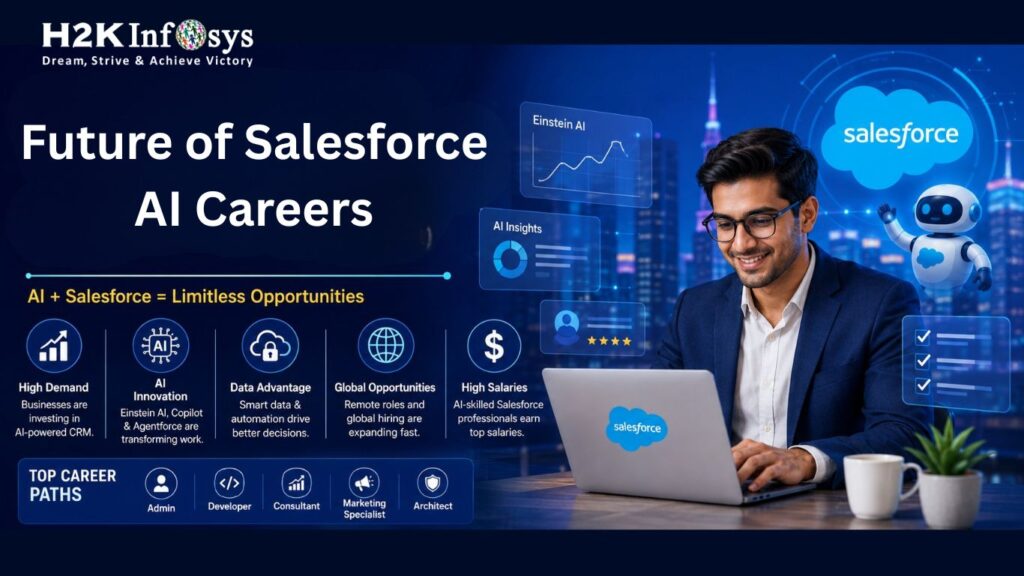
This is where things get interesting because Salesforce AI careers are branching into several specialized directions.
Salesforce Administrator
Still one of the best entry points.
Modern admins now work with:
- AI workflow configuration
- Automation tools
- User management
- Data governance
- Einstein features
- Reporting and analytics
The role has evolved beyond basic CRM maintenance.
Working professionals who participate in Salesforce hands-on training that includes real projects are mostly able to complete their career transition and secure employment much faster and more smoothly, as employers value practical hands-on experience.
Salesforce AI Consultant
Professional technical personnel assist various types of organizations in implementing and deploying AI-driven Salesforce solutions.
Responsibilities often include:
- The six core businesses
- modules spanning the full
- process chain that
- support enterprise AI
- implementation are clearly
- listed in sequential order.
Consultants who hold Salesforce certifications and possess business communication skills currently have highly competitive salaries.
Salesforce Developer
Developers still possess high commercial value, and enterprises have a rigid demand for customized AI integration.
- Typical work includes:
- The core
- technologies of
- the Salesforce
- The platform includes five categories
- of development capabilities, such as Apex.
Interestingly, while AI coding assistants can boost work efficiency, enterprises still require senior technical talent with expertise in system architecture.
Salesforce Business Analyst
This role is growing quietly but rapidly.
Businesses need analysts who can bridge:
- AI recommendations
- CRM reporting
- Customer insights
- Workflow improvements
- Executive decision-making
A good analyst helps leadership actually understand what Salesforce AI systems are telling them.
That’s harder than it sounds.
Marketing Cloud AI Specialist
Marketing automation has exploded lately.
AI now helps businesses:
- Predict customer behavior
- Personalize campaigns
- Improve email targeting
- Optimize ad spend
- Automate engagement journeys
Companies using Salesforce AI Marketing Cloud increasingly look for specialists who understand AI-driven personalization strategies.
Salaries Are Moving Upward
One thing I’ve noticed in recent hiring discussions is that Salesforce AI-related roles are commanding noticeably higher salaries than traditional CRM-only positions.
Part of that comes from scarcity.
There still aren’t enough professionals who understand:
- Salesforce ecosystems
- AI implementation
- Automation logic
- CRM strategy
- Data quality management
Approximate U.S. salary ranges in 2026:
| Role | Average Salary |
| Salesforce Administrator | $85,000 – $120,000 |
| Salesforce Developer | $110,000 – $155,000 |
| Salesforce AI Consultant | $130,000 – $180,000 |
| Marketing Cloud Specialist | $95,000 – $145,000 |
| Salesforce Architect | $160,000+ |
Of course, certifications, project experience, and specialization matter a lot.
Someone with solid Salesforce certification courses plus real implementation projects usually stands out quickly during hiring.
Why Companies Prefer Certified Salesforce Professionals
This hasn’t changed much over the years. Salesforce certifications still carry serious weight.
But now there’s more pressure on candidates to prove practical capability too.
Hiring managers increasingly ask:
- Have you worked on real workflows?
- Can you handle automation projects?
- Do you understand AI integrations?
- Can you troubleshoot business processes?
- Have you deployed Salesforce AI in real environments?
That’s why structured Salesforce training and placement programs have become more important than just self-paced video watching.
A certificate alone isn’t enough anymore.
Employers want practical confidence.
What Makes H2K Infosys Different in Salesforce Training
This is honestly where many learners either accelerate their careers or get stuck.
There are hundreds of random online tutorial teaching disconnected Salesforce concepts. The problem is that they often don’t prepare people for actual job environments.
What makes H2K Infosys stand out is the focus on:
- Real-time project training
- Practical implementation experience
- Industry-oriented curriculum
- Placement-focused preparation
- Interview guidance
- Live instructor-led sessions
A lot of students struggle because they only learn theory.
Then they enter interviews and freeze when asked practical questions like:
- “How would you optimize this workflow?”
- “How would you configure AI recommendations?”
- “How do you manage Salesforce automation conflicts?”
- “How would you troubleshoot reporting inaccuracies?”
That gap between theory and execution matters enormously in today’s market.
H2K Infosys focuses heavily on bridging that gap through hands-on Salesforce training classes and real-world exercises.
AI Skills That Give Salesforce Professionals an Advantage
You don’t need to become a machine learning engineer to succeed in Salesforce AI careers.
That’s an important clarification.
The strongest Salesforce AI professionals today usually focus on practical AI-adjacent skills like:
Prompt Engineering for CRM Workflows
Understanding how AI assistants generate responses and recommendations.
Automation Design
Using Flow Builder, Process Builder alternatives, and AI-triggered automations.
Data Management
AI systems depend heavily on clean CRM data.
Analytics Interpretation
Turning AI-generated insights into business actions.
AI Governance
Understanding ethical AI usage, privacy concerns, and compliance.
Customer Journey Personalization
Especially valuable in Marketing Cloud environments.
These are learnable skills especially inside structured Salesforce certification courses that include modern AI modules.
Remote Work Is Expanding Salesforce Opportunities
This part doesn’t get talked about enough.
Salesforce AI careers became increasingly remote-friendly after 2020, and AI adoption accelerated that trend even more.
Companies now hire Salesforce talent globally because:
- CRM systems are cloud-based
- AI workflows can be managed remotely
- Admin and developer tasks don’t require physical offices
- Collaboration tools have improved dramatically
For learners in India, this creates huge international opportunities.
I’ve personally seen professionals start with entry-level admin training and eventually land remote contracts with U.S.-based companies after gaining certification and project experience.
That pathway is very real now.
The Biggest Mistake New Salesforce Learners Make
A lot of beginners focus entirely on passing exams.
That approach worked better years ago than it does today.
Now employers care more about whether you can:
- Solve business problems
- Configure workflows
- Handle live CRM scenarios
- Understand automation strategy
- Communicate with stakeholders
This is why practical Salesforce training and placement programs matter so much.
When learners practice with real business cases, they develop confidence that certifications alone don’t provide.
And honestly? Interviewers can tell the difference almost immediately.
Real-World Example: AI + Salesforce in Retail
A retail company recently implemented Salesforce AI to improve abandoned cart recovery campaigns.
Sounds simple at first.
But behind the scenes, the project required:
- CRM data cleanup
- Workflow automation
- Customer segmentation
- AI prediction tuning
- Marketing Cloud configuration
- Dashboard reporting
The company initially assumed the AI would “just work.”
It didn’t.
They needed Salesforce professionals to configure, test, optimize, and monitor everything properly.
That’s the hidden reality behind most AI implementations right now.
AI increases the need for skilled Salesforce AI talent because businesses still require humans to make systems functional and reliable.
Which Salesforce Certifications Matter Most in 2026?
A few certifications consistently stand out in hiring markets:
Salesforce Certified Administrator
Still the foundational credential.
Salesforce Advanced Administrator
Valuable for larger enterprise environments.
Platform App Builder
Useful for customization-focused roles.
Salesforce AI Associate
Growing rapidly in relevance.
Marketing Cloud Certifications
Especially useful for AI-driven personalization careers.
Salesforce Consultant Certifications
Excellent for client-facing implementation roles.
The best Salesforce course options usually combine certification prep with hands-on labs and real deployment scenarios.
That combination matters far more than memorizing exam questions.
Is Salesforce Still a Good Career Despite AI?
Yes and arguably a stronger one now.
But the career path is changing.
The future belongs to professionals who combine:
- CRM expertise
- Business understanding
- Automation knowledge
- AI workflow skills
- Communication ability
People who adapt to AI-enhanced Salesforce environments will likely see excellent long-term demand.
The professionals most at risk are the ones refusing to evolve beyond older manual CRM workflows.
How Beginners Can Start a Salesforce AI Career
If someone asked me today where to begin, I’d probably suggest this roadmap:
- Learn Salesforce fundamentals
- Practice CRM workflows
- Study automation tools
- Understand AI integrations
- Complete hands-on projects
- Earn certifications
- Practice interview scenarios
- Build real-world confidence
That progression works far better than trying to rush through certifications alone.
Programs from H2K Infosys are particularly useful because they combine:
- Live learning
- Real-time projects
- Certification prep
- Placement assistance
- Industry-relevant training
And honestly, that practical exposure is what many employers are looking for now.
Final Thoughts
Salesforce AI careers are entering a major growth phase, not a decline.
Businesses are investing heavily in AI-powered CRM systems, but technology alone isn’t enough. Organizations still need skilled professionals who understand how to configure, optimize, govern, and improve these systems in real business environments.
That’s why demand for trained Salesforce professionals continues to rise across industries.
For learners considering Salesforce training classes, this is one of the strongest moments to enter the field especially if the training includes hands-on projects, certification guidance, and practical implementation experience.
A strong Salesforce course today is no longer just about learning CRM basics. It’s about preparing for the future of intelligent business systems.
And with the right Salesforce administrator classes, practical exposure, and career-focused learning from providers like H2K Infosys, professionals can position themselves for long-term success in one of the fastest-growing areas of enterprise technology.