If you’re wondering what actually gets taught in a modern Salesforce AI course syllabus, the short answer is this: you learn how Salesforce AI tools work inside real business environments, how to automate customer interactions, analyze CRM data intelligently, build AI-powered workflows, and prepare for Salesforce certification exams that employers are actively hiring for in 2026. The best programs also combine hands-on Salesforce admin skills with practical AI implementation training not just theory slides and buzzwords.
And honestly, that combination matters a lot right now.
Companies aren’t just searching for people who know AI. They want professionals who understand how AI fits into Salesforce ecosystems that sales teams, support teams, healthcare providers, banks, and retail companies already use every single day. That’s exactly why demand for strong Salesforce administrator classes and job-focused Salesforce certification training has grown so quickly over the last couple of years.
One thing I’ve noticed while speaking with professionals transitioning into Salesforce careers is that many people still think Salesforce AI training is only for developers. It’s not. A huge percentage of learners entering Salesforce admin training today come from non-coding backgrounds business analysts, support professionals, recruiters, QA testers, operations coordinators, even teachers moving into tech.
And with Salesforce pushing Einstein AI deeper into the platform, understanding AI-driven CRM workflows has become almost impossible to ignore.
Why Salesforce AI Skills Matter More Than Ever in 2026
A few years ago, Salesforce AI mostly meant predictive lead scoring and automated recommendations. Useful, yes but fairly limited.
Now? The ecosystem looks completely different.
Salesforce AI has aggressively expanded AI capabilities through Einstein Copilot, generative AI integrations, predictive analytics, AI-assisted workflow automation, and natural language CRM interactions. Businesses are deploying AI not only for sales forecasting but also for customer service resolution, healthcare engagement, fraud detection, marketing personalization, and operational automation.
That shift changed hiring expectations.
Recruiters increasingly expect Salesforce professionals to understand:
- AI-powered CRM automation
- Prompt-driven workflows
- Customer data intelligence
- AI governance and ethics
- Predictive analytics
- Einstein AI configuration
- Workflow optimization
- Automation security practices
The interesting thing is that many organizations still struggle to find professionals who can bridge Salesforce administration with AI functionality. That gap is creating strong opportunities for learners entering structured Salesforce training programs now.
What Does a Salesforce AI Course Usually Include?
A modern Salesforce course focused on AI generally combines three core learning areas:
- Salesforce Administration Fundamentals
- Salesforce AI & Einstein Features
- Certification Preparation + Real Projects
The stronger training programs, especially career-focused ones like those offered through H2K Infosys, typically structure the syllabus around real-world implementation rather than isolated concepts.
That difference sounds small until you actually start working on projects.
A lot of low-quality online programs teach features separately:
“Here’s Einstein.”
“Here’s Flow Builder.”
“Here’s Service Cloud.”
But real companies don’t work that way. Everything connects together.
Good Salesforce admin training teaches how AI tools interact across the broader Salesforce ecosystem.
Core Topics Covered in Salesforce Administrator Classes
Before diving deep into AI, students first build a strong Salesforce AI foundation. This part is critical because AI tools become far more useful when you understand the CRM structure underneath them.
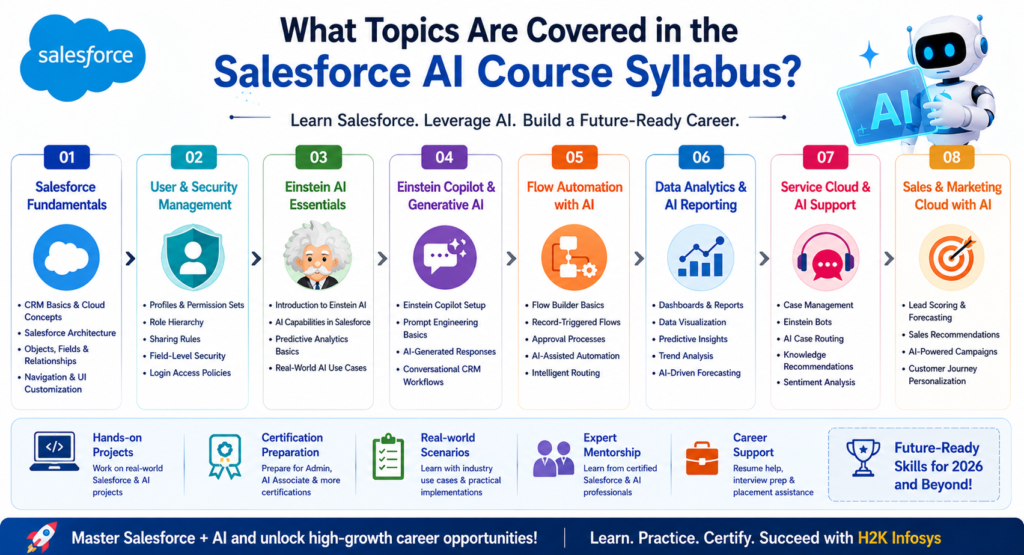
Salesforce Platform Basics
Students typically begin with:
- Salesforce architecture
- CRM fundamentals
- Cloud concepts
- Salesforce navigation
- User interface customization
- Object relationships
- Standard vs custom objects
- Record management
- Security models
At first, some learners underestimate this section because it feels basic. Then they hit automation projects later and realize why data architecture matters so much.
Without understanding relationships between objects, AI-generated workflows quickly become messy.
User and Security Management
This section focuses on:
- Profiles and permission sets
- Role hierarchy
- Organization-wide defaults
- Sharing rules
- Field-level security
- Login access policies
And yes, this becomes even more important with AI systems involved.
Companies are becoming increasingly cautious about AI governance, especially in healthcare, banking, insurance, and government sectors. Salesforce administrators are now expected to understand secure AI data handling not just simple user setup.
AI and Einstein Topics Covered in the Syllabus
This is usually the section most learners are curious about.
And honestly, it’s where modern Salesforce certification training has evolved the most since 2024.
Introduction to Salesforce Einstein AI
Students learn:
- What Einstein AI is
- How Salesforce integrates generative AI
- AI-powered CRM capabilities
- Predictive analytics basics
- AI use cases across industries
Good instructors don’t just explain features they explain business outcomes.
For example:
A healthcare company may use Einstein AI to predict patient appointment no-shows.
A retail business might use AI-driven recommendations to improve upselling.
A customer service center may deploy Einstein Bots to reduce ticket resolution time.
Those practical examples help learners understand why organizations are investing heavily in Salesforce AI initiatives.
Einstein Copilot and Generative AI
This is one of the biggest additions in modern Salesforce training programs.
Topics often include:
- Einstein Copilot setup
- AI-generated responses
- Prompt engineering basics
- Conversational CRM workflows
- AI-generated summaries
- Email generation assistance
- AI-powered customer interaction management
Something interesting is happening lately many companies are no longer asking whether they should adopt generative AI inside Salesforce. They’re asking how quickly they can operationalize it safely.
That’s a huge distinction.
And it’s one reason employers increasingly prefer candidates who already have hands-on exposure to Salesforce AI workflows.
Salesforce Flow Automation with AI
This section is usually where students begin building practical automation projects.
Common topics include:
- Flow Builder fundamentals
- Record-triggered flows
- Scheduled automation
- Approval processes
- AI-assisted workflow automation
- Dynamic recommendations
- Intelligent routing systems
One learner I spoke with recently mentioned that Flow Builder felt intimidating initially but after working through a few real business scenarios, it became one of the most valuable skills in their daily job.
That tracks with what employers are asking for too.
Automation expertise is no longer optional for Salesforce admins.
Data Analytics and AI Reporting
Modern Salesforce AI ecosystems generate enormous amounts of customer data.
AI tools become powerful only when organizations know how to analyze that data effectively.
Most Salesforce administrator classes now include:
- Dashboard creation
- Advanced reporting
- Data visualization
- Predictive insights
- Trend analysis
- Customer behavior analytics
- AI-generated forecasting
This area becomes particularly valuable for professionals moving into business analyst or CRM strategy roles.
Service Cloud and AI Customer Support
Customer support automation has exploded recently.
Many Salesforce AI course syllabi now dedicate full modules to Service Cloud AI capabilities.
Students learn:
- Case management
- Omnichannel support
- Einstein Bots
- AI-driven case routing
- Knowledge article recommendations
- Sentiment analysis
- Customer support automation
A lot of businesses discovered during the past couple of years that customers still want human interaction but they also expect incredibly fast responses.
AI-assisted Service Cloud workflows help companies balance both.
Sales Cloud AI Features
Sales teams rely heavily on predictive analytics now.
This section usually covers:
- Opportunity management
- Lead scoring
- AI-powered forecasting
- Pipeline intelligence
- Sales recommendations
- Automated engagement tracking
One trend worth mentioning organizations increasingly expect Salesforce admins to collaborate directly with sales leadership teams.
That means technical configuration skills alone aren’t enough anymore. Understanding business outcomes matters too.
Marketing Cloud and AI Personalization
Some advanced Salesforce training programs also include:
- AI-driven marketing campaigns
- Audience segmentation
- Customer journey mapping
- Predictive engagement
- Personalized recommendations
- Campaign analytics
Retail and e-commerce companies especially are investing heavily in these areas right now.
Hands-On Projects Included in Salesforce Admin Training
This part often separates average programs from truly career-focused training.
The strongest Salesforce administrator classes include practical project environments where students configure workflows, dashboards, automations, and AI tools inside sandbox environments.
Typical projects may include:
- Building automated lead assignment systems
- Creating AI-powered customer service workflows
- Designing approval automation
- Configuring Einstein Bots
- Developing sales dashboards
- Building intelligent reporting systems
That hands-on exposure matters tremendously during interviews.
A recruiter hearing:
“I completed three real Salesforce automation projects using Einstein AI tools”
responds very differently than hearing:
“I watched a few Salesforce tutorial videos.”
Salesforce Certification Preparation
Most high-quality Salesforce certification training programs align closely with official certification objectives.
Common certifications include:
- Salesforce Certified Administrator
- Salesforce AI Associate
- Salesforce Advanced Administrator
- Salesforce Platform App Builder
- Salesforce Business Analyst
Strong programs also prepare students for:
- Scenario-based interview questions
- Real implementation challenges
- Mock exams
- Resume preparation
- Portfolio development
That career-focused approach is one reason many learners prefer structured training providers instead of random self-paced video playlists.
How H2K Infosys Structures Salesforce AI Training
One reason H2K Infosys stands out in the Salesforce training space is the emphasis on practical implementation instead of purely academic instruction.
A lot of training providers still focus heavily on memorization.
H2K Infosys tends to emphasize:
- Real-time project experience
- Industry-oriented case studies
- Job-focused Salesforce admin training
- Interview preparation
- Hands-on labs
- AI-integrated Salesforce workflows
- Instructor-led mentorship
And honestly, that matters more than people initially realize.
Salesforce interviews in 2026 increasingly revolve around applied thinking:
“How would you automate this?”
“How would you secure AI-generated workflows?”
“How would you optimize customer engagement?”
Candidates with project exposure usually answer far more confidently.
Who Should Take a Salesforce AI Course?
This surprises people sometimes, but you do not need a hardcore technical background to succeed here.
Many successful learners come from:
- Customer support
- HR operations
- Finance
- Business analysis
- Healthcare administration
- Retail operations
- QA testing
- Marketing coordination
Salesforce ecosystems are business-centric by nature.
That makes them more approachable than many traditional programming-heavy tech careers.
Still, consistency matters.
The students who succeed fastest are usually the ones who practice inside Salesforce environments regularly instead of just watching recorded lectures passively.
Current Industry Trends Shaping Salesforce AI Training
A few major trends are influencing course syllabi right now.
AI Governance and Ethical AI
Organizations are becoming much more cautious about:
- AI hallucinations
- Data privacy
- Compliance management
- Customer trust
- Responsible automation
Modern Salesforce training increasingly addresses governance practices because companies need admins who can deploy AI responsibly.
Hyperautomation
Businesses want workflows connecting:
- CRM systems
- AI agents
- Marketing tools
- Customer support systems
- Analytics platforms
Salesforce admins with automation expertise are seeing stronger demand because of this shift.
AI-Augmented Customer Experience
Companies are racing to personalize customer interactions without overwhelming human teams.
That’s driving rapid adoption of:
- AI chat systems
- Predictive recommendations
- Intelligent ticket routing
- Conversational CRM tools
And that’s precisely why Salesforce AI expertise has become such a valuable niche skill.
What Makes a Good Salesforce Course?
Not all Salesforce training programs are equal. Honestly, the gap can be pretty dramatic.
A strong Salesforce course should include:
- Live instructor guidance
- Hands-on labs
- Real project work
- AI workflow exposure
- Certification prep
- Mock interviews
- Resume support
- Industry use cases
One thing experienced learners often mention afterward:
they underestimated how important mentorship would be.
When you get stuck configuring automation or debugging workflows, having experienced instructors available makes a huge difference.
That’s another area where structured programs like H2K Infosys tend to help learners move faster toward job readiness.
Career Opportunities After Salesforce AI Training
This field has expanded rapidly.
Common career paths include:
- Salesforce Administrator
- Salesforce Business Analyst
- CRM Analyst
- Salesforce Consultant
- AI CRM Specialist
- Salesforce Support Engineer
- Salesforce Automation Analyst
And salaries remain competitive because organizations continue struggling to hire professionals with both Salesforce and AI knowledge.
Especially candidates who understand automation strategy—not just technical setup.
Final Thoughts
The modern Salesforce AI course syllabus goes far beyond traditional CRM administration. Today’s training combines Salesforce platform management, AI-powered automation, Einstein tools, predictive analytics, workflow intelligence, and real-world business problem solving.
And that evolution is happening fast.
Companies aren’t just looking for admins who can reset passwords and build reports anymore. They want professionals who understand how AI transforms customer engagement, sales operations, automation strategy, and business decision-making.
That’s why practical, project-based Salesforce administrator classes and career-focused Salesforce certification training have become so valuable in 2026.
For learners serious about entering the Salesforce ecosystem, choosing a program that includes hands-on AI implementation, real business scenarios, and structured mentorship can make a massive difference in long-term career growth.
Programs from H2K Infosys continue gaining attention because they align closely with what employers actually expect today: practical Salesforce admin training combined with modern AI workflow expertise.