Choose Live Online AI Training offers real-time interaction with instructors, structured learning paths, and immediate clarification of concepts, unlike self-paced courses where learners progress independently. Professionals can engage with live coding sessions, collaborative problem-solving, and real-world project scenarios, which accelerates comprehension and practical skill acquisition. This approach ensures that knowledge gained aligns directly with enterprise IT requirements and industry-standard practices.
What is Live Online AI Training?
Choose Live Online AI Training is a structured educational program delivered in real time over a virtual platform. Unlike self-paced courses, which rely on pre-recorded lectures and materials, live training provides:
- Instructor-led sessions: Real-time lectures and demonstrations.
- Interactive Q&A: Immediate resolution of doubts.
- Hands-on exercises: Guided practical tasks with expert feedback.
- Collaborative projects: Group exercises simulating enterprise environments.
- Progress monitoring: Live assessment of learning milestones.
This model replicates a classroom experience digitally, enabling professionals to balance work commitments while engaging in immersive AI learning.
How Does AI Training Work in Real-World IT Projects?
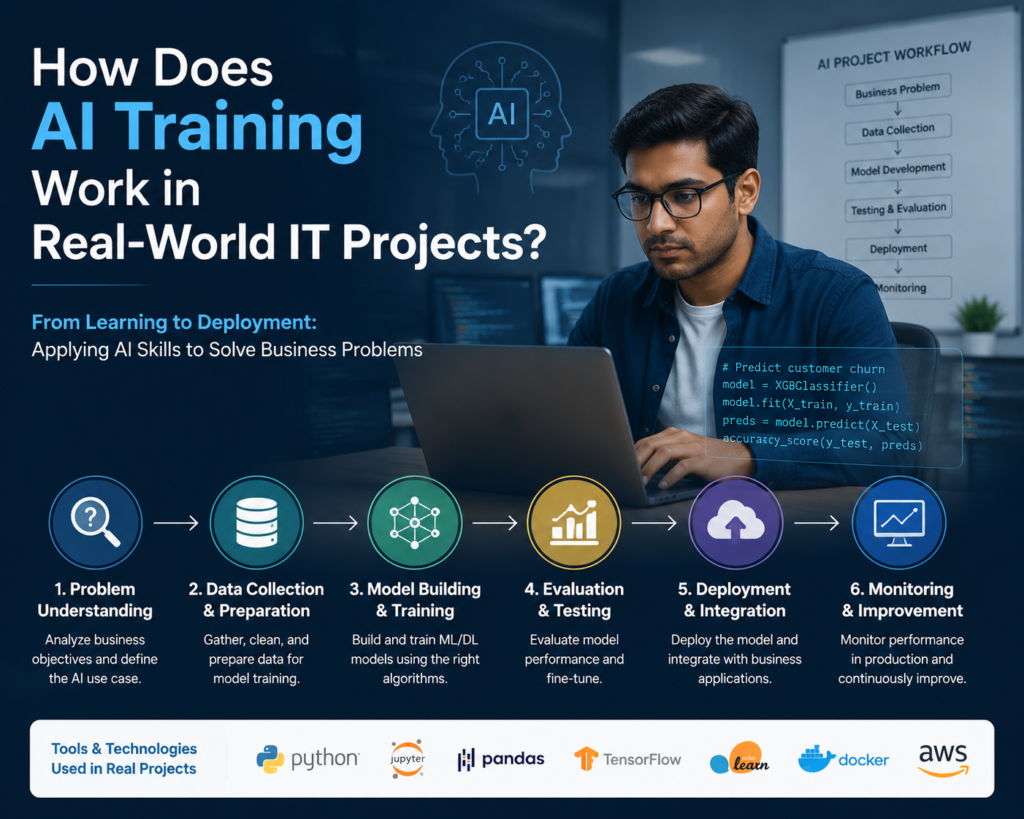
Choose Live Online AI Training equips professionals with skills to implement AI solutions in enterprise projects. Typical workflows include:
- Data Collection and Preprocessing
- Tools: Python, Pandas, NumPy
- Process: Cleaning, normalizing, and encoding enterprise datasets for model consumption.
- Model Development
- Frameworks: TensorFlow, PyTorch, Scikit-learn
- Activities: Feature selection, model training, hyperparameter tuning.
- Model Evaluation
- Techniques: Cross-validation, confusion matrix, ROC-AUC analysis
- Purpose: Ensuring model accuracy, precision, and scalability.
- Deployment & Monitoring
- Tools: Docker, Kubernetes, AWS SageMaker, Azure ML
- Tasks: Containerization, model hosting, real-time performance monitoring.
- Iterative Optimization
- Approach: Continuous feedback loops, retraining models with new data to maintain relevance and accuracy.
Live Online AI Training allows participants to work on these steps interactively, rather than passively watching tutorials, ensuring readiness for real-world enterprise workflows.
Why is Live AI Training Important for Working Professionals?
For professionals balancing career commitments, live AI training offers:
- Immediate clarification: Reduces misconceptions that can arise from self-study.
- Structured schedule: Promotes disciplined learning alongside professional responsibilities.
- Access to industry insights: Instructors often share practical enterprise scenarios.
- Networking opportunities: Interaction with peers and instructors fosters professional connections.
- Skill validation: Interactive assessments simulate real project problem-solving.
These advantages enhance both the retention of knowledge and the ability to apply it effectively in corporate AI initiatives.
What Skills Are Required to Learn an Artificial Intelligence Certified Course?
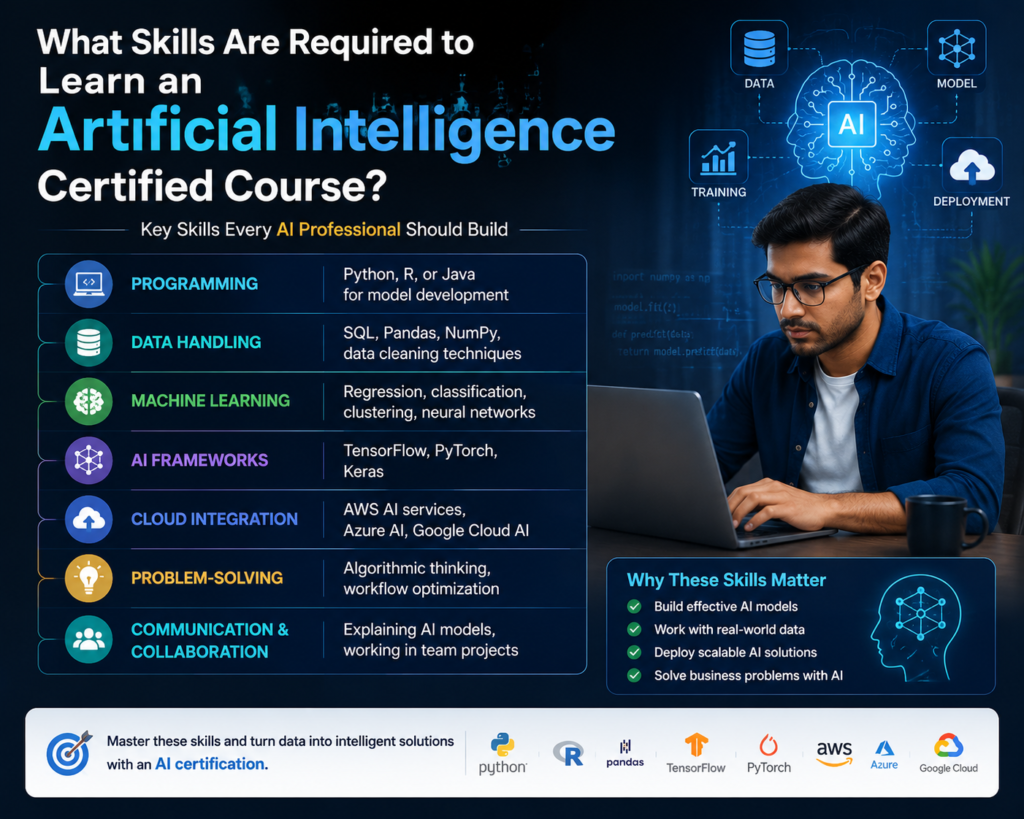
A professional pursuing an AI certification should develop:
| Skill Area | Details |
|---|---|
| Programming | Python, R, or Java for model development |
| Data Handling | SQL, Pandas, NumPy, data cleaning techniques |
| Machine Learning | Regression, classification, clustering, neural networks |
| AI Frameworks | TensorFlow, PyTorch, Keras |
| Cloud Integration | AWS AI services, Azure AI, Google Cloud AI |
| Problem-Solving | Algorithmic thinking, workflow optimization |
| Communication & Collaboration | Explaining AI models, working in team projects |
Choose Live Online AI Training sessions allow instructors to assess and strengthen these skills through exercises, guided projects, and interactive problem-solving.
How is AI Used in Enterprise Environments?
AI adoption in enterprise IT spans multiple functional areas:
- Predictive Analytics: Forecasting customer behavior, sales trends, and demand planning.
- Natural Language Processing (NLP): Chatbots, document analysis, sentiment analysis.
- Computer Vision: Automated defect detection, image recognition, security surveillance.
- Recommendation Systems: Personalized content and product recommendations.
- Automation & RPA Integration: Streamlining repetitive tasks and decision-making processes.
Training programs that provide live labs help professionals directly simulate these applications using industry-standard datasets and tools.
What Job Roles Use AI Daily?
Professionals trained in AI can enter roles where AI is applied routinely:
| Job Role | Responsibilities |
|---|---|
| AI Engineer | Build, train, and deploy AI models using ML/DL frameworks |
| Data Scientist | Analyze data, build predictive models, derive insights |
| ML Ops Specialist | Manage AI model deployment, scaling, and performance monitoring |
| Business Intelligence Analyst | Use AI insights to guide strategic decisions |
| NLP Engineer | Develop chatbots, sentiment analysis, language translation systems |
| Computer Vision Specialist | Implement image and video processing pipelines |
Live AI training helps learners understand these roles by simulating realistic projects and tasks.
What Careers Are Possible After Learning an AI Certification Course?
Completing an Artificial Intelligence Certified Course opens pathways in:
- AI and Machine Learning development
- Data Science and Analytics
- Cloud AI services and solution engineering
- AI-driven business consulting
- Research and development in AI technologies
Choose Live Online AI Training ensures professionals can demonstrate applied skills and problem-solving abilities in interviews and workplace scenarios.
Advantages of Live Online AI Training vs Self-Paced Courses
| Feature | Live Online Training | Self-Paced Courses |
|---|---|---|
| Instructor Interaction | Real-time guidance and Q&A | Limited or asynchronous feedback |
| Practical Labs | Guided hands-on projects | Independent or optional labs |
| Collaboration | Team exercises and peer discussions | Minimal interaction |
| Motivation & Accountability | Scheduled sessions encourage discipline | Self-motivation required |
| Immediate Clarification | Misconceptions resolved instantly | Delayed resolution via forums or email |
| Networking Opportunities | Access to instructors and peers | Limited to discussion boards |
Frequently Asked Questions (FAQ)
Q1: Can I pursue live online AI training while working full-time?
Yes. Sessions are scheduled to accommodate working professionals, with recordings available for review.
Q2: Do I need prior experience in AI?
Basic programming knowledge and familiarity with data handling are recommended, but live courses often include foundational refreshers.
Q3: How are live labs conducted?
Participants work on real datasets in guided exercises using tools like TensorFlow, PyTorch, and cloud AI platforms.
Q4: Will live training prepare me for certification exams?
Yes. Structured curricula, assessments, and instructor-led guidance align with certification requirements.
Q5: Is networking possible in live courses?
Yes. Interactive sessions, group projects, and discussion forums facilitate professional connections.
Practical Applications in Projects
Example Workflow in a Live AI Course:
- Data Ingestion: Connect to enterprise SQL databases.
- Preprocessing: Normalize and encode features using Python libraries.
- Model Training: Build neural networks in TensorFlow with live instructor guidance.
- Evaluation: Conduct k-fold cross-validation and interpret metrics.
- Deployment: Containerize the model using Docker and deploy on AWS SageMaker.
- Monitoring & Iteration: Set up performance dashboards and retrain models as needed.
This live approach ensures learners can execute real enterprise-level AI projects, a skill that self-paced learning often cannot fully replicate.
Key Takeaways
- Choose Live Online AI Training provides structured, interactive learning aligned with enterprise workflows.
- Real-time instructor interaction reduces misconceptions and accelerates skill acquisition.
- Hands-on labs simulate production environments, preparing professionals for real-world AI projects.
- Networking and collaborative exercises enhance professional development.
- Certification-focused curricula validate applied AI skills for career advancement.