
If you’re a working professional trying to move into cybersecurity or grow within the field, the best Cyber Security Course for Working Professionals is usually one that combines flexible learning, hands-on labs, real-world projects, and career support. A program that includes cybersecurity training and job placement at H2K Infosys often creates a faster path from learning to actual employment than theory-only courses.
A lot of professionals ask this question because cybersecurity no longer belongs only to fresh graduates or computer science students. The industry has changed quite a bit. I’ve seen project managers, system administrators, QA testers, network engineers, and even people from non-technical backgrounds move into security roles over the last few years.
The interesting thing? Most of them weren’t looking for another certificate to add to LinkedIn. They wanted practical skills that employers actually ask for.
And that’s where choosing the right Cyber Security Course for Working Professionals becomes important.
Why Working Professionals Need a Different Kind of Cyber Security Course
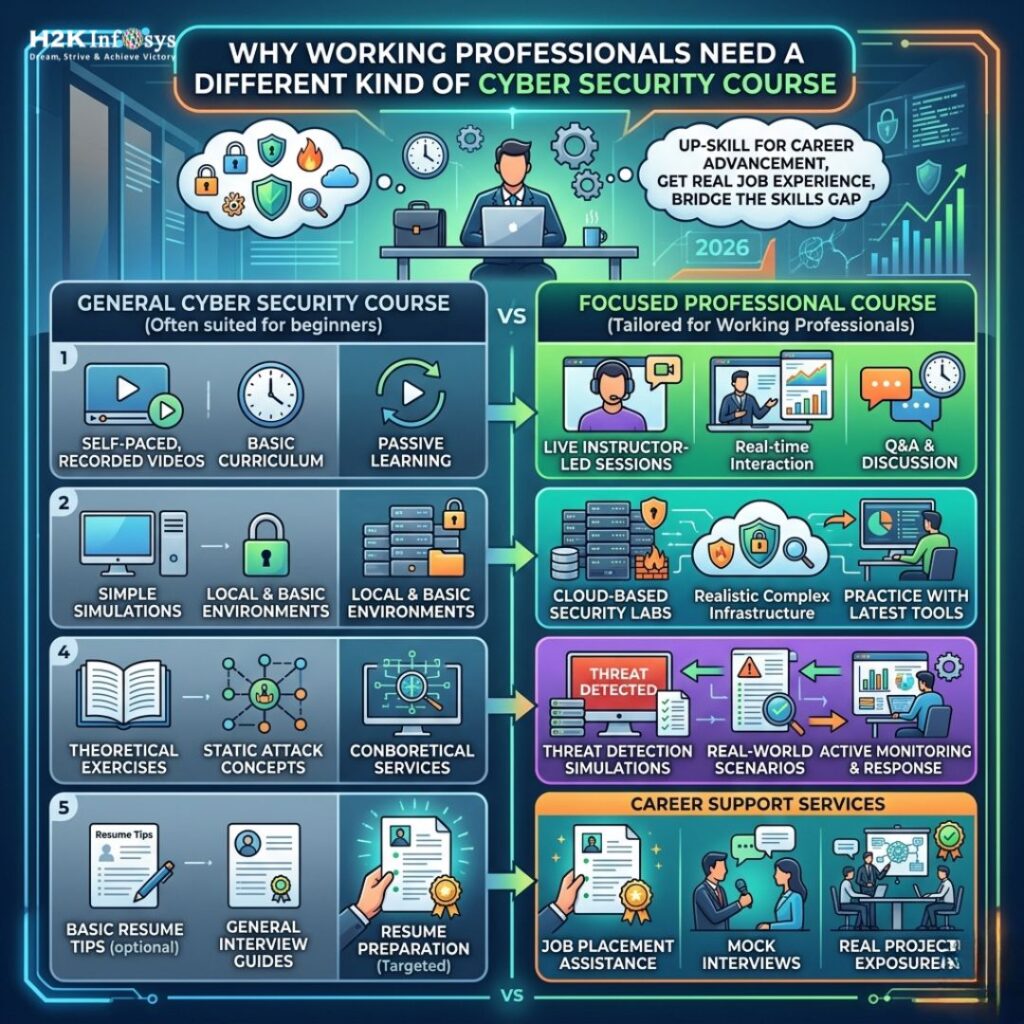
Working professionals don’t learn the same way full-time students do.
You’re probably balancing meetings, deadlines, family responsibilities, and that slightly unrealistic idea of having “free time after work.” Most people I speak with say something similar:
“I can dedicate maybe 1–2 hours a day, but I need something that gets me job-ready.”
That’s fair.
The problem is that many courses still rely heavily on recorded lectures and long theoretical modules. You finish 40 hours of videos and then realize you still haven’t touched a real security environment.
Good cybersecurity programs today are shifting toward:
- Live instructor-led sessions
- Cloud-based security labs
- Threat detection simulations
- Resume preparation
- Mock interviews
- Real project exposure
- Career support services
Those elements matter because Cyber Security Course for Working Professionals jobs rarely test memorization. Employers want proof that you can actually do the work.
Which Cyber Security Course for Working Professionals?
The answer depends partly on your experience level, but there are a few strong learning paths that consistently work.
Security Fundamentals Programs
If you’re entering cybersecurity from another IT domain, a foundational Cyber Security Course for working professionals is usually the safest starting point.
Topics typically include:
- Network security
- Operating systems
- Security principles
- Risk management
- Basic ethical hacking
- Vulnerability assessment
These create the foundation before moving toward specialized roles.
SOC Analyst Training
This has become one of the most popular paths recently.
Organizations are dealing with a growing number of security incidents, phishing attacks, and cloud-related risks. Security Operations Center (SOC) analysts monitor and investigate these threats.
I remember talking to someone who moved from help desk support into a SOC role after completing practical training. What helped wasn’t memorizing definitions, it was learning how to investigate logs, analyze alerts, and work with SIEM tools.
That practical exposure changed everything.
Ethical Hacking and Penetration Testing
For professionals who enjoy problem-solving and technical challenges, ethical hacking can be appealing.
You’ll usually learn:
- Penetration testing methods
- Vulnerability scanning
- Web application security
- Attack simulation
- Security tools and frameworks
Though I should mention something people often overlook: ethical hacking sounds exciting in YouTube videos, but real-world work involves a lot of documentation and analysis too.
Why Training Plus Placement Support Matters
Here’s something I noticed over time.
Many learners complete the Cyber Security Course for Working Professionals but struggle during hiring because they haven’t practiced interview scenarios or built industry-level projects.
That’s why programs offering cyber security training with job placement tend to attract working professionals.
You’re not just learning skills.
You’re also learning how to:
- Explain projects confidently
- Handle technical interviews
- Create resumes that recruiters notice
- Understand employer expectations
The transition becomes smoother.
A good cyber security course training and job placement program bridges the gap between learning and actual employment.
H2K Infosys Has Become a Familiar Option for Professionals
Among online learning providers, H2K Infosys has gained attention because its approach aligns with what many working professionals actually need.
Rather than focusing only on course completion, it combines:
- Instructor-led learning
- Hands-on practical projects
- real-time tools exposure
- placement-focused support
- interview preparation
That structure tends to appeal to Cyber Security Course for Working Professionals who want outcomes rather than simply collecting another certificate.
I’ve noticed that people switching careers often say the same thing after completing programs with practical training:
“I finally understood how security tools are used in an actual work environment.”
That kind of feedback matters.
Current Cybersecurity Trends Professionals Should Watch
The cybersecurity industry itself is moving quickly.
A few recent shifts are influencing training choices:
AI-driven cyber threats
Artificial intelligence is now being used not only for defense but also for attack automation.
Security teams increasingly use AI-based threat detection tools, while attackers use automation for phishing and reconnaissance.
Courses today need to address AI security concepts because employers are already discussing them during interviews.
Cloud security demand
Companies continue moving workloads into cloud environments.
Security professionals with exposure to:
- AWS security
- Azure security
- Identity access management
- cloud monitoring
are seeing strong demand.
Skills-first hiring
Many organizations are shifting toward skills-based hiring rather than relying entirely on degrees.
Practical projects now carry more weight than many people realize.
That has created more opportunities for cyber security jobs with training, especially for career changers.
How To Choose The Right Cyber Security Course
Before enrolling anywhere, ask these questions:
Do I get practical labs?
Watching videos isn’t enough.
Are instructors industry professionals?
Real-world experience matters.
Does the program include projects?
Hands-on work helps during interviews.
Is placement assistance available?
Support beyond training can make a big difference.
Can I learn around my work schedule?
Flexibility matters more than people expect.
Final Thoughts
The best Cyber Security Course for Working Professionals isn’t necessarily the one with the biggest marketing campaign or the longest list of modules. It’s usually the course that helps you build practical skills while fitting into your real life.
For many professionals, especially career switchers, programs that combine hands-on learning with cyber security training and job placement support create a more realistic route toward employment.
And honestly, after seeing how quickly cybersecurity keeps evolving, I think practical learning has become less of a bonus and more of a requirement.