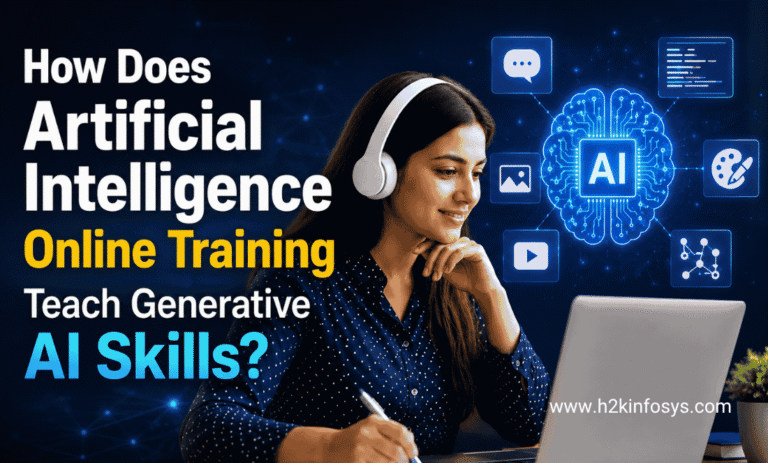
H2K Infosys’ Artificial Intelligence Online Training provides Generative AI skills by combining foundational machine learning concepts with hands-on experience in modern AI models, prompt engineering techniques, data pipelines, and enterprise AI tools. A structured Artificial intelligence Certificate Online program from H2K Infosys typically guides learners from core AI principles to the practical implementation of Generative AI applications used in business operations, software development, analytics, and automation.
With Generative AI skills becoming increasingly embedded in the industry, professionals are looking for artificial intelligence courses that offer both theoretical knowledge and practical skillsets. Training programs need to be effective in teaching not only how AI models function, but also how organisations install, monitor, regulate and scale AI solutions in production environments.
What Is Generative AI?
Generative AI is a subfield of Generative AI Skills that develops new material by learning patterns from existing data.
- Text
- Images
- Code
- Audio
- Video
- Synthetic data
Examples of Generative AI technologies include:
| Technology Type | Common Applications |
|---|---|
| Large Language Models (LLMs) | Content generation, chatbots |
| Image Generation Models | Design assistance, marketing visuals |
| Code Generation Models | Software development support |
| Speech Generation Models | Virtual assistants |
| Synthetic Data Generators | AI training datasets |
Modern Generative AI systems are mainly based on neural network, deep learning architectures and transformer based models.
What Is Online Artificial Intelligence Training?
Artificial Intelligence online training is an organised educational program that provides instruction on AI ideas, tools, frameworks, and practical implementation methodologies using virtual learning environments.
Most comprehensive courses of artificial intelligence include:
- Machine Learning Introduction
- Deep Learning ideas
- Neural Netwroks
- Natural Language Processing (NLP)
- computer vision.
- A Generative AI Guide
- AI model deployment AI ethics & governance
Many professionals are interested in Generative AI Skills since it allows them to authenticate their technical abilities and prove their competence in upcoming AI technologies.
Why Is Generative AI Becoming a Core Part of AI Training?
Organisations seeking solutions to automate knowledge work, boost efficiency and enhance customer experiences are increasingly focusing on generative AI.
Typical enterprise use cases include:
- Smart Chatbots
- Content creation platforms
- Automated documentation
- Code-generation assistants
- Knowledge Management Systems
- AI-powered customer support
- Data Augmentations
As usage develops, organisations are looking for professionals that understand both standard AI and Generative AI workflows.
How can online training in artificial intelligence teach generative AI skills?
Effective training programs use a progressive learning route in which knowledge is acquired incrementally.
Step 1: Understanding AI and Machine Learning Foundations
Before learning about Generative AI skills, students normally study:
- Basics of Artificial Intelligence
- Supervised learning
- neural networks, unsupervised learning
- Model evaluation Data pre-processing
These ideas give the required framework for understanding how generative models find patterns from huge datasets.
Core Topics Covered
- Engineering features
- Training data
- Model validation
- Loss function
- Optimisation methods
- Basics of deep learning
Without these fundamentals, advanced Generative AI Skills concepts can be difficult to understand.
Step 2: Learning Deep Learning Architecture
Deep learning is strongly dependent on generative AI.
Students learn:
- Artificial Neural Networks (ANNs)
- CNN (Convolutional Neural Network)
- Recurrent Neural Network (RNN)
- Transformers Attention mechanisms
A lot of recentGenerative AI skills is on transformer architecture because it forms the basis of many large language models.
Enterprise Relevance
Transformer-based solutions are commonly used by development teams for:
- Automation of customer support
- Abstract of the document
- Enterprise Search Engine.
- Knowledge assistants
Knowing about these architectures, professionals can talk better with AI engineering teams.
Step 3: Studying Large Language Models (LLMs)
Generative AI teaching is a huge part of Large Language Models.
Training generally consists of:
- Tokenization
- Embedding
- Context windows
- Inference Fine-tuning Retrieval-Augmented Generation (RAG)
Students will examine how LLMs develop human-like answers by learning patterns from large training datasets.
Common Learning Activities
- Prompt experimentation
- Model comparison
- Response evaluation
- Hallucination analysis
- Context management
These exercises help learners understand both the capabilities and limitations of AI systems.
Step 4: Prompt Engineering Training
Prompt engineering has emerged as a critical ability for Generative AI.
Students learn to write prompts that improve the output.
Example Workflow
- definition goal
- , add context
- Add restrictions
- Format specify
- Assess response
- Refine prompt
- Example of an enterprise
Enterprise Example
Business analyst can create prompts to:
- Create reports
- Document Summarisation
- Learn from client feedback
- Develop technical documentation
Prompt engineering improves productivity while reducing inconsistencies in AI-generated outputs.
Step 5: Real-World Projects with AI Tools
Practical training is essential for skill development.
| Tool Category | Examples |
| Programming | Python |
| Machine Learning | Scikit-learn |
| Deep Learning | TensorFlow, PyTorch |
| NLP | Hugging Face Transformers |
| Data Analysis | Pandas |
| Visualization | Matplotlib |
| Model Deployment | Docker |
| Cloud AI Services | AWS, Azure, Google Cloud |
Hands-on projects help bridge the gap between theory and implementation.
Step 6: Creating Generative AI Applications in the Real World
Most Artificial intelligence Certificate Online have capstone projects.
Examples include:
Development of AI Chatbot
Students learn to:
- link language models
- Construct discussion flows
- Context Management
- API integrations
- Document Intelligency System
Document Intelligence Systems
Projects may involve:
- PDF processing.
- InformationExtraction
- Conclusion
- AI Content Generation Knowledge Retrieval
AI Content Generation
Learners create workflows for:
- Content Marketing
- Product descriptions
- Technical writing
These projects simulate real enterprise implementation scenarios.
How Does Artificial Intelligence Work in Real-World IT Projects?
AI systems rarely work in isolation.
They are usually embedded inside larger technology stacks.
Common Enterprise Workflow
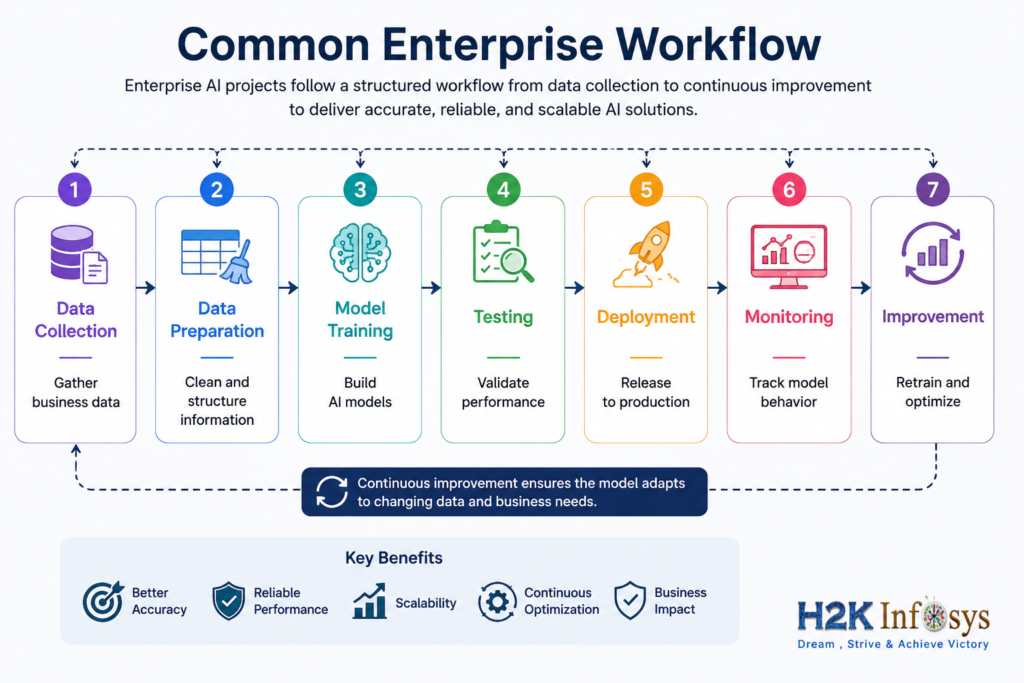
| Stage | Activity |
| Data Collection | Gather business data |
| Data Preparation | Clean and structure information |
| Model Training | Build AI models |
| Testing | Validate performance |
| Deployment | Release to production |
| Monitoring | Track model behavior |
| Improvement | Retrain and optimize |
Generative AI projects follow similar workflows but often include additional governance and quality-control mechanisms.
Why Generative AI is Important for Working Professionals?
Generative AI is revolutionising how companies process information, perform repetitive tasks and support decisions.
Professionals benefit by learning:
- AI-powered productivity
- Automating Workflow
- Systems for Smart Search
- Data Analytics
- AI-Driven Development Tools
Such qualities can improve effectiveness in several work roles.
Industries Using Generative AI
- Healthcare
- Banking
- Insurance
- Retail
- Manufacturing
- Telecommunications
- Technology services
- Education
The demand for AI literacy is expanding beyond traditional data science roles.
What Skills Are Required to Learn Artificial Intelligence?
Most learners can begin with basic technical knowledge.
Recommended Technical Skills
Foundational Skills
- Computer literacy
- Basic mathematics
- Logical thinking
- Problem solving
Programming Skills
Python remains the most widely used language in AI training.
Common topics include:
- Variables
- Functions
- Loops
- Data structures
- Libraries
Data Skills
Learners should understand:
- Data cleaning
- Data visualization
- Dataset management
- Statistical concepts
Generative AI Skills
Advanced learners develop expertise in:
- Prompt engineering
- LLM integration
- Model evaluation
- Retrieval systems
- AI governance
How Is Generative AI Used in Enterprise Environments?
Organizations typically deploy Generative AI within controlled environments.
Common Enterprise Applications
Knowledge Management
AI systems help employees locate information quickly from internal documentation.
Customer Support
Virtual assistants can:
- Answer questions
- Route requests
- Summarize support tickets
Software Development
Developers use AI tools for:
- Code generation
- Documentation
- Testing assistance
- Refactoring support
Business Analytics
AI can assist with:
- Report generation
- Data summarization
- Trend identification
What Challenges Do Organizations Face When Implementing Generative AI?
Successful implementation requires more than selecting a model.
Organizations often address challenges related to:
Data Security
Sensitive information must be protected.
Common controls include:
- Encryption
- Access management
- Data masking
Governance
Organizations establish policies covering:
- Model usage
- Data handling
- Human oversight
Accuracy
Generative AI can occasionally produce incorrect outputs.
Teams often implement:
- Human review processes
- Validation systems
- Monitoring frameworks
Scalability
Production deployments require:
- Infrastructure planning
- Cost management
- Performance optimization
These topics are increasingly included in advanced courses of artificial intelligence.
What Job Roles Use Generative AI Daily?
Generative AI skills are relevant across numerous technology and business positions.
Role-to-Skill Mapping
| Job Role | Generative AI Skills |
| AI Engineer | Model development |
| Machine Learning Engineer | Training and deployment |
| Data Scientist | Analytics and experimentation |
| Business Analyst | AI-assisted reporting |
| Software Developer | Code generation tools |
| Product Manager | AI product strategy |
| Solutions Architect | Enterprise AI design |
| DevOps Engineer | AI deployment automation |
Many organizations expect technical professionals to understand AI-assisted workflows.
What Careers Are Possible After Learning Artificial Intelligence?
Career opportunities vary depending on technical depth and specialization.
Entry-Level Roles
- Junior Data Analyst
- AI Support Specialist
- Machine Learning Associate
- Data Operations Analyst
Mid-Level Roles
- Data Scientist
- Machine Learning Engineer
- AI Developer
- NLP Engineer
Advanced Roles
- AI Architect
- Lead Data Scientist
- AI Product Manager
- Generative AI Consultant
Many professionals use an artificial intelligence certificate online as part of their broader career development strategy.
Recommended Learning Path for Generative AI
| Stage | Learning Focus |
| Stage 1 | AI Fundamentals |
| Stage 2 | Python Programming |
| Stage 3 | Machine Learning |
| Stage 4 | Deep Learning |
| Stage 5 | Natural Language Processing |
| Stage 6 | Large Language Models |
| Stage 7 | Prompt Engineering |
| Stage 8 | Generative AI Projects |
| Stage 9 | Deployment and MLOps |
| Stage 10 | Enterprise AI Governance |
This progression helps learners build skills systematically.
Frequently Asked Questions (FAQ)
Is Generative AI part of Artificial Intelligence?
Yes. Generative AI is a specialized area of Artificial Intelligence focused on creating new content such as text, images, code, audio, and video.
Do I need programming experience to learn Generative AI?
Basic programming knowledge is helpful, especially Python, but many beginner-friendly AI courses introduce programming concepts gradually.
What is the value of an artificial intelligence certificate online?
A certificate demonstrates structured learning and can help validate knowledge of AI concepts, tools, and practical applications.
Which programming language is most commonly used in AI?
Python is the most widely used language because of its extensive ecosystem of AI and machine learning libraries.
Are Generative AI skills useful outside software development?
Yes. Business analysts, project managers, marketers, customer support professionals, and product managers increasingly use Generative AI tools.
What tools are commonly taught in courses of artificial intelligence?
Popular tools include Python, TensorFlow, PyTorch, Scikit-learn, Hugging Face, Pandas, Docker, and cloud AI platforms.
How long does it take to learn Generative AI?
The timeline varies by experience level. Learners typically spend several months building foundational AI knowledge before progressing to advanced Generative AI projects.
Conclusion
Artificial Intelligence online training teaches Generative AI skills through a combination of foundational AI concepts, deep learning theory, large language model training, prompt engineering, hands-on projects, and enterprise implementation practices. Effective programs prepare professionals to understand not only how Generative AI works but also how it is deployed, governed, and maintained in real-world business environments.
Key Takeaways
- Generative AI focuses on creating new content from learned patterns.
- Artificial Intelligence online training typically combines theory with hands-on projects.
- Large Language Models and prompt engineering are central Generative AI skills.
- Enterprise AI projects require attention to governance, security, and scalability.
- AI skills are increasingly relevant across technical and business roles.
- An artificial intelligence certificate online can help demonstrate structured AI knowledge.
- Modern courses of artificial intelligence often include practical Generative AI implementation.
Explore H2K Infosys Artificial Intelligence courses to gain hands-on experience with Generative AI tools, workflows, and enterprise use cases.
Enroll in a structured learning path designed to support professional skill development and long-term career growth.