
To become an AI engineer you need to build good foundations in programming, math, machine learning and hands-on AI projects and prove your skills with practical experience, certifications and real-world applications. The fastest path in 2026 is not just to learn AI concepts, but learn how to build, deploy and improve AI systems that solve real business problems.
If you are thinking about how to become an AI engineer right now, you’re getting into the game at a very interesting time. AI is no longer the domain of research labs or big tech companies. Machine learning models, generative AI tools and automation systems are sought after in healthcare, finance, retail, cybersecurity and software development.
I’ve seen so many beginners make the same mistake, they watch AI videos for months, but never make anything. AI engineering is a hands-on skill. Those who excel are often those who have learned the basics, built projects and understood how AI works in real-world settings.
What Does an AI Engineer Really Do?
An AI engineer develops, tests, and deploys artificial intelligence solutions. It’s a sort of hybrid between a software engineer and a data scientist.
An AI engineer typically works on:
- Machine Learning model development
- Creating AI-powered applications
- Training and fine tuning neural networks
- Working with large language models (LLMs)
- Developing recommendation engines and AI chatbots
- Embedding AI APIs into business applications
- Implementing AI models on cloud platforms
For example, if you use a shopping website and it suggests products based on your behaviour or if you ask some questions to a customer support chatbot and it answers immediately, it is usually AI engineers behind those systems.
As generative AI platforms rapidly expand, companies are also hiring engineers who are familiar with things like large language models, retrieval-augmented generation (RAG), AI agents, and automation workflows.
How To Become An AI Engineer : Roadmap 2026 (Step-by-Step)
Getting into AI engineering is not a one-day job. A clear learning path can save you a lot of trial and error.
Step 1: Learn Programming Basics (Begin with Python)
Python is the most popular language for AI development because of its simple syntax and strong ecosystem.
You should learn:
- Basics of Python
- Object Orientated Programming
- Data structures
- Algorithms
- APIs: Working with APIs
- Clean and Reusable Code Writing
Many beginners jump straight to Machine Learning without any programming knowledge. This causes problems later on because AI engineering is a lot of software development.
A good AI engineer is not only someone who trains models but also someone who can develop applications around those models.
Step 2. Develop your foundation in mathematics
You don’t need to be a mathematician but you need to understand the ideas behind the AI models.
The key areas include:
- Linear algebra
- Probability
- Statistics
- Basic calculus
For example, once you understand things like vectors, matrices, and optimisation, it’s a lot easier to understand how data flows through a neural network.
The idea is not to memorise formulae. The goal is to understand why an AI model does what it does.
Step 3: Understand Machine Learning and Deep Learning
This is where your AI engineer journey starts to become practical.
You should know:
- Supervised Learning.
- Unsupervised learning
- Training the model
- Feature creation
- Evaluation of model
- Neural networks
- Tools of deep learning
Some popular tools are:
- TensorFlow
- PyTorch
- Scikit-learn
Don’t get caught up in theory. Build little projects.
This is what the user wants to know. I need to tell him what the user wants to know.
- Email Spam Detection
- Customer prediction model
- Recognition system (image)
- Example of application on sentiment analysis
They are evidence of your capability when you go for jobs.
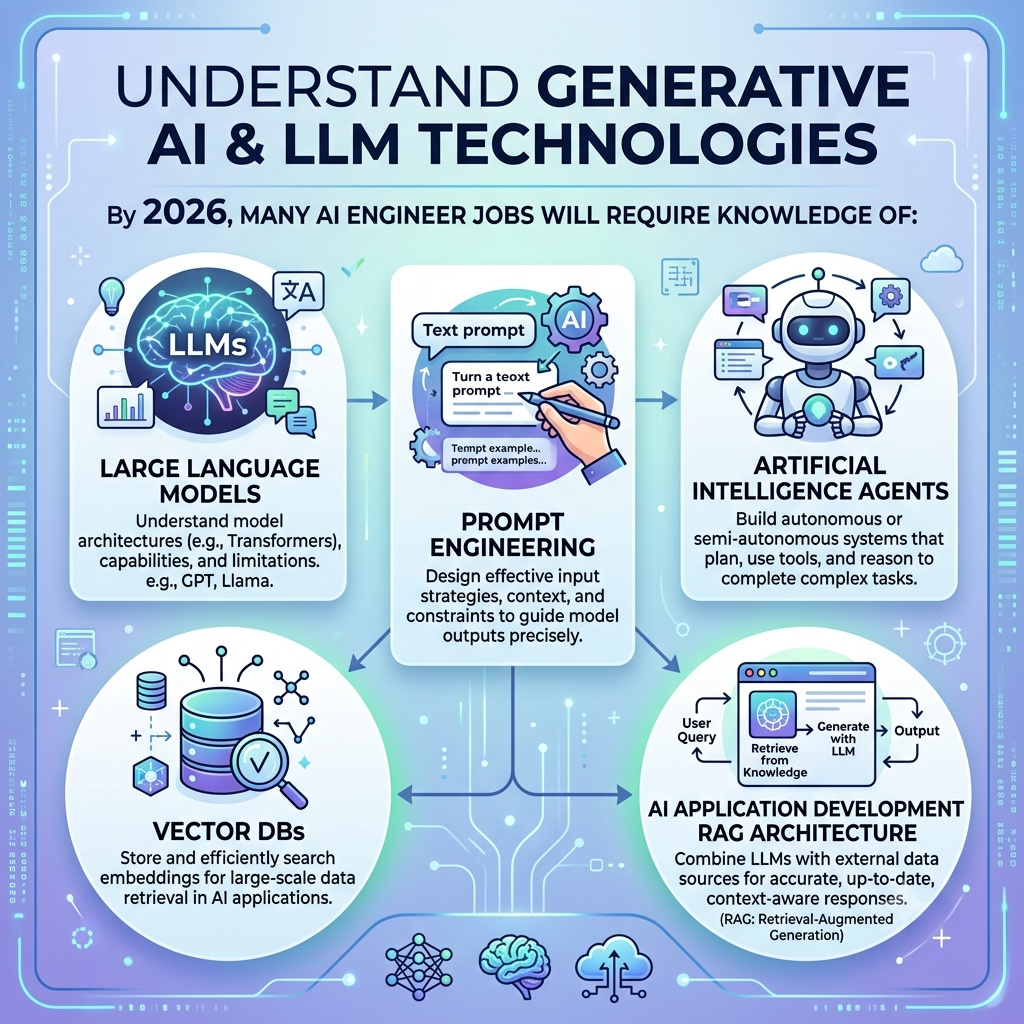
Step 4: Understand Generative AI and LLM Technologies
The AI industry has changed dramatically with the rise of generative AI.
By 2026, many AI engineer jobs will require knowledge of:
- Large Language Models
- Prompting engineering
- Artificial Intelligence agents
- Vector DBs
- AI Application Development RAG Architecture
For example, a company might not need someone to build a language model from the ground up. They may need an engineer who can connect an existing AI model with company data and build a useful internal assistant.
Here is where the true skills of AI engineering come in.
AI Engineer Roadmap 2026: Skills To Look For
A practical AI engineer roadmap 2026 needs to comprise of technical knowledge and practical experience.
Here’s a quick overview:
Level: Beginner
Discover:
- Python
- Programming basics
- Mathematics for Beginners
- Handling data
- Machine learning ideas
Purpose:
Create simple AI projects.
Intermediate Class
Learn more:
- Deep learning Neural networks
- Natural Language Processing (NLP)
- Visual Computing
- Machine learning library
Objective: To
Create portfolio projects.
Level A
Understand:
Use cases of LLMs Generative AI
Cloud deployment MLOps AI system architectures
Objective:
Create AI solutions for production.
Looking for an AI Engineer Certification Online?
Certifications don’t replace skills, but a good certification can help structure your learning and prove to employers that you have completed professional training.
When selecting an AI engineer certification online course, consider programs that feature:
- Live instructor-led training
- Real coding drills
- Industry Projects
- Tools for machine learning and AI
- Career support Interview preparation
Many learners struggle as they collect certificates but can’t explain their projects in interviews. “A sound program has to be based on practical implementation and confidence building.
Why Practical AI Training Is Important for Beginners
AI is a rapidly evolving field. A course developed years ago may not have the technologies companies are using today.
Modern AI training topics should include:
- Generative AI use cases
- Hands-on machine learning projects
- AI deployment in the cloud
- Tools of the trade
- hands on coding
This is one of the reasons why many learners opt for career-oriented training platforms like H2K Infosys. Their AI and technology training programs are designed to educate students through a structured curriculum, hands-on assignments and industry-oriented skills.
If you are transitioning into AI from some other field, a guided learning path can help you skip the trial-and-error phase. You don’t have a question of “what should I learn next?” but instead a roadmap built around what the industry expects today.
You can check their AI related training options through H2K Infosys official website.
Real-World AI Engineer Projects to Build
Projects are important if you want your profile to be taken seriously by the employers.
Some ideas for practical projects:
- AI Chatbot with LLMs
- Create a chatbot that answers questions from documents or company knowledge.
Skills learned include:
- Integration LLM
- Data handling
- RAG Ideas
- AI Applications Development
- AI Resume Filtering Software
Develop a resume scanner that will match resumes to job descriptions.
What you will learn:
- NLP
- Text processing
- Machine learning Recommendation System
Create a system similar to streaming or shopping websites.
Learned skills:
- Analysis of data
- Prediction models
- Modelling of user behaviour
- It Takes How Long To Become an AI Engineer?
It will depend on your background how long this takes you.
For someone who starts from scratch:
Programming basics: 1-3 months
Machine learning foundations: 3-6 mos
Advanced AI Skills & Projects: 6-12 months
Many learners get employable within a year with regular practice.
The biggest thing is consistency. Usually it is more useful to spend 2 hours a day working on skills than to study randomly for long hours once a week.
AI Engineer Jobs & Career Opportunities (2026)
AI engineering is finding its way into many industries.
Possible roles may include:
Machine Learning Engineer / AI Engineer / AI Developer / Data Scientist / NLP Engineer / Computer Vision Engineer / Generative AI Engineer
Companies are especially interested in professionals who can combine AI knowledge with software development expertise.
The value of someone who can take an idea for AI and turn it into a working product is always going up.
Final Thoughts: Is AI Engineering a Good Career?
Absolutely, AI engineering is one of the most promising tech careers in 2026 but success is not just about watching tutorials. The most improved people are the ones who are practicing, building projects, following the latest AI trends and keep improving.
Begin with Python. Study machine learning. Develop real-world projects. If you need a structured path, get guidance. Then, keep expanding into generative AI and modern AI engineering tools.
The AI industry is moving fast but that also means there is room for new engineers who are willing to learn and adapt. Clear roadmap, practical training and consistent effort can take you from beginner to job-ready AI professional.