For AI Engineer training programs with job assistance, look for platforms that teach real-world skills, offer hands-on projects, and help you prepare for interviews and find a career. One such path is H2K Infosys with many budding AI professionals considering AI-focused training along with career support to transition learners into AI engineering roles.
The demand for AI engineers has exploded. Companies are no longer experimenting with AI. They are building products around machine learning models, generative AI tools, automation systems, and data-driven solutions. But getting into this field is not just about watching a few tutorials or learning the basics of Python. You need detailed AI Engineer roadmap, practical experience, and guidance on how to convert your skills to a job opportunity.
A good training program can make a real difference there.
Why are AI Engineer Training Programs with Job Assistance Necessary?
Many people begin learning AI with great enthusiasm and end up getting stuck halfway.
Maybe you’ve been there. You’ve just finished a Python course, you understand some machine learning concepts, and you’re browsing AI engineering job descriptions. And then you see all those terms like neural networks, LLMs, MLOps, cloud deployment, vector databases, model optimisation and more. There’s a huge difference between “learning AI” and “being job-ready.”
A structured AI Engineer training program helps bridge that gap by combining:
- Technical concepts
- Real time projects
- Industry Tools –
- Tips for resumes
- Mock interviews
- Career mentoring
The assistance with job is important because companies generally want to hire people who can demonstrate practical ability not just certificates.
What to Look for in AI Engineer Courses?
Not all AI Engineer courses are the same. Some are heavy on theory, others are built around industry applications.
Ideally a good program should cover areas such as:
1. Python Programming for AI
Python is still one of the most important languages in AI development. You should be comfortable working with libraries such as:
- Numpy pandas
- Scikit-learn, TensorFlow or PyTorch
These are the building blocks for a lot of AI projects.
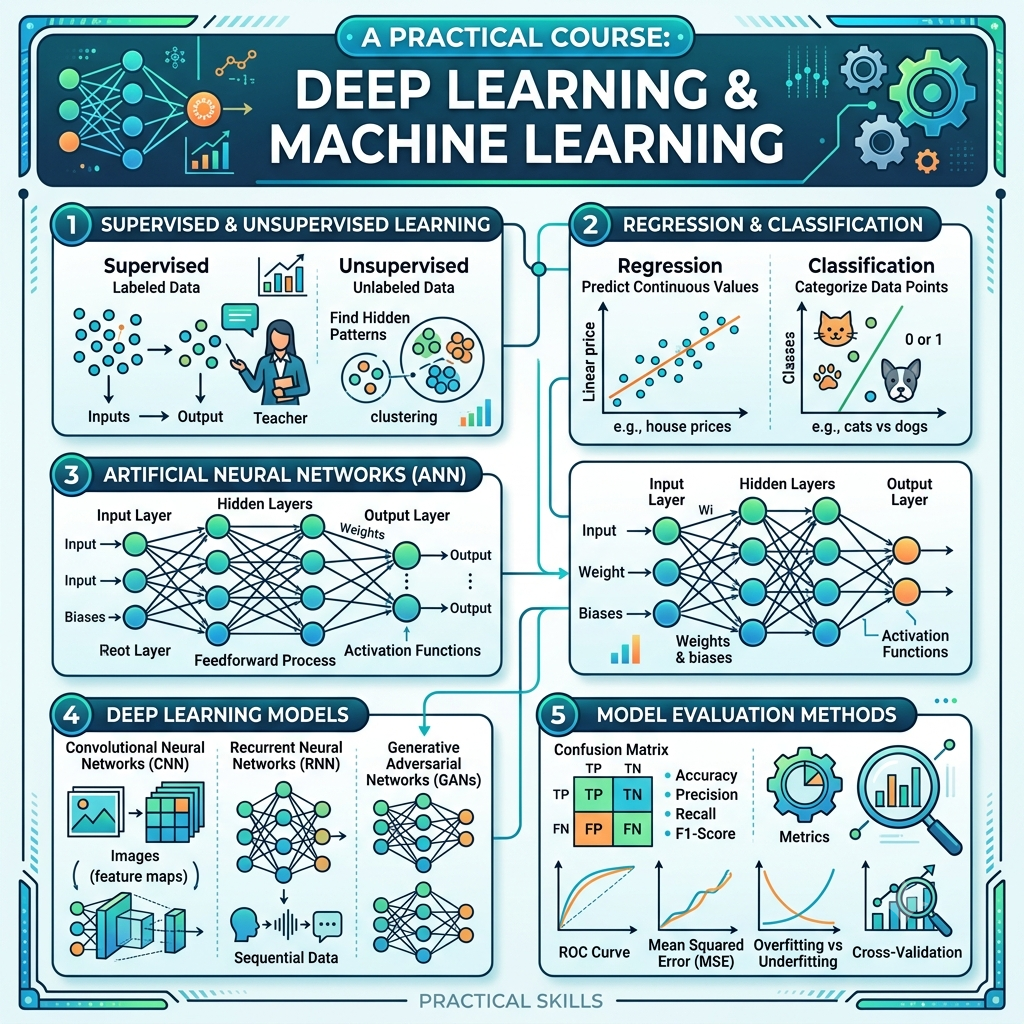
2. Deep learning and machine learning
AI engineers need to know how models learn and how they make predictions.
A practical course should contain:
- Supervised and unsupervised learning
- Regression and Classification
- Neural networks, artificial
- Deep learning models
- Model evaluation methods
Knowing the theory is useful but it is usually when and how to apply it that employers are seeking.
3. Large Language Models and Generative AI
Generative AI has revolutionised the AI landscape. Tools based on large language models are now being embedded into customer support, healthcare systems, finance platforms, software development workflows, and many other industries.
Modern AI Engineer courses should include topics such as:
- Fundamentals of LLMs
- Engineering suggestion
- Retrieval Augmented Generation (RAG)
- AI app development
- AI APIs Use
This is especially critical as companies are more interested in engineers who can build AI-powered applications, not just train models.
H2K Infosys is a worthwhile option to look at for AI engineer training.
When it comes to picking an AI program, many students look for a blend of technical training and career support. H2K Infosys is committed to provide industry orientated training based on practical skills.
The program approach generally emphasises:
- Instructor-led Training
- Workplace project experience
- Curricula related to the industry
- Preparing for an interview
- Resume and career advice
For someone on an AI Engineer roadmap, this kind of structured learning can help organise the journey rather than bouncing between random online resources.
A common problem for beginners is that they don’t know where to start. Start with machine learning? Do you? Cloud platforms: worth learning. Should you build projects? 2. Do you care about generative AI?
“Those questions have a clearer path with a guided program that provides answers.
What is a Realistic AI Engineer Road-map?
A realistic roadmap typically looks like this:
Stage 1: Develop Your Programming Skills
Begin with:
Data structures in Python
Basic statistics Data management
You don’t need to become a software engineer overnight, but you should be comfortable writing and reading code.
Step 2: Get to Know the Basics of Machine Learning
Enter:
- Algorithms Data preprocessing
- Model training Performance evaluation
At this point, work on small projects. E.g.
- Predicting Customer Churn
- Recommender systems
- Models for sales forecasting
You learn a lot more by doing small projects than by reading documentation.
Stage 3: Transitioning to Deep Learning and AI Applications
Understand:
- Neural networks
- Computer Vision Fundamentals
- Generative AI Workflows Natural Language Processing
- Build Projects That Solve Real Problems.
For example, instead of building a simple chatbot just to prove that you know how to build chatbots, build one that answers questions from company documents using RAG techniques. That shows a practical understanding.
Stage 4: Get ready for AI engineering jobs
That’s where job help comes in.
You want to focus on:
- Resume enhancement
- Boost for LinkedIn
- AI Portfolio
- Technical Interviewing
- code practice
“Being able to talk about the project you built, and why you did what you did, is more likely to catch the attention of a recruiter.
Will AI Engineer Jobs be in Demand in 2026?
AI adoption continues to expand across industries. Corporations are investing in automation, AI assistants, predictive analytics and smart software systems.
Recent trends indicate that companies are moving away from merely playing around with AI tools and are now using AI for everyday work. This means that there is an increasing demand for professionals who can build, deploy, and maintain AI solutions.
The roles are changing, too. An AI engineer today might be building:
- Generative AI applications
- Automation with AI
- machine learning pipeline
- Cloud AI Systems
- AI Solutions for Enterprise
The field is moving quickly and knowing just the older machine learning concepts may not be sufficient. New AI technologies must be included in modern training.
Realistic Expectations for AI Training Programs
One thing to remember: a training program isn’t a magic shortcut to a job.
The learners who tend to achieve the best results are those who:
- Exercise regularly
- Create projects outside of class
- Enquire
- Improve their tech comm
- Keep on learning after the course ends
Consider training as a structured path and a support system. It’s just as much about how hard you work to use those skills.
How Job Assistance Can Help You Launch Your AI Career
The non-technical side of getting hired is underestimated by many novices.
Job assistance could assist you with:
- Knowing what the industry expects
- Getting ready for interviews
- Crafting a better resume
- How to display projects
- Increasing confidence in job hunting
Sometimes two candidates have similar technical knowledge, but the one who can explain their work better gets the chance.
Closing Thoughts
Choosing the right AI Engineer training program is not just about choosing a course, it’s about choosing a learning path that will make you job ready.
A good program should combine technical knowledge with hands-on projects and career advice. If you are looking for AI Engineer courses and want a structured approach with job assistance then H2K Infosys is one option that you can consider on your way.
The AI industry will keep growing, and those who have solid fundamentals and hands-on experience will be the best positioned to build a successful career. Having a clear AI Engineer roadmap, regular practice and right guidance can really make learning AI a professional opportunity.