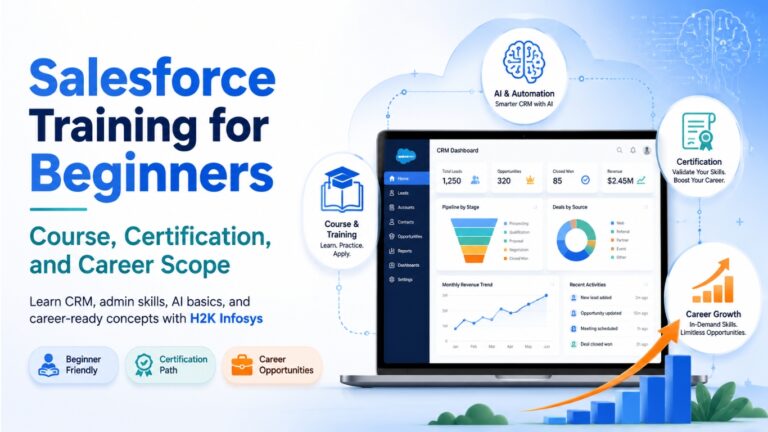
Salesforce Training for Beginners with H2K Infosys is a practical way to learn CRM, certification skills, Salesforce Einstein, and real admin work without feeling lost on day one. You do not need to start as a coder; you need steady practice, business curiosity, and a course that shows how Salesforce is used in actual companies.
Salesforce looks simple from the outside: a CRM tool for sales teams. Then you open it and see objects, records, permissions, flows, dashboards, service cases, apps, roles, and now AI agents. That is usually when beginners realize random video learning is not enough. Salesforce Training gives you a map.
At its core, Salesforce helps companies manage customers, sales pipelines, service requests, reports, and automation. A Salesforce administrator keeps that system useful by shaping the platform around business needs. Salesforce describes admins as people who work with stakeholders, customize the platform, and help companies get more value from its features.
Why Salesforce Is Still a Smart Beginner Career in 2026
Salesforce Training for Beginners matters in 2026 because CRM work is changing fast. Companies are no longer asking only, “Can we store customer data?” They are asking, “Can our CRM predict risk, suggest replies, automate follow-ups, and help teams work faster?” That is where Salesforce and AI come in.
Salesforce Einstein includes generative AI capabilities such as sales emails and customer service replies, while Agentforce is positioned as an AI agent platform that can answer questions, reason through requests, retrieve business knowledge, and take action across teams.
Think of a support team with hundreds of pending cases. A trained admin can set up queues, assignment rules, dashboards, escalation paths, flows, and AI-supported suggestions. That is the real value of Salesforce Training for Beginners.
What You Learn in a Salesforce Course
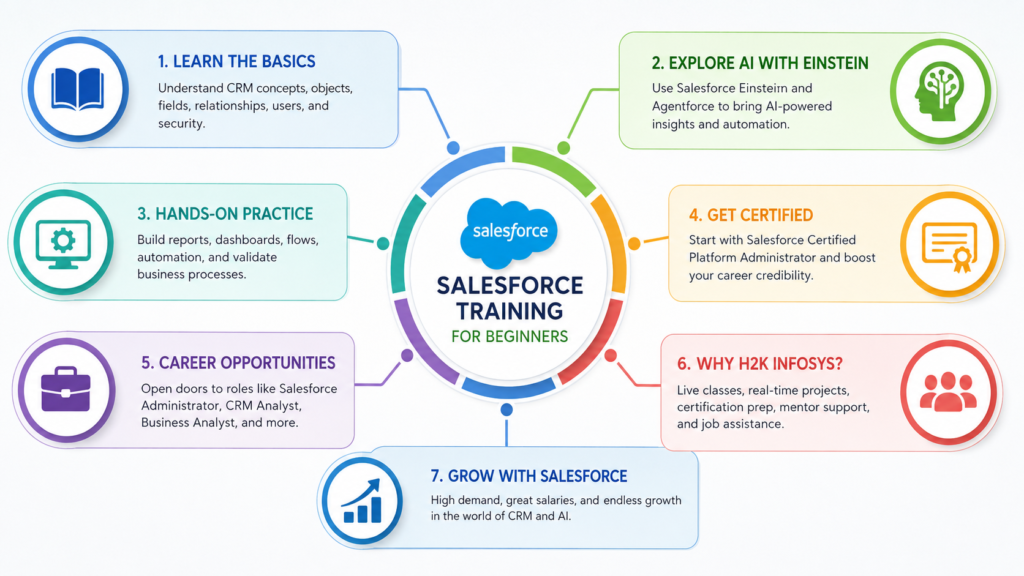
A good Salesforce Training for Beginners should start with the basics that become important later: leads, accounts, contacts, opportunities, users, profiles, roles, permission sets, objects, fields, reports, dashboards, and data imports. Once these are clear, automation and AI features make more sense.
Most Salesforce training courses should also include validation rules, flows, security, app customization, data quality, and business scenarios. For example, you might build a sales process where leads are assigned automatically, managers see pipeline dashboards, and users only access the right records. That kind of practice is where Salesforce Training for Beginners starts feeling real.
H2K Infosys leans into this practical route. Its Salesforce Admin Certification program is described as 100% online and job-oriented, with real-time project experience, certification preparation, instructor support, and job assistance. The course page also mentions users, security rules, data handling, reports, dashboards, sales and service apps, quizzes, homework, and case studies.
Why H2K Infosys Is Useful for Beginners
Self-study is possible, yes, but it can get lonely when your flow fails or a user cannot see a record. Salesforce Training for Beginners at H2K Infosys is attractive because the company emphasizes live virtual classes, hands-on projects, mentor support, recordings, flexible schedules, mock interviews, and job placement assistance. H2K Infosys also says it is an Atlanta-based IT online training provider with Salesforce, Salesforce Training for Beginners, and AI-focused courses.
That combination helps career switchers. A customer support professional may already understand cases. A sales coordinator may understand leads and opportunities. A QA tester may be good at checking scenarios and permissions. Salesforce administrator training turns that past experience into platform skills.
Certification Path – Salesforce Training for Beginners
The best first credential for most learners is the Salesforce Certified Platform Administrator certification. Salesforce lists a dedicated admin preparation path of about 59 hours and 55 minutes, alongside related options such as Platform Administrator II, Platform App Builder, Sales Cloud Consultant, Service Cloud Consultant, and Agentforce Specialist.
Will a certificate alone get you hired? Not usually. A better formula is Salesforce Training for Beginners plus certification plus portfolio projects plus interview practice. Build a dashboard. Create users. Fix access. Import messy sample data. Create a flow. Explain why you designed it that way. That is what makes your learning credible.
A simple Salesforce Training for Beginners roadmap is: learn CRM concepts, practice objects and relationships, study permissions and sharing, build reports, learn flows, explore Salesforce Einstein and Agentforce, then prepare with mock exams and real scenario questions.
Salesforce Einstein, Agentforce, and AI Skills
A few years ago, Salesforce Training for Beginners could ignore AI and still be fine. That is changing. Salesforce announced Agentforce in 2024 as an upgrade from Einstein Copilot, saying it could retrieve data, reason, build plans, and take action. Salesforce now says Agentforce helps employees and customers with autonomous AI agents based on business knowledge.
The point is not to be an overnight AI engineer for beginners. The aim is to understand how clean data, permissions, workflows, and business rules affect AI output. So, Salesforce Einstein can create or recommend but bad data and bad process design still produce bad results. That’s why Salesforce Training for Beginners should teach the basics before AI shortcuts.
H2K Infosys also provides a relevant online, job-oriented, project-based Salesforce AI Specialist Certification program for roles like Salesforce AI Specialist, CRM AI Consultant, Automation Consultant, and AI Solutions Analyst.
Salesforce Course Career Prospects
After completing the Salesforce Training for Beginners can seek jobs like Junior Salesforce Administrator, CRM Analyst, Salesforce Support Specialist, Salesforce Business Analyst, Salesforce Operations Associate or entry-level consultant. The right role depends on your background: support is for Service Cloud, sales operations is for Sales Cloud, and QA or business analysis can be a pathway to admin-plus-analyst work.
Industries such as technology, healthcare, finance, insurance, education, retail, nonprofit, manufacturing and professional services use Salesforce. . The admin role sits between business and technology: you talk to users, configure solutions, test changes, and explain reports in plain English.
This is also why Salesforce Training for Beginners should not be treated like exam cramming. Employers care whether you can troubleshoot. If a sales rep cannot access an account, would you check profile permissions, role hierarchy, sharing rules, ownership, teams, or object-level access first? Those are the moments that separate memorization from working skill.
How to Pick the Right Salesforce Training Courses
When comparing Salesforce Training for Beginners course, do not choose only by fee. Look for live classes, labs, recordings, assignments, certification prep, interview support, resume help, and project work. Ask whether you will build anything from scratch. Ask whether AI topics are included. Ask whether the trainer explains why a setup choice matters.
Good Salesforce Training for Beginners should help you create a custom object, build a dashboard, import leads, set field validation, create a flow, manage permissions, and explain the business reason behind each step. H2K Infosys is positioned well here because it promotes real-time training, cloud labs, mentor support, recorded access, and career guidance.
A Practical Study Plan
Start with CRM basics. Then study navigation, objects, fields, relationships, users, profiles, permission sets, roles, sharing, reports, dashboards, data loading, validation rules, flows, and admin scenarios.
Once the admin base is steady, bring in Salesforce Einstein, Agentforce basics, and certification revision. This order matters. AI tools become easier when you already understand where customer data lives, who can see it, and what process the business wants to improve. Salesforce Training for Beginners works best when it follows that order instead of jumping around.
Final Thoughts
Salesforce Training for Beginners is a strong starting point for beginners because it teaches a business platform that companies actually rely on. With H2K Infosys, learners get a guided Salesforce course, live online classes, hands-on practice, certification support, and a career-focused path into CRM roles.
The first few weeks may feel slow. That is normal. Once you build your first dashboard, fix your first permission issue, or automate a basic approval step, Salesforce starts feeling like a career skill you can keep building. A focused Salesforce Training for Beginners plan simply makes that climb cleaner.
FAQ’s – Salesforce Training for Beginners
1. Is Salesforce easy to learn?
Yes. If you start with administration, Salesforce is easy to learn for beginners. Salesforce Training will guide you through CRM concepts, users, reports, dashboards, security, automation and more.
2. Do I need to learn coding to learn Salesforce?
No. Admin learners typically deal with configuration, permissions, reports, dashboards, data, and flows. If you get into development, coding comes in handy later.
3. Which certification should I get first?
The Salesforce Certified Platform Administrator credential is the most common starting point for new admins, as it maps to the core admin role.
4. What is Salesforce Einstein?
What is Salesforce Einstein? Salesforce Einstein is Salesforce’s AI layer for CRM, such as content generation, predictions, service responses, personalisation, productivity support, and more.
5. Can Salesforce make it easier to change jobs?
Yes. Salesforce Training has helped support, sales, QA, business analysis, operations and admin folks transition into CRM and cloud roles.
6. When will I be job-ready? How long does it take?
Many learners will be able to get the foundation in a few months, but job readiness depends on practice, projects, certification preparation and interview confidence.