Yes, Artificial Intelligence Training and Placement is definitely worth it for working professionals if you choose the right program. The one thing that sets us apart is not just learning AI tools but also hands-on experience, building an industry-ready portfolio, and career support to turn new skills into real jobs.
AI is no longer a nice-to-have skill. If you’re in any of these fields software development, business analysis, testing, finance, healthcare or marketing companies want people who can work with AI, not against it. This is why many professionals are opting for structured Artificial Intelligence Training courses rather than learning all from random YouTube videos or online tutorials.
Why More Working Professionals Are Investing in AI Skills
It was only a few years ago that AI was something you learned if you wanted to be a data scientist. That has changed surprisingly quickly.
Today, AI is a part of day-to-day business operations. AI assistants are helping developers code. Marketing teams use generative AI to generate content ideas. Financial analysts automate reports. AI-powered platforms are screening resumes for HR teams. Even customer support is heavily dependent on intelligent automation.
When I’ve spoken with professionals across industries I’ve noticed something interesting: most aren’t worried that AI will take their jobs. They fear someone else with AI knowledge will replace them.
That’s a far more realistic fear.
Rather than hiring AI experts for every role, companies today seek employees who can pair their existing domain expertise with AI knowledge.
The most difficult part isn’t learning AI, it’s learning it correctly
There is plenty of learning material online.
Thousands of free videos explain machine learning algorithms, python programming or prompt engineering. The problem is that most professionals don’t have infinite hours to exercise:
- What to learn first
- What tools are actually used in industry
- Projects employers anticipate
- How To Make a Portfolio That Stands Out
- How to prep for AI interviews
In that regard, a structured Artificial Intelligence Training program can often make a noticeable difference.
Instead of hopping between unrelated resources, the learner is presented with a roadmap that is structured around current industry expectations.
What are the advantages of investing in an AI training program?
Not all courses provide equal value.
The best programs often have a mix of several things that are hard to get from self-learning.
1. Curriculum relevant to industry
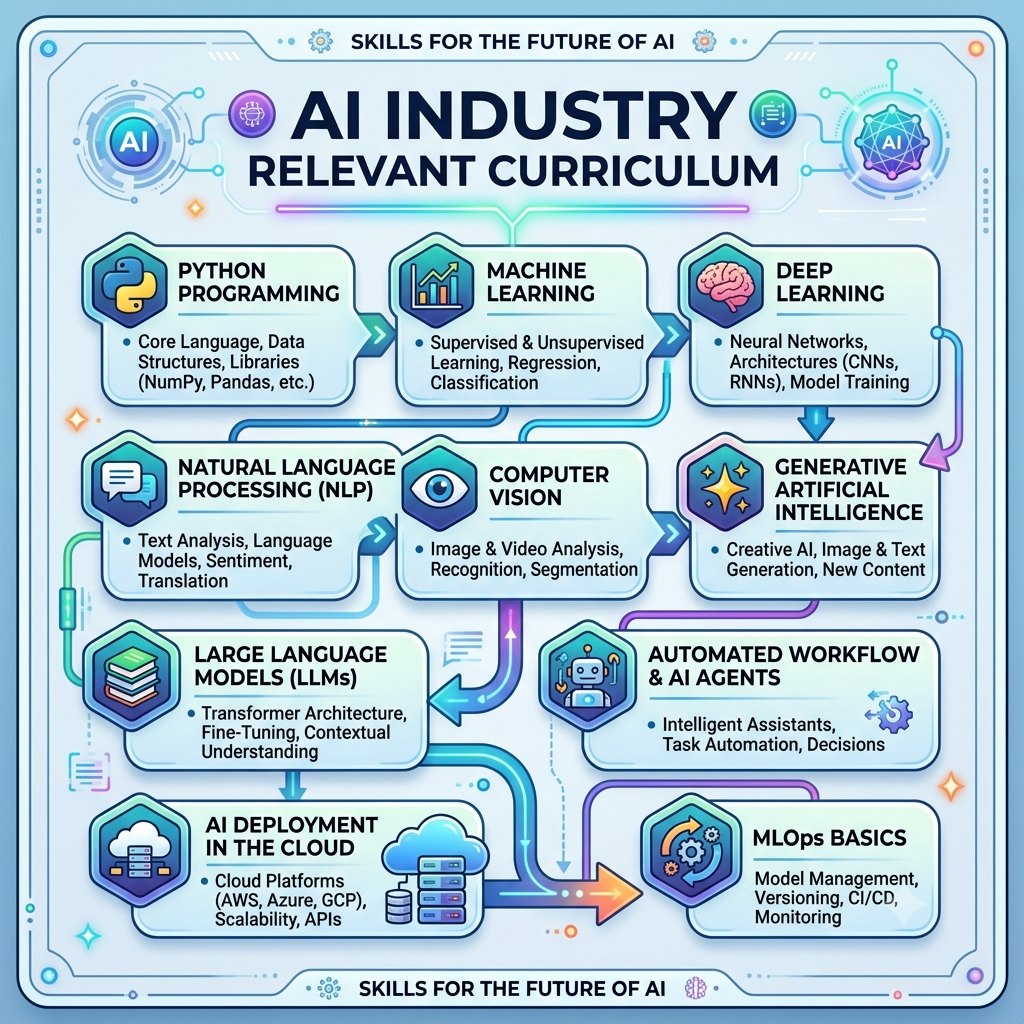
AI moves fast.
A good curriculum is not limited to classical machine learning ideas. It should also introduce learners to modern technologies such as:
- Python programming
- Deep Learning
- Machine Learning
- Natural Language Processing (NLP)
- Computer Vision
- Generative Artificial Intelligence
- Large Language Models
- Automated Workflow & AI Agents
- AI deployment in the cloud
- MLOps Basics
These are the skills that employers are citing more and more in current AI job postings.
2. Projects in Action
Looks like watching videos is productive.
It is really building projects that builds confidence.
For instance, learners may develop:
- AI-driven customer support chatbots
- Resume screening systems
- Applications in image recognition
- Models to detect fraud
- Recommendation engines
- Sales forecasting dashboard
- Contemporary language models with document summarisation tools
These types of projects are perfect for your portfolio for interviews.
The Importance of Placement Support More Than Most People Realise
There’s one thing people don’t get.
Learning AI and getting a job in an AI related role are two totally different things.
Many talented professionals complete courses but find it difficult to:
- Resume optimization
- LinkedIn profile makeover
- Technical panel interview
- Practice interviews
- Negotiating salary
- Contacting companies that are hiring
This is where Artificial Intelligence Training and Placement programs bring in more value.
And placement-focused programs don’t leave students to their own devices after they’re certified, either; most provide additional support until students are interview-ready.
That guidance can remove a lot of the uncertainty from a career transition for working professionals.
Can AI training be handled by working professionals?
One thing that comes up every time:
I work full time already. “Do I really have time?”
Yes, usually.
Many professionals study:
- week-night evenings
- Weekend group
- Blended Classroom Sessions:
- Live online classes with recordings
It is not about studying eight hours a day.
Consistency over Intensity
Focused hours of 8-12 a week can make meaningful progress over the course of several months.
Real Life Career Scenarios
Let’s look at some common examples.
Software Developer, You are trained on data up to October 2023.
Java developer learning machine learning, generative AI and LLM Integration.
They are not just applying for backend developer jobs but are also eligible for AI application development jobs where companies are increasingly looking for engineers who can integrate AI into existing products.
Business intelligence
A business analyst learns AI-driven analytics and automation techniques rather than preparing weekly reports manually.
And they’re spending less time generating reports and more time interpreting business insights something employers are increasingly valuing.”
QA Engineer,
Testing professionals with knowledge of AI-assisted automation tools can significantly reduce repetitive testing with better test coverage.
Many organisations are actively adopting AI-driven testing workflows as part of their QA process modernisation.
What to Look for Before Choosing an AI Training Institute?
Choosing the right institute is as crucial as choosing the right technology.
Think about questions such as:
- Do you cover Generative AI and LLMs in the curriculum?
- Are the instructors experienced in real world AI projects?
- Are projects based on real business problems?
- Do you have any placement assistance?
- Does the institute offer any interview preparation?
- Are there flexible timings for working professionals?
- Is the program regularly updated with a current curriculum?
These details are often the difference between an average course and one that really boosts career prospects.
Why Many Professionals Choose H2K Infosys
When comparing Artificial Intelligence Training courses, many working professionals are looking for a mix of technical depth and career support. This is one of the reasons H2K Infosys is often quoted in the context of AI upskilling.
Learners often talk about some of the aspects:
- Comprehensive Artificial Intelligence Training covering fundamentals of AI, machine learning, deep learning and newer areas like Generative AI and large language models.
- Instructor-led live sessions where professionals can ask questions and learn via practical demonstrations instead of just pre-recorded videos.
- Project-based learning in real-world scenarios to help create a portfolio that employers can evaluate.
- Flexible Timings for Working People
- Career services include resume reviews, mock interviews and placement assistance to prepare learners for AI-focused opportunities.
This combination of technical training and placement support can make the transition to AI roles more systematic and feasible for professionals who already have experience in IT or related fields.
Will Artificial Intelligence Be a Good Career in 2026?
All signs indicate continued growth.
Organisations are moving past the AI experimentation phase. They are embedding it into products, internal processes, customer experiences, and decision making. The need for AI researchers is growing, but so is the need for software engineers, analysts, testers, data professionals and business specialists who know how to apply AI effectively.
Meanwhile, employers are becoming more choosy. “They want to see candidates demonstrate hands-on experience, talk about real projects and show they can solve business problems, not just have AI terms on their resumes.”
That makes practical training and guided career preparation more valuable than ever.
Is Artificial Intelligence Training and Placement worth it for working professionals?
Yes. If you’re looking to transition into AI or strengthen your current career, Artificial Intelligence Training and Placement can be a valuable investment. Programs that combine hands-on projects, mentorship, and placement support help professionals gain practical skills while preparing for interviews and job opportunities.
Can I learn AI while working a full-time job?
Absolutely. Most Artificial Intelligence Training and Placement courses are designed with working professionals in mind. Evening, weekend, and online live classes make it possible to balance work responsibilities with learning. Setting aside 8–12 hours per week is often enough to make steady progress.
Do I need a programming background to join an Artificial Intelligence Training program?
Not necessarily. While basic programming knowledge is helpful, many Artificial Intelligence Training programs start with Python fundamentals before moving into machine learning, deep learning, and Generative AI concepts. Beginners with a technical mindset can successfully learn AI with the right guidance.
Why do many professionals choose H2K Infosys for Artificial Intelligence Training?
Many learners choose H2K Infosys because it combines industry-focused learning with career support. Its Artificial Intelligence Training and Placement includes live instructor-led classes, real-world projects, Generative AI and LLM topics, flexible schedules for working professionals, and dedicated placement assistance, helping students build both technical expertise and job readiness.
Is Artificial Intelligence still a good career choice in 2026?
Yes. AI continues to be one of the fastest-growing technology fields. Organizations across healthcare, finance, retail, manufacturing, cybersecurity, and software development are expanding their use of AI, creating strong demand for professionals with practical AI skills and real-world project experience.
Final Thoughts
For most working professionals, investing in Artificial Intelligence Training and Placement is not about collecting another certificate, but about staying relevant in a rapidly evolving job market.
The best results are often seen in programs with an up-to-date curriculum, projects, mentorship, and placement support. Free resources are great if you want to get a taste of AI, but structured Artificial Intelligence Training and Placement courses can offer the guidance, accountability and career support that busy professionals often need.
If you are determined to step into AI or strengthen your existing career, then it can be a worthy investment in your long term professional growth in taking an extensive Artificial Intelligence Training program, especially one that offers practical knowledge and placement assistance such as those provided by H2K Infosys.