If you’re looking for one AI training course that works for both complete beginners and working professionals, the best choice is a program that combines strong fundamentals, hands-on projects, industry-recognized tools, and real placement support. A course that teaches theory alone is no longer enough in 2026. Employers want practical AI skills, portfolio projects, and experience solving real business problems.
Artificial Intelligence has moved far beyond being a niche technology. Whether it’s customer support, healthcare, finance, software development, marketing, or manufacturing, AI is reshaping how work gets done. That also means choosing the right AI training program has become more important than ever.
The challenge? There are hundreds of online certifications, bootcamps, and institute-based programs. Some focus heavily on theory, while others rush through practical concepts. After comparing what employers actually look for and how learners typically progress, one pattern stands out: the most successful students are those who learn by building real projects not just watching video lectures.
What Makes an AI Training Course Worth Your Time?
A good course should help you move from understanding AI concepts to confidently applying them in real-world situations.
Here are the qualities that matter most today:
- Beginner-friendly curriculum with no unnecessary complexity
- Strong foundation in Python, machine learning, and deep learning
- Hands-on projects using current AI tools
- Exposure to Generative AI, Large Language Models (LLMs), and AI automation
- Guidance from experienced industry mentors
- Resume preparation and mock interview support
- Placement assistance with hiring partners
One thing I’ve noticed while speaking with hiring managers is that portfolios often carry more weight than certificates. A candidate who has built an AI-powered chatbot, recommendation engine, or predictive analytics dashboard usually stands out more than someone who simply completed a short online course.
Why AI Skills Are in High Demand in 2026
The AI landscape has evolved rapidly over the past couple of years.
Organizations are integrating AI into daily operations instead of treating it as an experimental technology. Generative AI assistants, intelligent automation, predictive analytics, and AI-powered software development have become part of mainstream business workflows.
Professionals with practical AI experience are finding opportunities across roles such as:
- AI Engineer
- Machine Learning Engineer
- Data Scientist
- Generative AI Developer
- AI Automation Specialist
- Business Intelligence Analyst
- NLP Engineer
Companies increasingly expect candidates to understand not only traditional machine learning but also modern AI workflows involving prompt engineering, vector databases, retrieval-augmented generation (RAG), and LLM integration.
Choosing Between Online Platforms and Structured Training Institutes
Self-paced online courses certainly have their advantages. They’re flexible and often affordable.
The downside is something many learners discover halfway through: staying motivated without mentorship can be surprisingly difficult. It’s easy to complete videos, but much harder to build production-ready projects or prepare for technical interviews on your own.
Structured institutes typically offer:
- Live instructor-led sessions
- Peer learning
- Project mentoring
- Career guidance
- Placement assistance
- Industry networking opportunities
For someone serious about changing careers or accelerating professional growth, this structured approach often delivers stronger long-term results.
A Practical AI Training Program for Beginners and Professionals
Among the institutes offering comprehensive AI education, H2K Infosys has positioned itself as a practical choice for learners who want both technical skills and career support.
Rather than focusing only on theoretical concepts, their AI training program is designed around real industry workflows and business applications.
Some highlights include:
- Beginner-friendly learning path
- Python programming fundamentals
- Machine Learning algorithms
- Deep Learning concepts
- Generative AI applications
- Hands-on projects
- Live instructor-led training
- Career mentoring
- Resume optimization
- Mock interviews
- AI training and placement support
This combination makes it suitable for fresh graduates, career switchers, IT professionals, and even experienced engineers looking to add AI expertise to their existing skill set.
Who Should Consider an AI Training Course?
One misconception still floating around is that AI is only for programmers.
In reality, learners come from many different backgrounds.
An AI course can benefit:
- Recent graduates entering the technology industry
- Software developers expanding into AI
- Data analysts moving toward machine learning
- QA professionals transitioning into automation
- Business analysts working with predictive analytics
- Working professionals seeking career advancement
- Entrepreneurs interested in AI-powered products
The best programs explain complex concepts gradually rather than assuming everyone already has advanced coding knowledge.
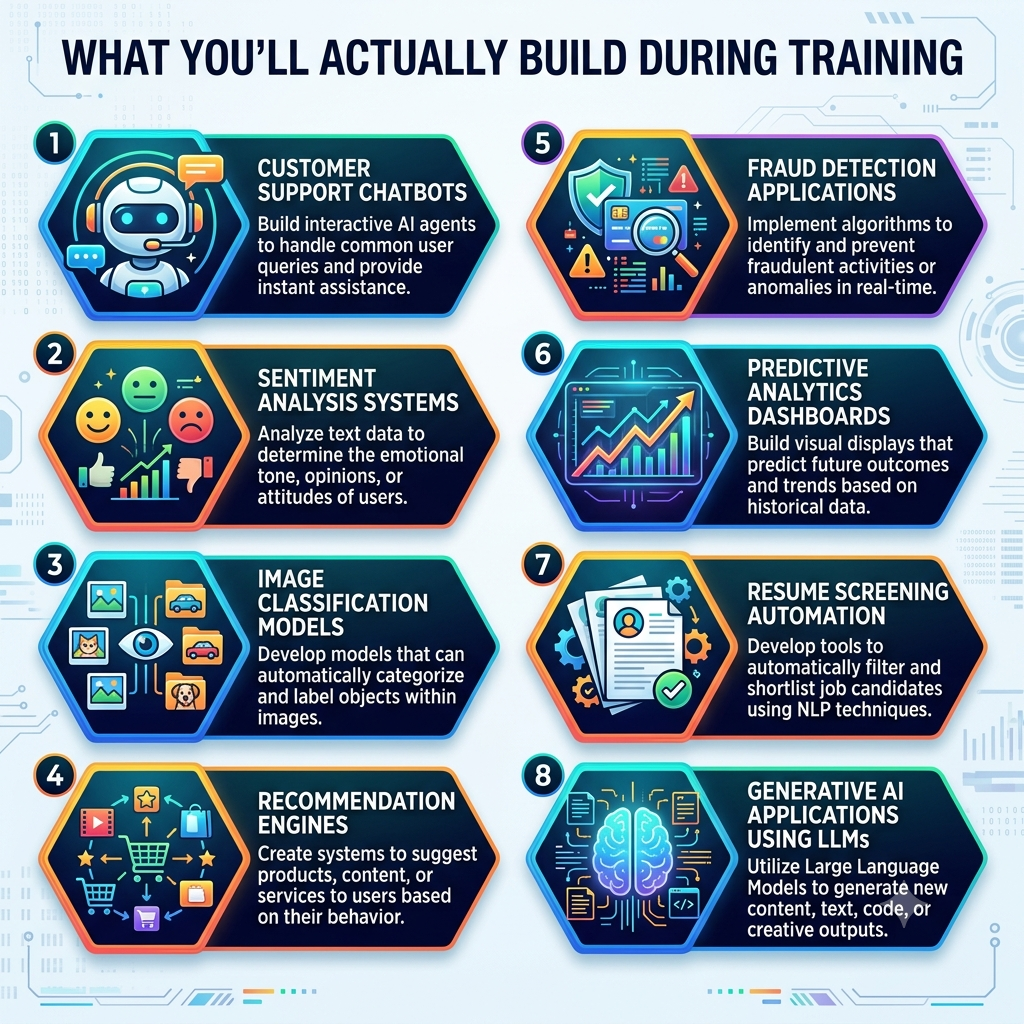
What You’ll Actually Build During Training
The difference between understanding AI and becoming employable often comes down to project experience.
A quality AI curriculum should include practical projects such as:
- Customer support chatbots
- Sentiment analysis systems
- Image classification models
- Recommendation engines
- Fraud detection applications
- Predictive analytics dashboards
- Resume screening automation
- Generative AI applications using LLMs
These projects help demonstrate practical problem-solving skills during interviews.
AI Training and Placement: Why It Matters
Learning AI is only one part of the journey.
Finding the right opportunity afterward can be equally challenging.
That’s where AI training and placement services become valuable. Programs that include career coaching often help learners with:
- Resume building
- LinkedIn profile optimization
- Portfolio development
- Mock technical interviews
- HR interview preparation
- Job referrals
- Placement assistance
For career changers especially, this guidance can shorten the transition from learning to employment.
A Realistic Learning Journey
Imagine someone working in software testing who wants to move into AI.
Instead of quitting their job and spending years earning another degree, they enroll in a structured AI training program. During evenings and weekends, they learn Python, machine learning, and Generative AI while building projects under mentor guidance.
Over a few months, they create a portfolio featuring an AI chatbot, a predictive analytics model, and an image recognition application. Combined with interview preparation and placement support, they’re in a much stronger position to pursue AI-focused roles.
This kind of transition has become increasingly common as companies prioritize demonstrated skills over traditional career paths.
Questions to Ask Before Enrolling
Before choosing any AI training course, consider asking:
- Is the curriculum updated regularly to include Generative AI and LLM technologies?
- Will I work on real industry projects?
- Are instructors experienced professionals?
- Is there live mentoring?
- Does the program include interview preparation?
- Is placement assistance available?
- Will I have a portfolio by the end of the course?
The answers to these questions often reveal far more than marketing claims.
Why H2K Infosys Stands Out
There are many AI learning options available today, but H2K Infosys differentiates itself by combining technical instruction with career-focused support.
Instead of treating certification as the finish line, the program emphasizes practical implementation, project-based learning, and interview readiness.
For beginners, the structured curriculum reduces the intimidation factor of learning AI from scratch.
For professionals, advanced projects and modern AI topics help bridge the gap between existing technical knowledge and today’s industry expectations.
Perhaps the biggest advantage is the emphasis on employability. A well-designed AI training program should do more than teach algorithms it should prepare learners to contribute confidently in real business environments.
Which AI training course is best for beginners?
The best AI training course for beginners is one that starts with Python fundamentals, machine learning basics, and gradually introduces advanced topics like deep learning and Generative AI. Look for a course that includes hands-on projects, live mentorship, and practical assignments rather than only recorded lectures.
Is an AI training program suitable for working professionals?
Yes. Many modern AI training programs are designed with flexible schedules, allowing working professionals to learn through live online classes, weekend sessions, or recorded content. These programs help professionals upskill without leaving their current jobs.
Why are hands-on projects important in AI training?
Projects allow you to apply what you’ve learned and build a portfolio that demonstrates your skills to employers. Practical experience with chatbots, recommendation systems, predictive models, or Generative AI applications often makes candidates more competitive during interviews.
How long does it take to complete an AI training program?
The duration varies depending on the curriculum and learning format. Most structured AI training programs can be completed in 3 to 6 months, while more advanced or part-time programs may take longer.
Why choose H2K Infosys for AI training?
H2K Infosys offers a practical AI training program that combines instructor-led sessions, real-world projects, industry-relevant curriculum, career mentoring, and AI training and placement support. The program is designed for both beginners and experienced professionals, helping learners build practical AI skills while preparing for interviews and job opportunities.
What career opportunities are available after completing an AI training course?
After completing an AI course, learners can pursue roles such as:
AI Engineer
Machine Learning Engineer
Data Scientist
Generative AI Developer
NLP Engineer
AI Automation Specialist
Business Intelligence Analyst
What is AI training and placement?
AI training and placement combines technical learning with career support. In addition to teaching AI concepts, these programs typically provide resume building, mock interviews, portfolio guidance, career mentoring, and placement assistance to help learners secure AI-related job opportunities.
Final Thoughts
Choosing the best AI training course depends on your goals, but the strongest programs share a common formula: practical learning, experienced instructors, real-world projects, and genuine career support.
If your objective is simply understanding AI, there are plenty of free resources available. But if your goal is building job-ready skills and increasing your chances of landing an AI role, investing in a structured AI training program with comprehensive AI training and placement assistance can make a significant difference.
For learners seeking a balanced combination of technical depth, hands-on experience, mentorship, and career guidance, H2K Infosys is a compelling option. Its project-driven curriculum, focus on current AI technologies, and placement-oriented approach align well with what employers increasingly expect in 2026. Rather than just earning another certificate, you’ll be working toward practical experience that can genuinely support your next career move.