Yes, an ai and machine learning course can be totally worth it for a beginner, as long as you find a practical course that covers the fundamentals, gives you hands-on project experience and helps you understand how AI is actually applied at work. Learning AI in 2026 is more about skills you can apply to real problems and less about chasing hype.
And there’s a reason why so many beginners are looking for ai and machine learning course right now. AI is no longer a specialist technology, but is moving into everyday business workflows, software development, analytics, customer support, healthcare, finance and automation. For example, the Stanford 2026 AI Index reports generative AI has achieved 53% population adoption in three years, and AI capability continues to accelerate.
But let’s be honest, doing a course does not make someone an AI engineer.
What matters is what you learn and how much you practise and whether you can actually build something after.
Why Are So Many Beginners Learning AI in 2027?
A few years ago AI was for researchers and Phd holders.
That’s changed.
Such as Businesses are using AI for:
- Automation of customer service
- fraud detection:
- Recommender systems
- Forecasting analytics
- Processing of documents
- Software Engineering
- Marketing analysis
- Applications of generative AI
- Automation of business processes
Machine learning and artificial intelligence specialists are still some of the fastest growing job categories in the World Economic Forum’s research, and its 2026 coverage underscores the pace at which AI is changing the skills employers prize.
There is one more important point.
AI isn’t replacing all jobs per se. Instead, many jobs are changing as people work side-by-side with artificial intelligence (AI) systems. The WEF has pointed to the increasing importance of humans who can identify problems, evaluate AI-generated results and control risks and decisions.
That makes for an interesting opportunity for beginners.
You don’t need to be a machine learning researcher; You can be the person in your current field who understands how to use, evaluate, build, or integrate artificial intelligence (AI) systems.
Do We Really Need a AI and Machine Learning Course for Beginners?
Not particularly.
Free tutorials, documentation, youtube videos, books and open source projects have a lot to teach you.
The problem is structure.
I’ve seen this happen a lot. Someone starts learning Python, dives into a machine learning tutorial, and suddenly they’re bombarded with NumPy, Pandas, regression, neural networks, tensors, APIs, and a dozen other new terms.
Three weeks later and the laptop is still there.
It’s not the motivation.
That’s why a structured ai and machine learning course for beginners can really help.
A good course provides you with a progression:
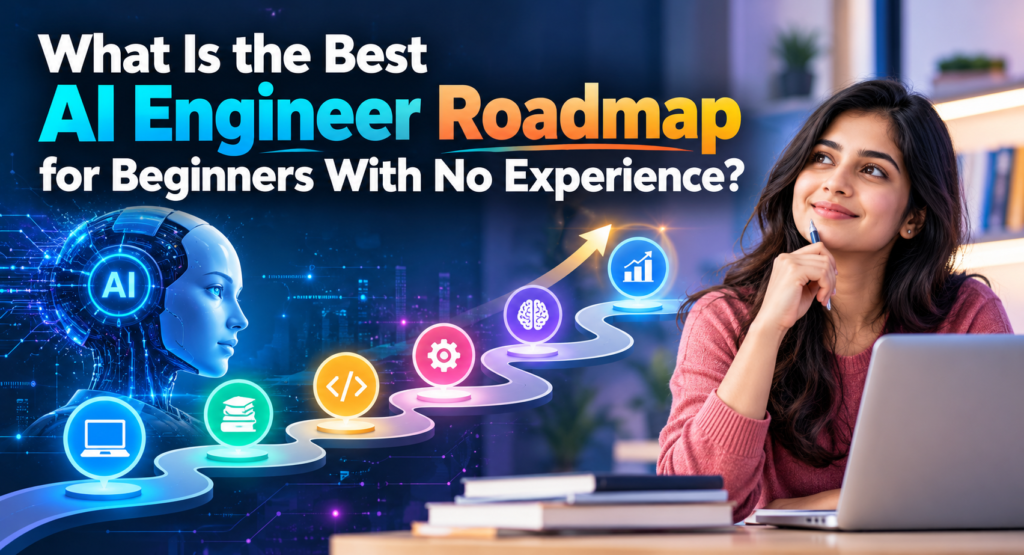
Python > data > machine learning basics > projects > advanced ideas > career prep
Instead of asking, “What do I learn next?” all the time, you can focus on learning.
What Should a Beginner Study First?
If the words neural network or supervised learning sound scary right now, don’t worry.
You don’t need to have all the answers on day one.
Something like this is a good starter roadmap.
1. Python Basics
Python is one of the most useful entry points for machine learning and artificial intelligence.
You should know:
- Variables and data types
- Conditions and loops
- Features
- Lists and dictionaries
- Object orientation basics
- File handling
- Basic debugging
You don’t have to be a Python guru before you get into AI.
You need just enough Python to solve problems without fighting the language every 5 minutes.
2. Data Processing
This is the lesssexy side of AI, and arguably the most important.
You will discover:
- NumPy
- Pandas
- Data cleaning
- Visual representation of data
- Missing values
- Choosing features
- Data pre-processing
Real world data is messy.
A course that teaches you how to run a model on a perfectly prepared dataset isn’t preparing you very well for real work.
3. Basics of Machine Learning
And this is where things begin to get fun.
You might find out things like:
- Supervised learning
- Unsupervised learning
- Backslide
- Classification
- Decision Tree
- Random forests
- Clustering Techniques
- Model assessment
- Feature engineering
Say, for example, a company wants to predict if a customer will cancel a subscription.
You could train a model on historical customer data, test its predictions and see which factors appear to have an effect on churn.
Suddenly, machine learning has become more than a textbook definition.
You have a problem in business.
What About Deep Learning and Generative AI?
This is where modern AI courses need to catch up.
While traditional machine learning remains hugely powerful, the modern AI ecosystem also comprises deep learning, neural networks, natural language processing, computer vision, and generative AI.
For instance, the present ai and Machine Learning course curriculum of H2K Infosys encompasses the learning areas such as prediction modelling, preprocessing of data, supervised and unsupervised learning, deep-learning concepts, neural networks and practical applications.
Data Science and Machine Learning includes Python, TensorFlow, Scikit-learn, deep learning, NLP, visualisation of data, and model training.
This is good because you shouldn’t learn AI in a 2019 bubble.
The landscape has shifted.
Why H2K Infosys is Interesting For Beginners?
If you are looking for a practical training option, then H2K Infosys may be worth checking out.
One thing that strikes me is the emphasis on going from fundamentals to hands-on work, rather than expecting beginners to come in knowing everything already.
Its beginner-friendly learning path for 2026 takes you from Python and data basics to machine learning, AI tools, projects, and job-ready skills.
That makes a lot of sense.
The idea is simple:
Learn Practice Build Teach Interview practice
The last part is easy to forget.
You might know random forests inside and out, but when an interviewer asks you:
“Tell me about a machine learning project you worked on?”
But the ability to explain what you built, why you built it the way you did, what went wrong and how you judged the outcome is a different skill altogether.
H2K Infosys says its AI training for beginners also includes hands-on projects, resume help, mock interviews and exposure to real-time project environments.
That’s a potent combination for anyone looking to turn learning into a career move.
What can a beginner actually build?
This is where I’d tell beginners not to think about complex AI applications.
Your first project doesn’t have to be the next chatGPT.
Begin small.
Example 1: Predicting Customer Churn
You get customer details like:
- Time since account creation
- How much I spend in a month
- Support requests received
- Type of subscription
- Past cancellations
Your model predicts if a customer will likely churn.
Classification, preprocessing, evaluation and business interpretations you learn.
Example 2: Predicting house prices
Estimate prices from historical property information
This is what you will learn:
- Backslide.
- Engineering features
- Visualising data:
- Model assessment
Example 3: Simple Recommendation Engine
Create a basic movie or product recommendation system that considers user preferences.
This gives you an introduction to the logic behind recommendation engines found across modern digital platforms.
These are not showy projects.
That’s the thinking.
Someone who’s just starting out but can build and explain 3 small projects often has something far more valuable than someone who’s watched 100 hours of AI lectures.
How Much Math Do You Need?
It’s a question I get asked all the time.
Some math helps, but you don’t need to be a mathematician to begin with.
Start with:
- Simple statistics
- Likelihood
- Average median variance
- Correlation
- Foundations of linear geometry
- Basic calculus concepts along the way
You can learn the maths as you learn machine learning.
Don’t spend 6 months learning sophisticated mathematics before you write your first model. You’re going to get bored.
This means learn enough math to understand why an algorithm does what it does, and then go deeper as your projects become more sophisticated.
Are AI and ML Courses Still Relevant When Generative AI Is All Around?
Yes. But the reason is different.
Generative AI tools have made it much easier to generate code, summarise, build prototypes, and interact with sophisticated technology.
This can cause a beginner to ask:
“If AI is able to write code, why do I need to learn AI?
Because using an AI tool and understanding an AI system aren’t the same thing.
You still need people who can:
- Define the problem
- Prepare the data
- Check whether outputs are reliable
- Evaluate models
- Understand limitations
- Design workflows
- Integrate AI into current systems
- Make decisions when the AI is wrong
The 2026 World Economic Forum discussion around AI and work makes this distinction particularly relevant: human value increasingly involves defining problems, setting constraints, evaluating outcomes, and exercising judgment.
So I’d look at AI education differently now.
Don’t learn AI simply to compete with AI.
Learn AI so you know how to work effectively with it.
What Should You Look for in AI and ML Courses?
Before paying for any program, check these things.
1. Does it start at your level?
If you’re a total beginner, don’t pick a course that assumes you already know Python, statistics and machine learning.
That’s a recipe for frustration.
2. Are there real projects?
Look for projects involving actual datasets and realistic problems.
Not only quizzes.
3. Does it teach the fundamentals?
Tools change.
The fundamentals don’t disappear that quickly.
A good course will teach concepts, not just tell you which buttons to click.
4.Does it include modern AI topics?
I would like exposure to areas such as: In 2026
- Machine learning
- Deep learning
- NLP
- Generative AI
- AI tools and frameworks
- Model evaluation
- Artificial intelligence in practice
5.Is there instructor or mentor support?
This can be quite surprisingly important.
Sometimes you are stuck because of one tiny Python error. You could spend four hours searching for it or someone experienced could point it out in five minutes.
6. Does it help with career preparation?
If you are looking for a job, look beyond the certificate.
Resume preparation, mock interviews, projects, portfolio guidance and job-oriented practice can be far more useful than another certificate sitting in a folder.
Why H2K Infosys Can Be a Practical Choice
H2K Infosys ai and machine learning course training is designed for beginners who are looking for a more hands-on and job-oriented learning experience.
Currently, the AI and Machine Learning course being advertized offers 40 hours of training, practical projects, prediction modelling, deep learning concepts, neural networks, and machine-learning fundamentals.
Its AI-focused content also covers exposure to tools like Python, Jupyter, Scikit-learn, TensorFlow/Keras, and in some advanced tracks, PyTorch.
And there’s good reason to try a demo before you commit.
As a part of the enrolment process, H2K Infosys provides demo sessions to the beginners, to give a feel of the training to the learners before they take up the actual training.
I’d recommend doing exactly that with any training provider.
Don’t fall for a fancy landing page.
Join the demo. Check out the syllabus. Who teaches it? Ask how projects work. See how much support you really get.
Then make up your mind.
Who Should Take an AI & Machine Learning Course?
An AI and Ml course can make sense for several types of learners.
Academics
If you are studying computer science, engineering, mathematics, statistics or any related field, AI skills can complement your academic background.
Software Development
AI and ML knowledge can help developers transition to AI engineering, intelligent applications, automation and machine learning development.
Data Analysts
This is a particularly natural transition.
If you’re already comfortable working with data, then learning machine learning can broaden what you’re able to do.
Employed professionals
You don’t necessarily need to leave your current career.
Someone in Finance, Healthcare, Marketing, Operations, QA, or Business Analysis might find AI useful in their area.
Absolute Beginners
Yes, even you.
You don’t have to wait until you’re “technical enough.”
A good beginner program will introduce the technical bits in stages.
When is AI Course Not Worth It?
And let’s not make this a sales pitch.
A course on AI is not worth your money if:
- A certificate is supposed to get you a job by itself.
- You don’t plan to practice outside class.
- You dislike programming. You don’t want to learn programming.
- There are no actual projects in this course.
- Syllabus is mostly out of date theory.
- It promises unrealistic salaries or guarantyd results.
- You’re only picking it because AI is hot right now.
AI is a serious technical discipline.
There will be frustrating days.
Your first model might be terrible. Your python code will not work. You’ll be asking yourself why a missing bracket has ruined your afternoon.
That’s normal.
The people who move forward are often those who keep on building.
A Simple Roadmap for Beginners
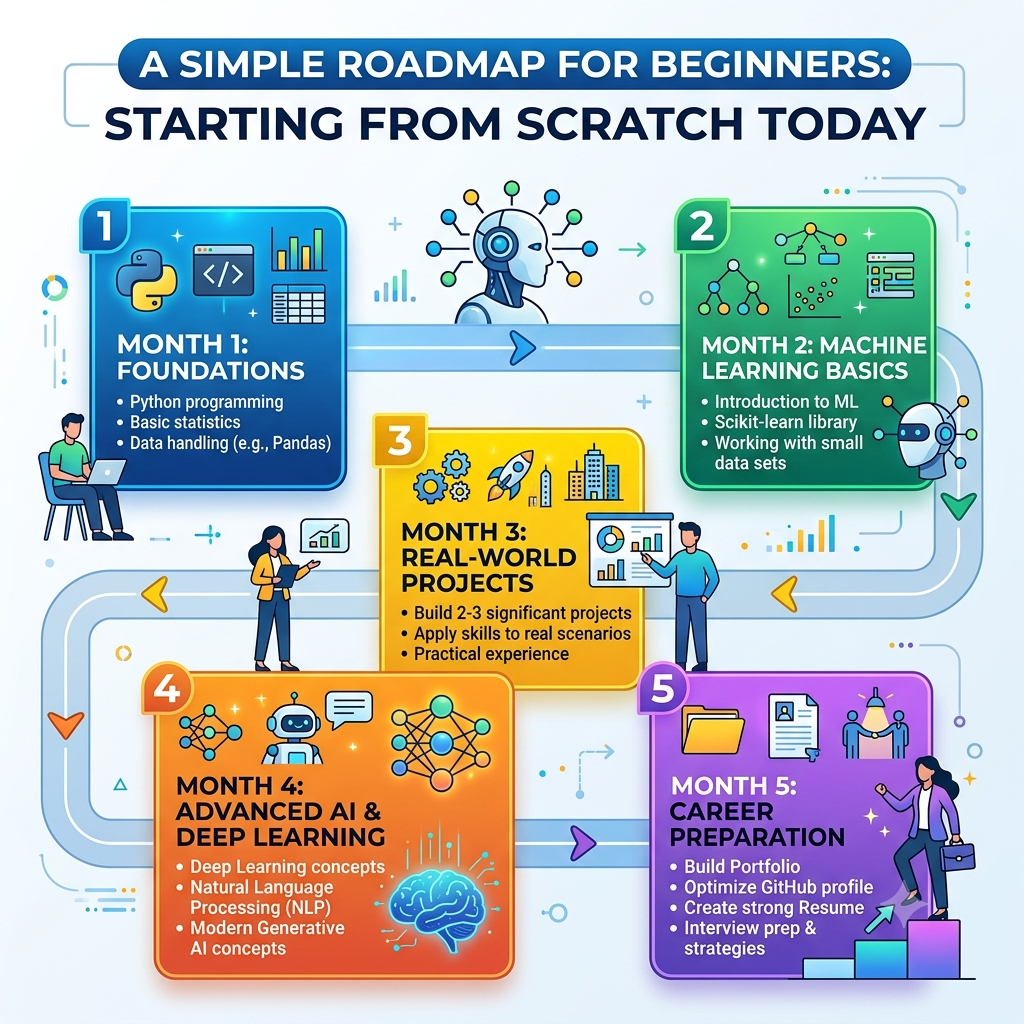
If I was starting from scratch today I would keep it pretty simple:
Month 1:
Python + basic statistics + data handling
Month 2: 2.
Basics of machine learning + Scikit-learn + small data sets
Month 3: #4.
Build 2-3 real world projects
Month 4:
Deep learning + NLP + modern generative AI concepts
5th Month:
Portfolio + GitHub + resume + interview prep
It doesn’t matter when it was.
Consistency is.
Even 60-90 minutes of focused practice most days can take you surprisingly far over a few months.
Final Thoughts : Are Machine Learning and AI Courses for Beginners Worth It?
Yes, if you choose the right course, and treat it as skill-building, not certificate-collecting.
AI is not slowing down. The Stanford 2026 AI Index shows continued acceleration in AI capabilities and adoption, and the World Economic Forum continues to emphasise AI-related skills and roles as a major force reshaping work.
But don’t sign up just because everyone is talking about AI.
Pick a program that allows you to start from where you are, learn the fundamentals of Python and machine learning, work with real data, create projects, experiment with state-of-the-art AI tools, and get help when you need it.
If you are a beginner and looking for a structured, career-oriented learning path, H2K Infosys is one school to consider. For one, its current training materials are focused on practical projects, modern AI/ML concepts, and career preparation.
Learn H2K Infosys AI & Machine Learning course Training
One last thought: don’t wait for the right moment. Most beginners will never feel ready enough. Start with the basics, build a little thing, break it, fix it, and do it again. This is where AI starts to become a skill, not just another buzzword.