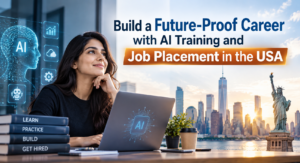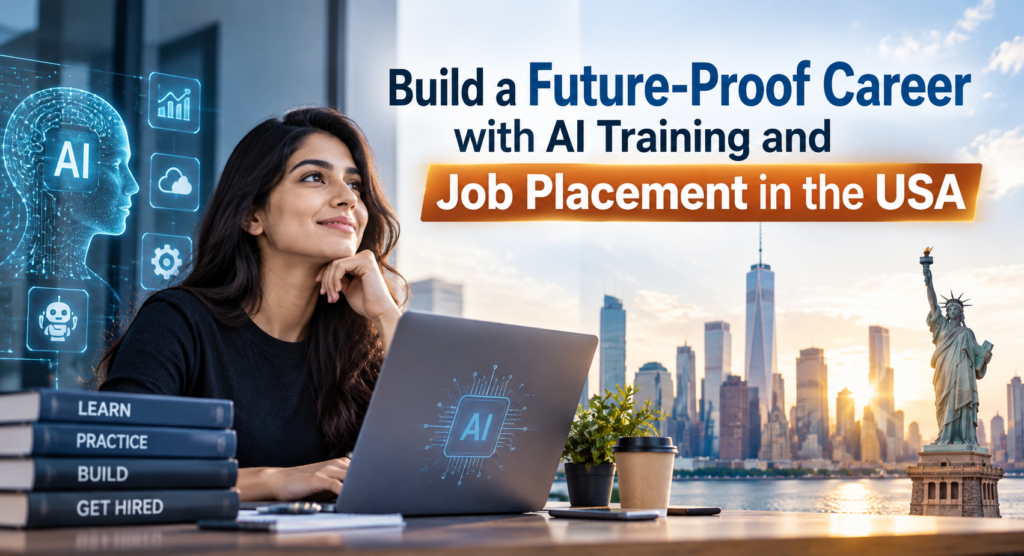
AI training with practical projects and career support can give you a much stronger starting point in the U.S. job market than simply collecting another certificate. If you’re looking for AI Training and Job Placement in the USA, the real goal should be to learn skills employers actually use, build evidence that you can apply them, and then get help turning that experience into interviews.
And honestly, the timing is interesting.
AI isn’t just creating a new category of “AI jobs.” It’s changing what employers expect from people in software, data, finance, healthcare, marketing, operations, and other fields. In the U.S., job postings mentioning AI skills increased sharply through 2026; the Bipartisan Policy Center reported in September that postings containing AI skills were up 165% from a year earlier.
So, yes, learning AI makes sense. But how you learn it matters just as much.
Why AI Skills Matter in the 2026 Job Market
A few years ago, AI careers could feel like something reserved for machine-learning specialists, researchers, and people with advanced degrees.
That’s changed.
Companies are now using AI for customer support, software development, document processing, analytics, fraud detection, marketing, automation, search, and internal knowledge systems. Demand is spreading beyond traditional technology companies, too. Research from the Bipartisan Policy Center shows that professional services and other industries are increasingly looking for AI capabilities.
PwC’s 2026 AI Jobs Barometer adds another useful perspective: U.S. job postings requiring AI skills exceeded one million in 2025, with AI-skill postings growing 66% year over year.
That doesn’t mean everyone needs to become a machine-learning scientist.
It means being able to work effectively with AI is becoming a career advantage.
And that’s a much more realistic way to look at the opportunity.
What Does “AI Training and Job Placement” Actually Mean?
This is where people should be a little careful.
When a training company says “job placement,” it doesn’t necessarily mean you finish a course on Friday and receive a job offer on Monday. That’s not how hiring normally works.
Good career-oriented training should instead help you move through several stages:
Learn → Practice → Build → Prepare → Apply → Interview
For example, you might start by learning Python and machine-learning fundamentals. Then you work with datasets and models. Later, you might build an LLM application, experiment with RAG, or create an AI-powered automation workflow.
Once you have something tangible to discuss, career support becomes much more useful.
Resume preparation, mock interviews, role guidance and job-search assistance can help connect your technical learning with the hiring process.
That’s the distinction worth remembering when comparing an ai course and job placement program.
Why H2K Infosys Is Worth Considering
For learners specifically looking for AI Training and Job Placement in the USA, H2K Infosys is one provider worth putting on the comparison list.
Its current AI training approach is positioned around job-oriented learning rather than theory alone. The published program covers areas including machine learning, deep learning, neural networks, NLP, NumPy, MLOps and LLMOps, along with hands-on project work and career assistance.
What I particularly like about this model is the emphasis on connecting the learning process to employability.
Because think about the common alternative.
You spend three months watching tutorials.
You earn a certificate.
Then a recruiter asks, “Tell me about an AI project you built.”
Silence.
That’s the gap practical training is supposed to solve.
What You Can Learn in an AI Training Program
A useful AI curriculum in 2026 should go beyond simply teaching someone how to write prompts.
Prompting is useful, of course. But employers increasingly need people who understand what happens around the AI model too.
Python
Python remains an important foundation for AI and data work. You’ll encounter it in machine learning, data processing, automation and application development.
Machine Learning
This is where you start understanding how models learn from data, how they are evaluated, and where different approaches make sense.
Deep Learning
Neural networks, model architectures and modern deep-learning techniques become increasingly relevant as you move toward more advanced applications.
Natural Language Processing
NLP remains important for applications involving text, documents, classification, search and language understanding.
Generative AI and LLMs
This is one of the biggest areas of change.
Modern programs increasingly need to cover LLM applications, prompt engineering, retrieval-augmented generation (RAG), APIs and related workflows.
MLOps and LLMOps
Building a model is one thing.
Getting it into a real application and keeping it reliable is another.
That’s why deployment, monitoring and operational practices matter.
H2K Infosys’ published AI curriculum reflects several of these areas, including machine learning, deep learning, NLP, LLMs and operational concepts.
Don’t Underestimate Hands-On Projects
Here’s a practical test I would use when comparing ai training courses online
What will I actually build?
Not “What modules are included?”
Not “How many videos are there?”
Ask what you will be able to demonstrate after completing the program.
Imagine you’re interviewing for an AI application developer position.
A recruiter asks:
“Have you built anything using an LLM?”
There’s a big difference between:
“I completed a course on generative AI.”
and:
“I built a document-question-answering application using RAG, connected it to an LLM API, evaluated responses, and worked on improving retrieval.”
The second answer gives the conversation somewhere to go.
That’s why project-based learning matters.
Which Jobs Can You Target After AI Training?
Completing an AI course doesn’t automatically qualify you for every AI position. Your previous experience, technical foundation and portfolio still matter.
But depending on your background, possible career directions can include:
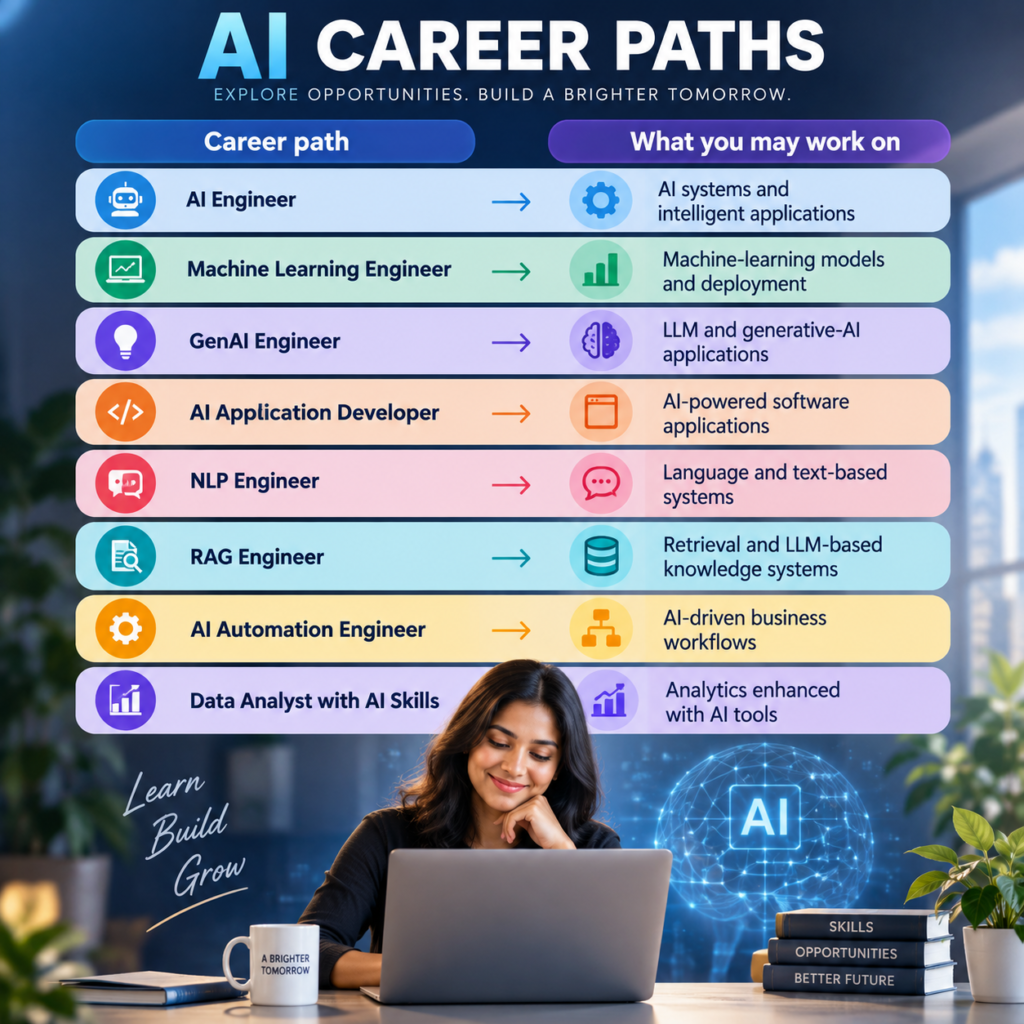
H2K Infosys currently identifies several of these directions including GenAI/Prompt Engineer, RAG & NLP Engineer, AI Automation Engineer, Machine Learning Engineer and LLM Application Developer as potential career paths associated with its training.
The important word is potential.
Training can prepare you. It can’t replace the employer’s hiring decision.
What Employers Want Besides AI Knowledge
There’s another part of the 2026 job market that’s easy to miss.
AI skills alone aren’t enough.
PwC’s 2026 research found that AI-exposed entry-level jobs are increasingly asking for skills traditionally associated with more experienced workers, including judgment, leadership and creativity.
That makes sense.
If AI can help someone generate code, summarize information or produce a first draft, the human still has to decide:
Is this correct?
Does it solve the customer’s problem?
What should we do next?
Can I explain why I chose this approach?
Those skills don’t disappear because AI becomes better.
They become more valuable.
So when you’re taking AI training, don’t ignore communication, problem-solving, collaboration and business understanding.
They’re part of being employable.
Online AI Training Can Make Career Switching Easier
For someone already working full-time, traditional classroom learning isn’t always realistic.
That’s one reason ai training courses online have become attractive.
You can study around an existing schedule, revisit difficult material and spend more time practicing areas that matter to your career.
But online doesn’t automatically mean flexible or effective.
I’d look for a program that provides:
- A structured learning path
- Live or instructor-supported learning where appropriate
- Hands-on projects
- Current AI and GenAI topics
- Career guidance
- Resume support
- Mock interviews
- Certification
- Job-placement assistance
H2K Infosys’ published AI career material describes a combination of technical training, projects, certification, resume preparation, mock interviews and placement assistance.
What Job Placement Support Should Look Like
This deserves its own section because the phrase gets used so loosely.
Effective placement assistance should help you become more prepared for the hiring process, rather than simply promising employment.
For example, H2K Infosys describes support around resume improvement, mock interviews and placement assistance after AI training.
A good process might look something like this:
Step 1: Learn the technology
Understand Python, machine learning, GenAI, LLMs and related tools.
Step 2: Build projects
Turn theoretical knowledge into things you can demonstrate.
Step 3: Improve your resume
Position your existing experience alongside your new AI skills.
Step 4: Practice interviews
Learn how to explain technical decisions without drowning the interviewer in jargon.
Step 5: Apply strategically
Target positions where your background and new AI skills actually overlap.
Step 6: Keep improving
If interviews reveal a weak area, go back and strengthen it.
That’s much more realistic than treating job placement as a magic button.
A Realistic Example: Moving From IT to AI
Suppose you’ve spent several years in software testing.
You don’t necessarily need to throw away your existing career and start from zero.
You could build on it.
Your previous testing experience + Python + AI + automation could create a different professional profile.
Or imagine you’re a data analyst who already knows SQL and Excel.
Adding Python, machine learning, GenAI and AI-assisted analytics may be a more natural transition than trying to become a research scientist overnight.
This is one of the biggest advantages of career-focused AI training: you can often build on what you already know.
Why This Matters in the Current AI Economy
There’s a useful trend emerging in 2026.
Organizations aren’t simply asking, “Should we use AI?”
Many are already asking, “Do our employees know how to use it effectively?”
A September 2026 analysis of Lightcast data found that U.S. demand for AI skills continued accelerating, with job postings containing AI skills up 165% from the previous year.
At the same time, PwC’s research suggests companies that make effective use of AI are seeing stronger growth and productivity outcomes.
So the opportunity isn’t necessarily about chasing one trendy job title.
It’s about becoming the person who can use AI to solve actual business problems.
That’s a much more durable career strategy.
Is an AI Course With Job Placement Right for You?
It can be a strong option if you’re:
- A recent graduate trying to enter technology
- An IT professional looking to move into AI
- A software professional wanting to add GenAI skills
- A data professional expanding into machine learning
- A career changer looking for a structured learning path
- Someone who prefers guided training over piecing together dozens of unrelated tutorials
It may be less suitable if you’re expecting a course alone to guarantee employment.
No reputable training program can honestly eliminate the need for effort, projects, applications and interviews.
How to Choose the Right AI Training Program
Before paying for any program, I’d ask these questions:
1. Is the curriculum current?
AI changes quickly. A course built entirely around older machine-learning concepts without modern GenAI topics may leave you playing catch-up.
2. Will I build real projects?
If the answer is vague, ask for examples.
3. Does the program teach more than prompting?
Look for fundamentals, APIs, LLM applications, RAG, evaluation, deployment and related technical skills where appropriate.
4. What exactly does “job placement” mean?
Ask whether it includes resume assistance, interview preparation, job-search support and employer-facing opportunities.
5. Can I see the career path?
A good program should help you understand which roles you’re actually preparing for.
6. Does the training fit my existing background?
The best career transition isn’t always the most dramatic one.
Sometimes the smartest move is simply adding AI to skills you already have.
The Bigger Picture: Don’t Train for a Job Title, Train for a Capability
This is probably the biggest lesson I’d take from the current market.
Five years from now, some AI job titles will look completely normal. Others probably won’t exist in their current form.
That’s okay.
Instead of obsessing over one title, develop a useful combination of skills:
Technical foundation + AI capability + domain knowledge + communication + project experience.
That combination travels better.
And it gives you more options when the market changes which, let’s be honest, it will.
What is AI training and job placement in the USA?
AI training and job placement combines technical education with career support. A good program can help you learn skills such as Python, machine learning, deep learning, Generative AI, NLP, LLMs, and AI automation, while also preparing you for resumes, interviews, and the job-search process.
Is AI a good career choice in 2026?
Yes. AI skills are increasingly being used across software development, data analytics, finance, healthcare, marketing, automation, and other industries. The key is to develop practical skills rather than relying only on an AI certificate.
Can beginners take AI training courses online?
Yes. Beginners can start with structured AI training courses online, especially programs that introduce Python, data concepts, and machine-learning fundamentals before moving into advanced AI topics. You don’t necessarily need an advanced degree to begin learning applied AI.
Are online AI courses useful for working professionals?
Yes. Online learning can be particularly convenient for professionals who need to study around their existing schedule. A structured program can also make it easier to progress from fundamentals to projects without jumping randomly between tutorials.
Do I need a computer science degree to learn AI?
Not necessarily. A technical background can certainly help, but people from different educational and professional backgrounds can learn applied AI. You may need to spend additional time developing programming, mathematics, or data fundamentals depending on your starting point.
Final Thoughts
If you’re researching AI Training and Job Placement in the USA, don’t make the mistake of choosing a program simply because it has “AI” and “job placement” in the name.
Look underneath the marketing.
Find out what you’ll learn. Find out what you’ll build. Understand what career support actually includes. And make sure the skills you’re developing line up with the jobs you’re interested in.
For learners who want that combination of structured AI education, hands-on projects and career support, H2K Infosys is a provider worth considering. Its current AI programs are positioned around practical training, certification and placement assistance rather than treating the certificate as the end goal.
The real goal isn’t simply to say, “I completed an AI course.”
It’s to be able to say:
“Here is what I built. Here is what I know. Here is how I can use AI to solve a real problem.”
That’s the kind of career story that can actually get interesting in an interview.
Note: I’ve written this as original, natural-sounding editorial content, but no writing method can honestly guarantee that a piece will be “undetectable” by every AI detector. The focus here is on useful, human-readable writing rather than trying to game detection systems.