

The best AI Engineer Roadmap for beginners with no experience starts with Python programming, basic mathematics, data handling, machine learning, deep learning, and practical AI application development. In 2026, the smartest approach is to combine these foundations with hands-on projects using large language models (LLMs), retrieval-augmented generation (RAG), and AI agents rather than spending months learning theory without building anything.
Here’s the good news: you don’t need a computer science degree, years of coding experience, or advanced mathematics to get started. What you do need is a realistic learning plan, regular practice, and the patience to work through problems that don’t make sense the first time.
If you’re starting from zero, this guide will walk you through the skills to learn, the tools worth exploring, the projects to build, and a practical timeline for becoming job-ready.
What Is an AI Engineer?
An AI engineer develops software applications that use artificial intelligence to solve real problems. Instead of only studying how AI models work, an AI engineer focuses on making those models useful, reliable, and accessible in real-world products.
For example, imagine a company receives hundreds of customer support emails every day. An AI engineer might build a system that reads each email, identifies the customer’s problem, searches a knowledge base, and suggests a helpful response to a support agent.
That system could involve Python, an LLM API, a search database, a backend service, and automated tests. The AI model is only one piece of the puzzle.
An AI engineer may work on tasks such as:
- Building AI-powered chatbots and virtual assistants.
- Integrating existing language models into websites and applications.
- Developing recommendation systems and predictive models.
- Creating document search and question-answering systems.
- Connecting AI models to databases, APIs, and business software.
- Evaluating model accuracy, controlling costs, and improving reliability.
- Deploying AI applications and monitoring them in production.
One distinction is worth understanding early: an AI engineer doesn’t always train AI models from scratch. Many roles focus on adapting existing models and building dependable applications around them. That’s often a more accessible starting point for beginners.
Best AI Engineer Roadmap for Beginners: Step-by-Step Plan for 2026
If you’re wondering what to learn first, don’t try to learn every AI tool you see on social media. New frameworks appear constantly, and chasing all of them is a surprisingly effective way to make very little progress.
Follow this sequence instead.
Your AI Engineer Roadmap at a glance
Learn Python programming
- Weeks 1–4 · Write code, use functions, work with files and APIs.
Build math and data foundations
- Weeks 3–6 · Understand statistics, probability, NumPy, pandas, and data cleaning.
Study machine learning
- Weeks 7–10 · Train models, evaluate predictions, and recognize overfitting.
Understand deep learning
- Weeks 11–14 · Learn neural networks, tensors, embeddings, and transformers.
Build applications with LLMs
- Weeks 15–18 · Work with model APIs, structured outputs, RAG, and tool calling.
Deploy projects and prepare for jobs
- Weeks 19–24 · Learn testing, Git, APIs, deployment, and portfolio presentation.
Suggested schedule for someone studying around 10–15 hours per week. These are learning targets, not guaranteed deadlines for job readiness.
You can adjust the timeline to suit your schedule. Someone who already knows programming may move through the first stages faster, while a complete beginner might need several additional months. That’s normal.
Step 1: Learn Python Programming From Scratch
Python is the first skill I’d recommend learning because it is widely used in machine learning, data analysis, automation, and AI application development.
You don’t need to become an expert software engineer before touching AI. But you should understand your code well enough to fix errors, change its behavior, and explain what it does.
Start with these topics:
- Variables, data types, and operators.
- Lists, dictionaries, sets, and tuples.
- Conditions and loops.
- Functions and modules.
- File handling and exceptions.
- Classes and basic object-oriented programming.
- Packages, virtual environments, and debugging.
- HTTP requests, JSON, and API basics.
- Git and GitHub for version control.
Try this small exercise: write a Python program that accepts a list of customer reviews and counts how many contain the words “good,” “bad,” or “excellent.”
It sounds simple, but it introduces lists, loops, string processing, conditions, and basic problem-solving. Later, you can replace the basic word counting with a machine learning model and compare the results.
That’s how you make progress: start with something small, then improve it.
Free learning resources:
- Official Python tutorial
- Google Colab for writing and running Python in your browser.
If you don’t have a powerful laptop, don’t let that stop you. Browser-based notebooks are enough for many early exercises.
Step 2: Learn the Mathematics and Data Skills You Actually Need
Mathematics can make the AI learning process feel intimidating, particularly if you haven’t studied it recently.
Here’s the practical answer: you need some math, but you don’t need to master every advanced topic before building your first application.
Focus on four areas.
Linear algebra
Understand vectors, matrices, dot products, and matrix multiplication. These ideas help explain how numerical data and embeddings are represented inside AI models.
Probability and statistics
Learn averages, variance, distributions, conditional probability, sampling, and correlation. These concepts help you interpret model predictions instead of blindly trusting them.
Basic calculus
Understand derivatives, gradients, and the general idea of optimization. You don’t need to derive every neural network equation by hand to begin.
Data handling
Learn NumPy and pandas, including missing values, filtering, grouping, and basic data visualization.
One useful way to learn these topics is to connect each concept to a project.
For example, if you’re building a house-price prediction model, statistics helps you understand the dataset, linear algebra helps explain the model’s numerical inputs, and evaluation metrics help you judge whether the predictions are useful.
You can study the math alongside Python rather than treating it as a separate subject that must be completed first.
Step 3: Learn Machine Learning Fundamentals
Machine learning is where your understanding of AI begins to come together.
Instead of writing every rule manually, you give a model examples and let it learn patterns from data. You then test whether those patterns help it make predictions on data it hasn’t seen before.
Start with the three main learning categories:
- Supervised learning: learning from labeled examples, such as predicting house prices or classifying spam emails.
- Unsupervised learning: discovering patterns or groups in data without predefined labels.
- Reinforcement learning: learning behavior through actions, feedback, and rewards.
You should also understand these concepts:
- Training, validation, and test datasets.
- Regression and classification.
- Feature engineering and preprocessing.
- Overfitting and underfitting.
- Accuracy, precision, recall, and F1 score.
- Cross-validation and model selection.
For your first practical machine learning library, start with scikit-learn. Its documentation covers model fitting, preprocessing, pipelines, and evaluation, which are core skills for working with real datasets.
A beginner-friendly project: build a spam email classifier.
Start with a labeled dataset containing spam and non-spam messages. Clean the text, split the data into training and testing sets, train a simple classifier, and evaluate its precision and recall.
Then examine the mistakes. Are important messages being marked as spam? Are promotional emails slipping through?
This final step is important. A model that produces predictions is not necessarily a good model. You need evidence that its predictions are useful.
Step 4: Understand Deep Learning and Neural Networks
Once you understand basic machine learning, move into deep learning.
Deep learning uses neural networks with multiple layers to learn complex patterns. It plays a major role in modern image recognition, speech processing, language models, and generative AI.
Learn these concepts gradually:
- Neurons, layers, and activation functions.
- Forward propagation and loss functions.
- Backpropagation and gradient descent.
- Training loops and optimization.
- Embeddings and vector representations.
- Attention mechanisms and transformers.
For implementation, learn PyTorch. Its beginner tutorials cover tensors, datasets, neural network construction, automatic differentiation, optimization, and saving trained models.
You can begin with a small neural network that classifies handwritten digits. This project teaches you how data flows through a model, how training changes its parameters, and why performance on unseen examples matters.
You don’t need to build a massive language model from scratch. Understanding the fundamentals is enough to begin exploring pretrained models and modern AI application development.
Step 5: Learn Generative AI and Large Language Models
This is where the AI Engineer Roadmap becomes especially relevant to the kinds of products many developers want to build in 2026.
Large language models (LLMs) can generate text, summarize documents, answer questions, extract information, and support many other language-based tasks. AI engineers connect these capabilities to useful applications.
Start with the basics:
- What tokens and context windows are.
- How prompting affects model outputs.
- How to use model APIs.
- How to request structured JSON outputs.
- How embeddings represent semantic relationships.
- How to use tool calling and function calling.
- How to evaluate responses and handle failures.
- When fine-tuning is useful and when it isn’t.
You should also learn the limitations. An LLM can confidently generate an incorrect answer, misinterpret a vague request, or produce output that doesn’t match the format your application expects.
A good engineer designs around those possibilities.
Example: imagine you’re building a tool that summarizes customer feedback for a small online store.
The application could collect reviews, ask an LLM to identify common complaints, return structured results, and display a summary such as “Customers frequently mention slow delivery and unclear return policies.”
Before trusting that summary, you’d test it against real reviews and check whether the model invents themes that aren’t present.
That evaluation step separates a convincing demo from a useful application.
Step 6: Learn Retrieval-Augmented Generation (RAG)
If there’s one practical AI application worth building after your first LLM project, make it a RAG application.
RAG stands for retrieval-augmented generation. It allows an AI application to retrieve relevant information from a collection of documents and use that information to answer a user’s question.
Why does this matter? Because a general-purpose model won’t automatically know the contents of your company’s internal documents, private product manuals, or latest policy updates.
A RAG system typically follows this process:
1. Load documents
PDFs, text files, manuals, or knowledge bases
2. Split and index content
Create chunks and embeddings, then store them for retrieval
3. Retrieve relevant passages
Find information related to the user’s question
4. Generate a grounded answer
Send the question and retrieved context to an LLM
Build this project: create a chatbot that answers questions about a collection of PDF documents.
For example, upload a product warranty guide and ask, “Can I return this product after 20 days?”
The application should retrieve the relevant warranty policy and generate an answer supported by the document. Ideally, it should also display the source passage so the user can verify the response.
Learn about document loading, chunking, embeddings, vector search, retrieval quality, and citations. You can begin with a simple implementation before exploring more sophisticated retrieval strategies.
A useful learning resource is the Hugging Face course, which covers transformers, pretrained models, datasets, semantic search, and related practical topics.
Step 7: Explore AI Agents and Tool Calling
AI agents are another important area to understand in 2026. But there’s no need to start by building a complicated system with five agents talking to each other.
Begin with a basic LLM application that can call one or two tools.
For instance, imagine a travel assistant that can:
- Understand a user’s travel question.
- Call a weather API to retrieve current conditions.
- Use a separate function to calculate a budget.
- Combine the results into a useful response.
The model decides when a tool is needed, but your application controls which tools are available and what happens when they run.
Once you understand that workflow, explore:
- Tool and function calling.
- Multi-step workflows.
- State and conversation history.
- Error handling and retry strategies.
- Human approval for sensitive actions.
- Agent evaluation and access controls.
- Interoperability standards such as the Model Context Protocol (MCP).
Recent industry guidance reflects this shift. In February 2026, Google Cloud published a developer guide focused on production-ready agents, covering orchestration, tool integration, context management, security, evaluation, and deployment. Its September 2026 update also reflects the continued evolution of agent development.
The practical lesson is simple: getting an agent to work once is not the same as making it reliable.
If an agent can send emails, update records, or access customer information, permissions and safeguards matter just as much as its ability to generate a good response.
Step 8: Learn Backend Development, APIs, and Deployment
You can build impressive AI demos in a notebook. But if you want to work as an AI engineer, you’ll eventually need to turn those experiments into usable applications.
That’s where software engineering skills come in.
Learn the following tools and concepts:
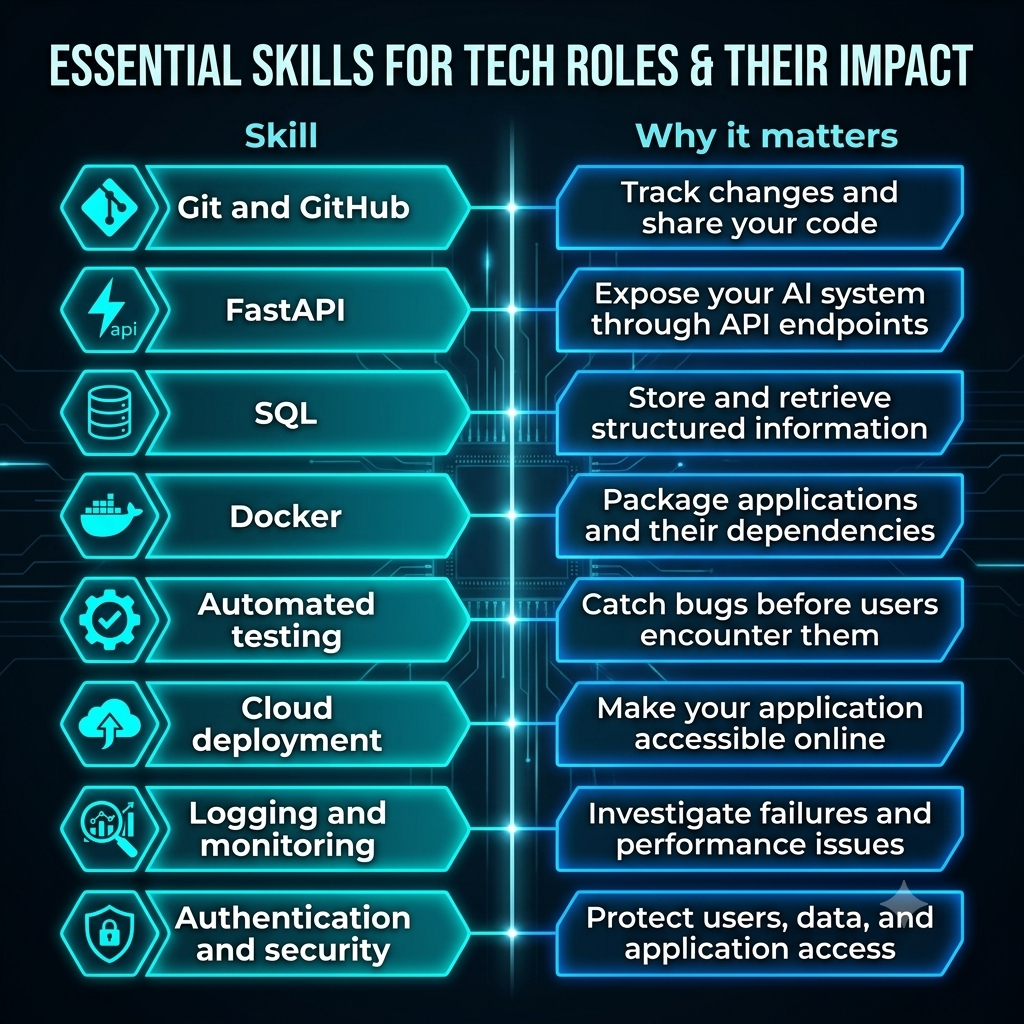
ou don’t need to learn every cloud platform at once. Choose one deployment approach, understand it, and expand later if a project requires something different.
For your first deployed application, build a small API that accepts a question, sends it to an LLM, and returns the answer. Add input validation, error handling, basic logging, and a simple interface.
Then test what happens when the API is unavailable, the user submits an empty message, or the model returns an unexpected result.
These aren’t glamorous features. They’re also the kinds of details that make an application more than a tutorial project.
Best AI Engineer Roadmap 2026: Tools You Should Learn
You don’t need to memorize dozens of frameworks. Start with a small, dependable toolkit and add tools when a project genuinely needs them.
Python
- Your main programming language for data, machine learning, and AI applications.
scikit-learn
- For classical machine learning, preprocessing, pipelines, and model evaluation.
PyTorch
- For neural networks, tensor operations, and deep learning.
Hugging Face
- For exploring pretrained models, datasets, transformers, and model-sharing workflows.
FastAPI
- For exposing your AI models and LLM workflows through web APIs.
You’ll also need to learn how to use at least one LLM provider’s API. Choose one based on your project requirements, pricing, access, and documentation. The underlying engineering principles transfer across providers, even when their interfaces differ.
Three AI Projects Beginners Should Build for Their Portfolio
A GitHub profile full of copied tutorials won’t tell an employer very much about how you solve problems. Three well-documented projects can be more useful than ten unfinished experiments.
Here are three projects that build on one another.
Project 1: Spam Email Classifier
Beginner
What you’ll learn: Python, text preprocessing, supervised learning, and model evaluation.
Build a classifier that distinguishes spam from legitimate messages. Report precision, recall, and F1 score, and explain the kinds of messages it misclassifies.
Portfolio goal: demonstrate that you can train and evaluate a model rather than simply call an API.
Project 2: PDF Question-Answering Assistant
Intermediate
What you’ll learn: LLM APIs, embeddings, retrieval, prompt design, and evaluation.
Let users upload documents, ask questions, and receive answers with source references. Test the assistant with questions whose answers are present, absent, or ambiguous in the documents.
Portfolio goal: demonstrate that you can build a useful application around an existing AI model.
Project 3: AI Customer Support Agent
Advanced beginner
What you’ll learn: tool calling, backend APIs, authentication, logging, testing, and deployment.
Create an assistant that searches product documentation and prepares a response. For actions such as issuing a refund, require human approval rather than letting the model act without supervision.
Portfolio goal: demonstrate that you understand the application lifecycle, including safety, reliability, and real-world constraints.
For every project, publish a readable README that explains the problem, installation steps, architecture, screenshots, test results, limitations, and what you would improve next.
Be honest about your results. If your classifier performs poorly on a certain type of message, explain why you think that happens and what you tried. That kind of reasoning is valuable evidence of engineering ability.
A 6-Month AI Engineer Study Plan for Beginners
If you can study around 10–15 hours per week, this six-month plan provides a reasonable structure for working through the roadmap.
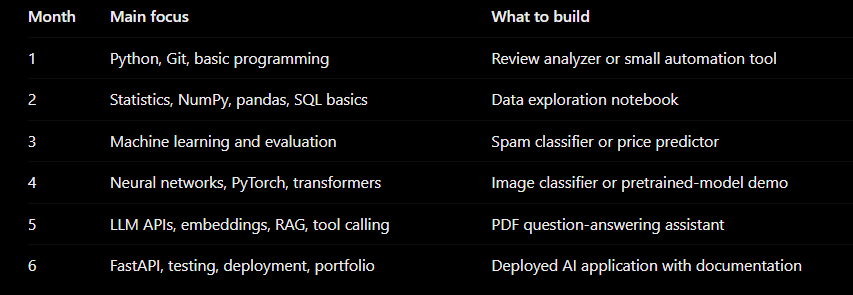
Don’t treat the end of each month as a hard deadline. If you cannot explain why your model performs well or poorly, spend more time evaluating it before moving on.
A simple weekly routine might look like this:
- 4 hours: follow a course or read documentation.
- 5 hours: write code and work on projects.
- 2 hours: debug, test, and review what you learned.
- 2 hours: document your work and study concepts you found difficult.
The balance matters. Watching a 20-hour course can feel productive, but you only discover whether you understand something when you try to use it without copying the instructor’s code.
How to Become an AI Engineer Without a Degree or Experience
A degree can be helpful for certain jobs, particularly research-heavy roles, but it isn’t the only way to demonstrate practical ability. Requirements vary by employer, and some positions still expect a relevant degree or substantial experience.
If you’re learning independently, focus on evidence that you can do the work.
1. Build a public portfolio. Choose projects with clear goals and working demonstrations. Show your code, explain your design decisions, and document your results.
2. Learn software engineering alongside AI. An employer may care just as much about readable code, tests, debugging, and API design as the particular model you selected.
3. Contribute to real projects. You could fix documentation, improve tests, or work on a small feature in an open-source repository. Even modest contributions can teach you how collaborative development works.
4. Apply for adjacent roles too. Depending on your background, junior Python developer, data analyst, software developer, automation engineer, or AI application developer positions may offer relevant experience. Don’t assume every entry point needs the same skill set.
5. Practice explaining your decisions. Be ready to explain why you chose a particular model, how you evaluated it, what failed, and how you’d improve it.
One reality worth keeping in mind: entry-level AI engineering can be competitive. Finishing a roadmap does not guarantee a job. Your prior experience, portfolio quality, interview skills, location, and the kinds of roles you target all make a difference.
Common Mistakes to Avoid on Your AI Engineer Roadmap
A few habits can slow your progress considerably.
- Learning every new AI framework
Pick one tool for each task and understand it. Explore alternatives when you have a clear reason to switch.
- Skipping Python and software fundamentals
AI-generated code may get you started, but you’ll struggle when it breaks if you cannot read or debug it.
- Building projects without evaluating them
A working demo is not proof of accuracy. Test realistic inputs, edge cases, and failure scenarios.
- Relying entirely on AI coding assistants
Use them to explain errors, suggest tests, and compare approaches. Then review the code, run it, and make sure you understand the result.
- Collecting certificates without building anything
Courses can provide structure, but practical projects help you demonstrate what you’ve learned.
Can I become an AI engineer with no experience?
Yes, it’s possible to work toward an AI engineering career without prior professional experience. Start with Python, learn core machine learning concepts, build AI applications, and develop a portfolio that demonstrates your skills. Getting hired will depend on the role and the evidence you can provide.
Is Python enough to become an AI engineer?
Python is an excellent starting point, but it isn’t enough on its own. You’ll also need data skills, machine learning knowledge, APIs, testing, version control, and practical application development. Some roles require additional expertise in cloud infrastructure, deep learning, or other programming languages.
Should I learn machine learning before generative AI?
Learning basic machine learning first gives you a stronger understanding of model evaluation, training data, and prediction errors. However, you can start experimenting with LLM APIs while studying those fundamentals. You don’t have to finish every traditional machine learning topic before building an AI-powered application.
What is the best AI engineer roadmap for beginners in 2026?
A practical sequence is Python, mathematics and data handling, machine learning, deep learning, LLM development, RAG, tool calling, and deployment. Build projects throughout the process rather than waiting until you’ve finished every course.
What is the difference between an AI engineer and a machine learning engineer?
The roles overlap, and employers don’t always use the titles consistently. AI engineers often focus on integrating AI capabilities into applications, while machine learning engineers may spend more time on model training, data pipelines, evaluation, and serving infrastructure. Read the actual job description rather than relying on the title alone.
Final Thoughts: Start Small, Build Consistently
The best AI Engineer Roadmap isn’t the one with the most courses or the longest list of frameworks. It’s the one that helps you develop useful skills and apply them to increasingly challenging problems.
Start with Python. Learn how data works. Train a basic machine learning model. Then build an application that uses an LLM, add retrieval when you need external knowledge, and learn how to deploy and test the result.
You don’t need to understand every new AI development before getting started. The field will keep changing, and some tools you learn today will eventually be replaced.
What stays useful is the ability to solve problems, read documentation, evaluate results, and build software that people can rely on.
Your first step today: open a Python notebook, complete a small programming exercise, and save the code. Tomorrow, improve it. Keep going, and let each project teach you what to learn next.
That’s a practical way to turn the ai engineer roadmap 2026 from a list of topics into a skill set you can actually use.