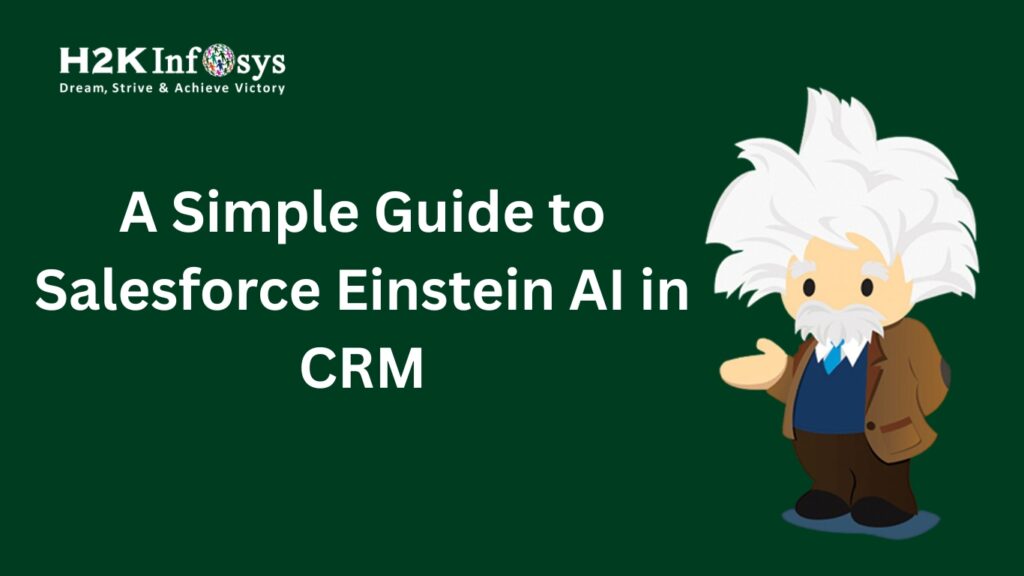
If you’re trying to understand how AI fits into CRM today, here’s the simple answer: Salesforce Einstein is the built-in artificial intelligence layer that helps businesses predict customer behavior, automate tasks, and make smarter decisions directly inside Salesforce. H2K Infosys often highlights it as one of the most practical AI tools for real-world CRM users.
What Exactly Is Salesforce Einstein (And Why Everyone’s Talking About It)
Let me put it the way I explain it to beginners in Salesforce training classes imagine your CRM quietly learning from every email, every deal, every customer interaction and then whispering, “Hey, this lead is worth your time,” or “This deal might slip.”
That’s basically what Salesforce Einstein does.
It’s not some futuristic add-on anymore. It’s baked right into the Salesforce ecosystem. Over the past couple of years especially with the rise of generative AI Einstein has evolved from “nice-to-have automation” into something teams actually rely on daily.
And honestly? Once you’ve seen it in action, going back to manual CRM feels exhausting.
Why Salesforce Einstein Matters in 2026
AI in CRM isn’t new but what’s changed recently is how usable it has become.
Earlier, tools required heavy setup, data science teams, and patience. Now, even someone taking Salesforce admin certification classes can configure meaningful AI features.
A few real-world shifts I’ve noticed lately:
- Sales teams expect predictions, not just reports
- Customer support teams want AI-suggested replies instantly
- Marketing teams rely on behavior-based personalization
- Executives want dashboards that explain why, not just what
Salesforce Einstein sits right in the middle of all this.
Breaking Down Salesforce Einstein
Let’s simplify the components, because the naming can get confusing.
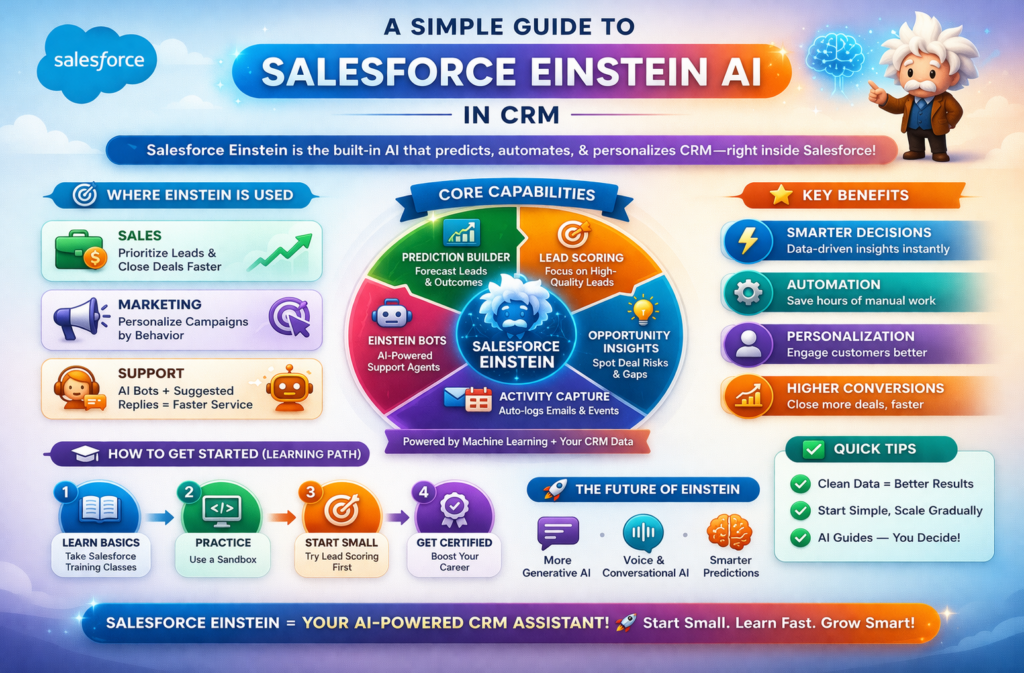
1. Einstein Prediction Builder
This is where things get interesting.
You can basically ask:
“Which leads are most likely to convert?”
And Einstein builds a model using your data.
No coding. Just logic and clean data.
I remember working with a small sales team that assumed their best leads came from paid ads. Einstein proved otherwise referrals had a much higher conversion rate. That one insight changed their entire strategy.
2. Einstein Lead Scoring
This one’s a favorite in most Salesforce classes.
Instead of guessing which leads matter, Einstein scores them automatically based on past conversions.
So your team stops chasing cold leads and focuses on the ones that actually move.
It sounds simple, but in practice, it saves hours every week.
3. Einstein Opportunity Insights
This feature feels almost like having a sales coach inside your CRM.
It flags:
- Deals with no recent activity
- Missing key stakeholders
- Risk signals based on past data
I’ve seen teams recover deals just because Einstein pointed out something they overlooked.
4. Einstein Activity Capture
This one is underrated.
It automatically logs emails and calendar events into Salesforce. No more “I forgot to update CRM.”
And let’s be honest most people do forget.
5. Einstein Bots
These are AI-powered chatbots for customer service.
They can:
- Answer common questions
- Route tickets
- Handle basic requests
With the rise of instant support expectations, these bots are becoming essential.
Where Salesforce Einstein Is Used (Real Scenarios)
Let’s step away from features for a second and talk about how companies actually use this.
Sales Teams
A SaaS company I worked with used Salesforce Einstein to prioritize enterprise leads. Within 3 months, their close rate improved not dramatically, but enough to justify the entire setup.
Sometimes AI doesn’t create miracles, it just removes inefficiencies.
Marketing Teams
Einstein helps segment audiences based on behavior.
Instead of blasting emails, marketers send targeted campaigns.
And yes, open rates improve but more importantly, engagement feels more human.
Customer Support
Support agents get suggested replies and next steps.
It reduces response time and, interestingly, reduces stress for agents too.
How Salesforce Einstein Fits Into Certification and Learning
If you’re considering a Salesforce certification course, you’ll definitely come across Salesforce Einstein.
It’s no longer optional knowledge.
In fact, many Salesforce admin certification classes now include:
- AI basics in CRM
- Data preparation for AI
- Einstein feature configuration
- Ethical AI usage
And here’s something I always tell learners:
You don’t need to become a data scientist to use Salesforce Einstein but you do need to understand your data.
The Learning Curve (Honest Take)
Let’s keep it real, this is not entirely plug-and-play.
A few things that can throw people off:
- Shitty poor quality data = shitty more wrong predictions
- Misconfigured fields = useless insights
- Over-reliance on AI without validation
I’ve watched teams trust scores without questioning them. That’s risky.
AI should guide decisions not replace thinking.
Salesforce Einstein and Generative AI (The New Wave)
This is where things are getting exciting.
Salesforce has been integrating generative AI into Einstein meaning it can now:
- Draft emails
- Summarize customer interactions
- Generate reports in plain language
So instead of digging through dashboards, you can ask:
“What happened with our top deals this quarter?”
And get a readable answer.
That’s a big shift.
A Quick Story From the Field
I once worked with a mid-sized company that resisted Salesforce Einstein at first.
Their argument?
“We already know our customers.”
Fair enough.
But after implementing Einstein Lead Scoring, they discovered something surprising:
Their “gut feeling” leads weren’t always the best ones.
Within weeks, their sales pipeline became more structured.
Not perfect but more predictable.
And in business, predictability is gold.
Common Misconceptions About Salesforce Einstein
Let’s clear a few things up.
“It’s Only for Big Companies”
Not true.
In fact, even small teams benefit perhaps more so, as they don’t have a big analytics team.
“It Replaces Human Jobs”
No.
It gets rid of my work, allowing people to spend time working on strategy and relationships.
“It Runs Perfectly From the Beginning”
Definitely not.
It needs:
- Clean data
- Proper setup
- Ongoing adjustments
How to Learn Salesforce Einstein
If you’re a newcomer, take this simple route:
Step 1: Learn the Basics
Look for Salesforce training classes with AI modules.
Step 2: Practice in a Sandbox
Avoid jumping straight into experimentation in live environments.
Step 3: Focus on One Use Case
Lead scoring is a really good place to start.
Step 4: Measure Results
Follow-up progress conversion rates, response time, etc.
Step 5: Expand Gradually
When you feel ready, add additional features.
Sessions: The Importance of Training More Than Ever
And this is where structured learning becomes helpful.
A good Salesforce certification course will show you not only how to use features, but also when and why to use those features.
And that’s the tougher part, to be frank.
I’ve seen folks complete certifications but still suffer because they did not put the concepts into practice.
Hands-on practice is everything.
The Role of H2K Infosys in Salesforce Learning
Many learners today look for training providers that focus on real-world applications.
H2K Infosys, for example, emphasizes:
- Practical scenarios
- Job-oriented training
- Hands-on labs
This makes a difference when dealing with tools like Salesforce Einstein.
Because theory alone won’t help you configure AI models.
Challenges You Might Face
Let’s not sugarcoat it there are challenges.
Data Issues
If your CRM data is messy, Salesforce Einstein won’t perform well.
Adoption Resistance
Teams may hesitate to trust AI recommendations.
Overcomplication
Trying to implement everything at once can backfire.
The Future of Salesforce Einstein
Looking ahead, Salesforce Einstein is moving toward:
- More conversational AI interfaces
- Deeper integration with generative AI
- Better explainability (why predictions are made)
And this last part is important.
Because businesses don’t just want answers they want to understand them.
Final Thoughts
If you’re exploring CRM or planning to enroll in Salesforce classes, don’t treat Salesforce Einstein as an advanced topic you’ll “get to later.”
It’s already central to how modern CRM works.
And the sooner you start experimenting with it, the more comfortable it becomes.
Not perfect. Not magical. But genuinely useful.
Quick Recap
- Salesforce Einstein puts AI directly into CRM workflows
- It also aids forecasting, automation and steering decisions
- Even if you are new to it, it is doable with proper training
- Clean data[reading] and sensible use -> real value
- It’s now mandatory in every Salesforce certification course