Introduction: The AI Revolution Driving U.S. Jobs
Artificial Intelligence (AI) is no longer just a futuristic concept it’s the present reality shaping every major industry in the United States. From self-driving cars and voice assistants to fraud detection and healthcare diagnostics, AI is powering innovation everywhere.
According to the U.S. Bureau of Labor Statistics, the demand for AI professionals is projected to grow by 23% through 2032, much faster than the average for all occupations. In 2025, AI related roles are among the highest-paying and fastest-growing careers in the U.S.
If you’re looking to break into this field, investing in structured AI learning courses or enrolling in professional Courses of Artificial Intelligence can be your first step toward a successful, future-proof career.
1. Why AI Jobs Are in High Demand in 2025
The digital transformation wave has accelerated AI adoption across sectors. Every organization from tech giants like Google, Microsoft, and Amazon to financial firms and healthcare providers is leveraging AI to automate processes, improve efficiency, and gain predictive insights.
Key Drivers of AI Job Growth
- Automation and Efficiency: Businesses use AI to automate routine operations and cut costs.
- Data Explosion: AI helps organizations analyze massive amounts of data for better decision-making.
- Personalization: Companies use AI to tailor services like recommendations, ads, and content.
- Cybersecurity Needs: AI-driven threat detection systems are essential to combat sophisticated cyber attacks.
- Innovation: AI fuels innovation in robotics, NLP, and autonomous systems.
As these trends continue, skilled AI professionals will remain in high demand across industries.
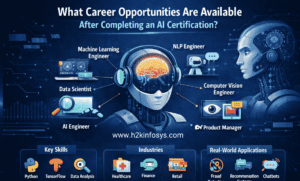
2. Top AI Job Roles in the U.S. (2025)
AI offers a diverse range of roles, each requiring different skills and expertise. Let’s look at some of the most in-demand positions in 2025:
a) AI Engineer
AI Engineers design, test, and deploy intelligent algorithms and models. They work on tasks like image recognition, NLP, and automation systems.
Average U.S. Salary (2025): $130,000 – $170,000 per year
Key Skills:
- Python and TensorFlow
- Machine Learning algorithms
- Deep Learning frameworks
b) Machine Learning Engineer
ML Engineers develop and fine-tune models that help machines learn from data. They collaborate closely with data scientists and software developers.

Average Salary: $125,000 – $160,000
Key Skills:
- Data preprocessing and model training
- Python, Scikit-learn, Keras
- Cloud platforms (AWS, Azure, Google AI)
c) Data Scientist
Data Scientists extract insights from large datasets using AI and ML techniques. They design predictive models to guide business strategies.
Average Salary: $115,000 – $150,000
Key Skills:
- Statistics and data analysis
- Machine learning algorithms
- Python, R, SQL
d) NLP Engineer
Natural Language Processing Engineers focus on teaching machines how to understand human language. They work on chatbots, voice assistants, and translation tools.
Average Salary: $110,000 – $145,000
Key Skills:
- NLP frameworks (SpaCy, NLTK, Hugging Face)
- Deep Learning
- Linguistic modeling
e) AI Product Manager
AI Product Managers bridge technical and business teams. They plan product roadmaps, manage deployment, and ensure ethical AI use.
Average Salary: $120,000 – $155,000
Key Skills:
- Business analysis and communication
- Understanding of AI pipelines
- Data strategy and model evaluation
3. U.S. Salary Trends for AI Jobs in 2025
The AI job market in 2025 shows strong salary growth, driven by limited talent and high demand.
| Job Role | Average Salary (2025) | Experience Level |
|---|---|---|
| AI Engineer | $150,000 | 3–7 years |
| Machine Learning Engineer | $140,000 | 2–5 years |
| Data Scientist | $135,000 | 2–6 years |
| AI Product Manager | $130,000 | 3–8 years |
| NLP Engineer | $125,000 | 2–5 years |
| Computer Vision Specialist | $145,000 | 3–7 years |
Salary Insights
- Entry-level AI professionals can expect $90,000–$110,000 annually.
- Senior AI leaders and researchers earn over $200,000+ with bonuses and stock options.
- Salaries are highest in cities like San Francisco, New York, Seattle, and Austin due to strong tech ecosystems.
4. Skills Needed for a Successful AI Career
Mastering AI requires a blend of technical and analytical skills. Here’s what employers look for:
Core Technical Skills
- Programming: Python, R, and Java are essential.
- Mathematics & Statistics: Strong knowledge of algebra, calculus, and probability.
- Machine Learning Frameworks: TensorFlow, Keras, and PyTorch.
- Data Handling: SQL, Pandas, NumPy for data preprocessing.
- Cloud & APIs: AWS, Azure AI, or Google Cloud AI for deployment.
Soft Skills
- Problem-solving and analytical thinking.
- Effective communication for explaining complex concepts.
- Adaptability to fast-evolving technologies.
Pro Tip:
Taking AI learning Courses that focus on real world projects can help you gain these skills faster and make your resume stand out in the job market.
5. How to Start a Career in AI (Step-by-Step)
Breaking into AI can seem overwhelming, but a structured approach makes it easier.
Step 1: Build a Strong Foundation
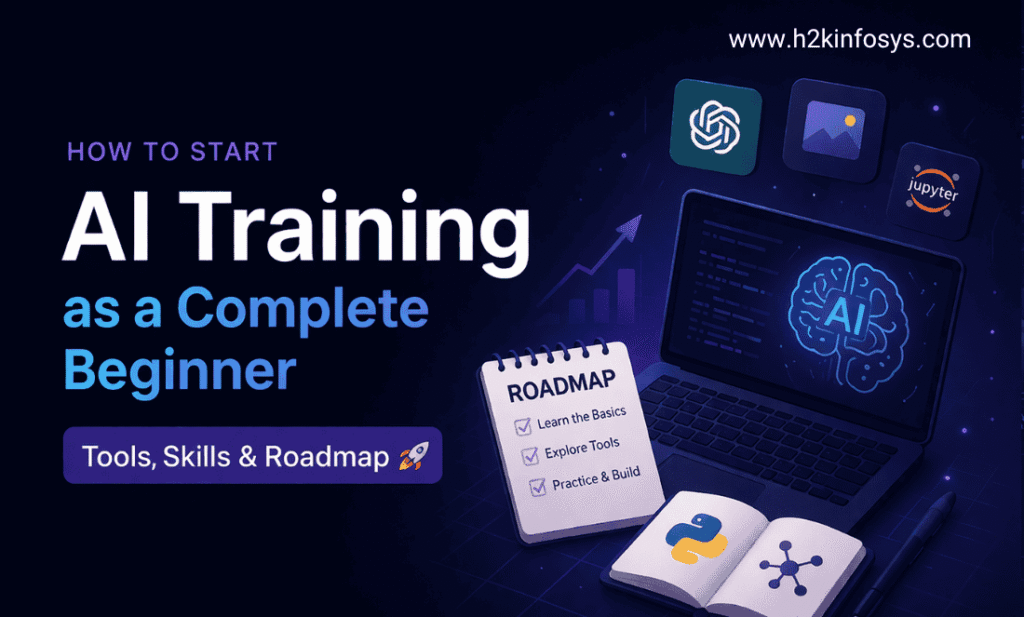
Start with courses of Artificial Intelligence that cover Python, data science, and machine learning fundamentals. H2K Infosys offers beginner-friendly programs designed for hands-on learning.
Step 2: Practice with Real Projects
Apply what you learn by building projects like:
- Image classification systems
- Chatbots
- Recommendation engines
This helps demonstrate your skills to potential employers.
Step 3: Earn Certifications
Enroll in AI learning courses that provide verified certifications. Employers value candidates who show commitment through recognized programs.
Step 4: Contribute to Open Source
Collaborate on GitHub or Kaggle projects to gain experience and visibility in the AI community.
Step 5: Build a Portfolio and Network
Create a digital portfolio showcasing your best projects. Join AI forums, attend webinars, and network with industry experts for job opportunities.
6. Best Industries for AI Jobs in 2025
The demand for Artificial Intelligence professionals is growing rapidly across multiple industries in 2025, as organizations continue to integrate AI-driven automation, data analytics, and intelligent decision-making into their core operations. Below are some of the best industries for AI jobs in 2025, offering exciting roles and strong career growth opportunities.

- Healthcare:
AI is revolutionizing diagnostics, drug discovery, and personalized medicine. Professionals skilled in machine learning and data analytics are helping doctors predict diseases, analyze medical images, and optimize treatment plans. - Finance and Banking:
Financial institutions use AI for fraud detection, algorithmic trading, and credit risk assessment. AI experts in this field build predictive models that enhance decision-making and improve customer security. - Cybersecurity:
With increasing cyber threats, AI plays a crucial role in detecting vulnerabilities, automating responses, and securing sensitive data. The demand for AI-driven security analysts is higher than ever.

Retail and E-commerce:
Companies use AI to personalize customer experiences, optimize pricing, and manage supply chains efficiently. AI-powered recommendation systems and chatbots have become business essentials.
Manufacturing:
Smart factories are adopting AI for predictive maintenance, robotics, and production optimization, creating vast opportunities for AI engineers and automation specialists.
Education and EdTech:
AI enhances adaptive learning, automates grading, and tailors content to individual learning needs, opening roles for AI researchers and developers.
In 2025, nearly every industry will rely on AI expertise, making AI careers among the most future-proof and rewarding paths in the U.S. and beyond.
7. Benefits of AI Learning Courses
Enrolling in AI learning courses offers numerous benefits for students and professionals aiming to advance their careers in technology. These programs provide a strong foundation in machine learning, deep learning, and data analysis, enabling learners to understand how Artificial Intelligence systems think, learn, and make decisions.
- Career Advancement:
AI is one of the fastest-growing fields globally. Completing a certified AI course helps you qualify for high-demand roles such as AI Engineer, Data Scientist, or Machine Learning Specialist. - Hands-On Experience:
Most AI courses include real-world projects, allowing learners to apply theoretical knowledge in practical environments using tools like TensorFlow, Keras, and PyTorch. - Cross-Industry Relevance:
AI skills are valuable across sectors healthcare, finance, cybersecurity, marketing, and logistics making professionals versatile and employable worldwide. - High Salary Potential:
AI professionals often earn top-tier salaries due to their specialized expertise and demand in the job market. - Innovation and Problem-Solving:
Learning AI enhances creativity by teaching how to design intelligent systems that automate tasks, solve complex problems, and improve decision-making.
In short, AI learning courses empower individuals to future-proof their careers and lead in the era of intelligent automation.
With platforms like H2K Infosys, you get exposure to both theoretical knowledge and practical implementation of AI models.
8. Challenges and Future Trends in AI Careers
Key Challenges in AI Careers:
- Rapid Technological Advancements:
The AI landscape evolves quickly, with new tools and frameworks emerging every few months. Professionals must continually upskill through updated AI learning courses and certifications to stay relevant. - Data Quality and Management:
AI systems depend on large volumes of high-quality data. Poor or biased data can lead to inaccurate models and unreliable predictions, posing major challenges for AI professionals. - Ethical and Legal Concerns:
Issues such as bias, transparency, and privacy in AI algorithms have created a growing demand for ethical AI development and explainable models. - Skill Gap and Talent Shortage:
Despite the popularity of AI, there’s a shortage of experts proficient in machine learning, deep learning, and MLOps, leading to intense competition in the job market. - High Learning Curve:
Mastering complex subjects like neural networks, NLP, and reinforcement learning requires strong mathematical and programming foundations, which can be challenging for beginners.
Emerging Future Trends in AI Careers:
- Generative AI Growth: AI-driven creativity in content, design, and automation is shaping new industries.
- AI-Powered Cybersecurity: Smarter defense systems will rely on predictive threat modeling.
- Rise of Explainable AI (XAI): Transparent algorithms will dominate enterprise adoption.
- AI with IoT and Quantum Computing: Integrated intelligent systems will create hybrid job roles.
- Responsible AI Leadership: Organizations will prioritize professionals focused on fairness, accountability, and ethical innovation.
9. Real-World Example: AI Career Success Story
Consider Emily Rodriguez, a data analyst who upskilled through AI learning courses at H2K Infosys. Within six months, she transitioned into a Machine Learning Engineer role at a top fintech company, earning a 60% salary increase. Her practical projects such as predictive analytics and customer churn modeling impressed recruiters instantly.
Her growing expertise in deep learning, natural language processing, and predictive modeling opened new doors. By applying AI-driven automation to repetitive marketing tasks, she reduced reporting time by 70%, directly influencing sales outcomes. Recognizing her contribution, the company sponsored her to complete advanced courses of Artificial Intelligence, where she learned about neural networks and generative AI applications.
Today, Ananya works at a top U.S.-based tech firm, designing intelligent systems that personalize customer engagement at scale. Her story highlights how continuous learning, the right training, and real-world application can transform a traditional career into a high-paying AI profession. With structured mentorship and the right certification path, anyone can make the leap into the future of Artificial Intelligence.
10. Future of AI Careers in the U.S.
The future of AI careers in the U.S. looks exceptionally promising as Artificial Intelligence continues to reshape industries such as healthcare, finance, cybersecurity, manufacturing, and education. According to recent market forecasts, AI-related jobs are projected to grow by over 35% in the next five years, making it one of the fastest-expanding career domains in the country.
With businesses increasingly investing in automation, predictive analytics, and generative AI, the demand for professionals skilled in machine learning, natural language processing, and deep learning is skyrocketing. Roles such as AI Engineers, Data Scientists, AI Ethicists, and MLOps Specialists are becoming critical to organizational success. Companies like Google, Amazon, Microsoft, and Tesla are leading this hiring wave, offering competitive salaries and growth opportunities.
However, staying employable in this evolving landscape requires continuous learning. Enrolling in AI learning courses and mastering tools like TensorFlow, PyTorch, and cloud-based AI platforms can give professionals a strong edge.
As the U.S. moves toward an AI-driven economy, government and private sectors are expected to collaborate on policies that promote responsible innovation and workforce readiness. The future clearly belongs to those who adapt, innovate, and lead with Artificial Intelligence expertise.
Conclusion: Your AI Career Starts Here
Artificial Intelligence is transforming every industry from finance and healthcare to cybersecurity and automation and the U.S. job market is brimming with opportunities for skilled professionals. With the right guidance and structured AI learning courses, you can build the knowledge, confidence, and technical skills required to succeed in this competitive field. Whether your goal is to become a Machine Learning Engineer, Data Scientist, or AI Developer, mastering the courses of Artificial Intelligence helps you stay ahead of automation and secure high-paying, future-proof roles.
H2K Infosys offers hands-on, instructor-led Artificial Intelligence Engineer Course programs that blend theory with practical projects, helping you gain real-world experience employers value. Begin your journey today, learn from industry experts, and unlock your potential in one of the most promising career fields of 2025.