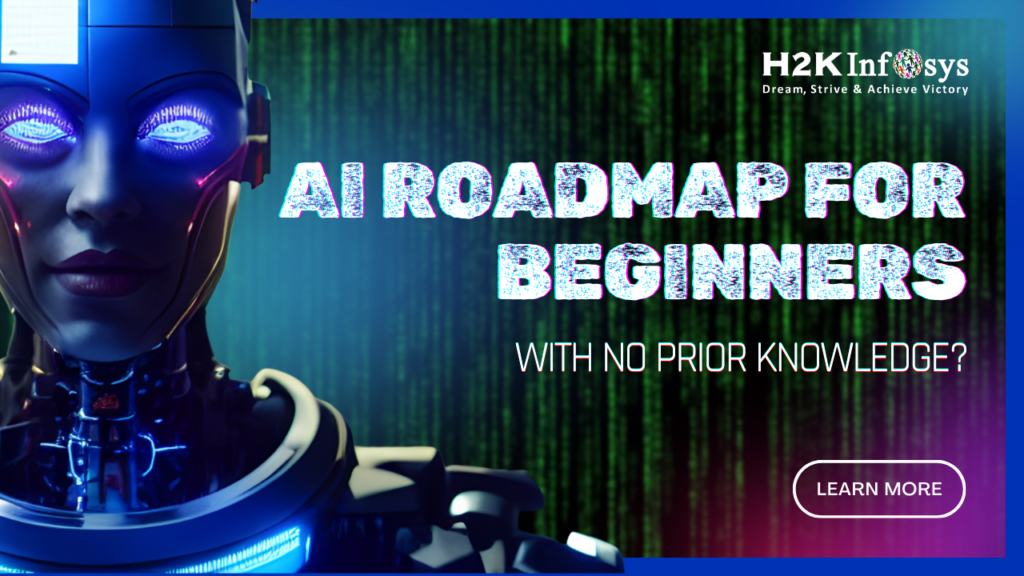
If you’re starting from zero, the simplest AI roadmap for beginners looks like this:
Learn basic math and Python → understand machine learning fundamentals → practice with small projects → explore deep learning and real-world AI tools.
That’s honestly the path most people follow today even those working at companies like Google or OpenAI started with the same fundamentals. The difference now? There are far more AI online courses for beginners and hands-on tools than there were even five years ago.
Let’s walk through this step by step, in a way that actually makes sense if you’re completely new.
Step 1: Understand What AI Really Is
When people first try to learn AI from scratch, they often jump straight into complicated models or fancy libraries. I’ve seen beginners do this and they usually get overwhelmed in a week.
A better approach is to first understand the idea behind AI.
At its core, Artificial Intelligence is simply about teaching machines to recognize patterns and make decisions from data.
Examples you already use every day:
- Netflix recommending shows
- Gmail filtering spam
- Voice assistants like Google Assistant or Siri
- Chatbots powered by models like ChatGPT
Once you see AI as pattern recognition instead of “robot intelligence”, the learning path suddenly feels less intimidating.
Step 2: Learn Python
Almost every AI roadmap for beginners includes Python and for good reason.
It’s readable, beginner-friendly, and backed by massive AI libraries.
Focus on learning:
- Variables and data types
- Loops and conditions
- Functions
- Lists and dictionaries
- Basic data handling
You don’t need to become a Python wizard. Honestly, most AI work relies on libraries that handle the complex parts.
Helpful libraries you’ll eventually encounter:
- NumPy
- Pandas
- Matplotlib
- Scikit-learn
A lot of the best AI Roadmap For Beginners start exactly here.
Step 3: Learn Basic Math
This is where many beginners panic.
You don’t need a PhD in mathematics to learn AI from scratch.
Focus on the math that directly helps with machine learning:
Key concepts:
- Linear algebra (vectors, matrices)
- Probability
- Statistics
- Basic calculus (gradients)
Think of math here as understanding why the model works, not memorizing formulas.
Step 4: Study Machine Learning Fundamentals
Once you know some Python and math, you can move into machine learning, which is the core of AI.
You’ll start encountering ideas like:
Supervised learning
- Predicting house prices
- Spam detection
Unsupervised learning
- Customer segmentation
- Pattern discovery
Reinforcement learning
- Game-playing AI
- Robotics training
A small insight from experience:
The moment you build your first working ML model, things suddenly click.
Even something simple like predicting movie ratings can feel surprisingly exciting.
Step 5: Start Small Projects
Reading tutorials is helpful, but real understanding comes from building things.
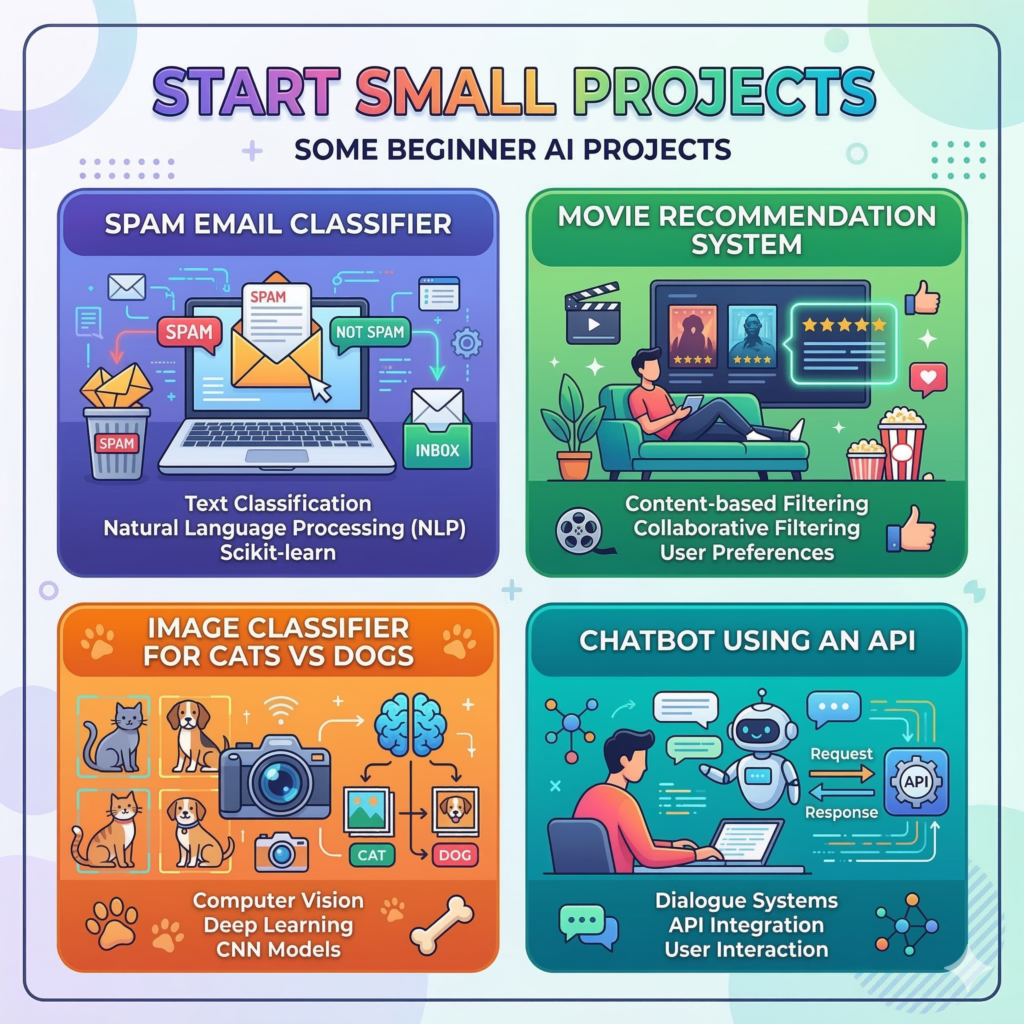
Some beginner AI projects:
- Spam email classifier
- Movie recommendation system
- Image classifier for cats vs dogs
- Chatbot using an API
Many beginners skip projects, which slows progress dramatically.
The truth is:
AI skills develop through experimentation.
Step 6: Explore Deep Learning and Modern AI
Once you’re comfortable with machine learning, you can move into deep learning, which powers most of today’s AI breakthroughs.
Popular frameworks include:
- TensorFlow
- PyTorch
These tools are used by companies like Meta, Microsoft, and NVIDIA to build advanced AI systems.
This is also where you’ll encounter things like:
- Neural networks
- Computer vision
- Natural language processing
- Generative AI
And yes, tools behind systems like ChatGPT come from this area.
Step 7: Stay Updated With AI Trends
AI is evolving fast almost too fast sometimes.
Just in the last couple of years we’ve seen:
- Explosion of generative AI tools
- AI copilots integrated into software
- Rapid progress in open-source AI models
Companies such as OpenAI and Anthropic are releasing new models regularly, which means learning AI today also involves following industry updates.
A simple habit that helps:
Spend 10 minutes a day reading AI news or research summaries.
Best AI Online Courses for Beginners
If you’re wondering where to start, these beginner-friendly options consistently help people learn AI from scratch:
1. Machine Learning by Andrew Ng
Offered on H2K Infosys
Still one of the most recommended AI courses worldwide.
2. AI For Everyone
Also by IIT Workforce
Great for understanding AI without deep coding.
3. Deep Learning Specialization
For those ready to go deeper into neural networks.
These courses form a solid foundation in almost every modern AI roadmap for beginners.
A Realistic Timeline to Learn AI
People often ask how long it takes.
From what I’ve seen:
| Learning Stage | Approx Time |
|---|---|
| Python basics | 1–2 months |
| Math fundamentals | 1–2 months |
| Machine learning | 2–3 months |
| Projects & practice | ongoing |
So realistically, 6–8 months of consistent learning can get you surprisingly far.
A Small Tip Most AI Roadmaps Don’t Mention
Here’s something that helped me early on.
Don’t try to learn everything about AI.
Pick one direction and explore it deeply.
For example:
- Chatbots
- Computer vision
- Data science
- Generative AI
The field is huge. Narrowing your focus makes progress much faster.
Final Thoughts
The best AI roadmap for beginners isn’t complicated:
Start with Python → learn the basics of math → study machine learning → build projects → explore deep learning and AI tools.
And honestly, the biggest advantage beginners have today is access to incredible AI online courses for beginners and open-source tools that simply didn’t exist a decade ago.
If you stay curious, build small projects, and follow developments in the field, learning AI from scratch is absolutely achievable even if you’re starting with zero technical background.