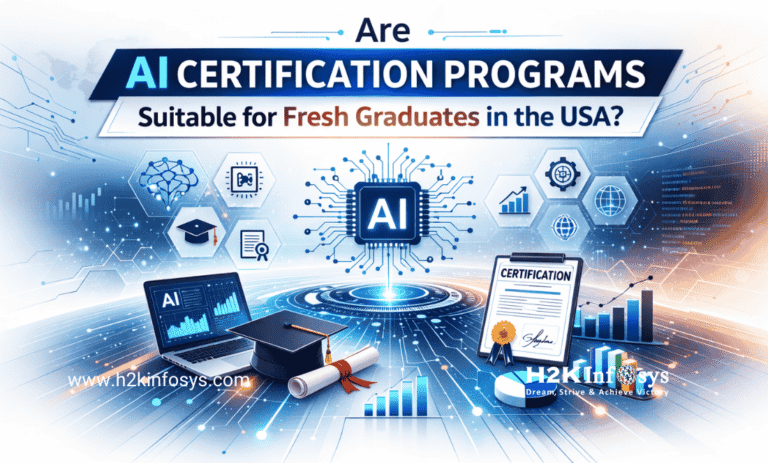
Yes, AI certification programs at H2K Infosys are suitable for fresh graduates in the USA, provided they are designed with beginner-friendly learning paths and include foundational programming, machine learning, and applied AI skills. The Best AI Certification Courses help graduates transition from academic knowledge to practical, industry-ready skills required in real-world IT environments. These certifications are especially useful for graduates from computer science, engineering, mathematics, data science, or related fields who want structured guidance toward AI-focused roles.
AI certifications do not replace formal degrees, but they complement academic education by focusing on applied tools, workflows, and enterprise use cases that employers commonly expect candidates to understand.
What Is an AI Certification Program?
An AI certification program is a structured training pathway that teaches the principles, tools, and practical applications of Artificial Intelligence. These programs typically cover topics such as machine learning, deep learning, data processing, model deployment, and AI integration into business systems.
Unlike traditional university courses, AI certification programs focus more heavily on applied implementation, including:
- Writing Python scripts for machine learning models
- Using frameworks like TensorFlow or PyTorch
- Preparing and cleaning datasets
- Deploying AI models in production environments
Core Components of AI Certification Programs
| Component | Purpose | Example Tools |
|---|---|---|
| Programming Foundations | Writing AI algorithms and automation scripts | Python, NumPy |
| Data Processing | Preparing and transforming data | Pandas, SQL |
| Machine Learning | Building predictive models | Scikit-learn |
| Deep Learning | Training neural networks | TensorFlow, PyTorch |
| Model Deployment | Running AI models in real environments | Docker, FastAPI |
| Cloud Integration | Deploying scalable AI systems | AWS, Azure |
The best AI certification courses combine theory, hands-on labs, and real-world project workflows.
Why Are AI Certification Programs Important for Fresh Graduates?
Fresh graduates often have theoretical knowledge but limited experience with enterprise tools and production workflows. AI Certified Courses programs help bridge this gap by introducing applied technical skills.
Key Benefits for Fresh Graduates
1. Structured Learning Path
Certification programs organize learning into progressive modules:
- Programming basics
- Machine learning fundamentals
- Real-world AI projects
This structured approach helps graduates avoid fragmented or incomplete learning.
2. Industry-Relevant Skills
AI certified courses focus on tools commonly used in production environments:
- Python for model development
- Git for version control
- Cloud platforms for deployment
These tools align with real enterprise workflows.
3. Improved Job Readiness
Employers typically evaluate candidates based on their ability to:
- Work with datasets
- Build models
- Understand deployment concepts
Certifications help graduates demonstrate applied knowledge.
4. Practical Experience
Hands-on projects simulate real-world use cases such as:
- Customer behavior prediction
- Fraud detection
- Recommendation systems
How Does AI Work in Real-World IT Projects?
Artificial Intelligence systems typically follow a structured development workflow.
Typical AI Project Workflow
| Step | Description | Example |
|---|---|---|
| Data Collection | Gathering raw data | Customer transaction data |
| Data Preprocessing | Cleaning and transforming data | Removing missing values |
| Model Training | Teaching model patterns | Training fraud detection model |
| Model Evaluation | Testing model accuracy | Accuracy score calculation |
| Deployment | Integrating model into applications | Fraud detection API |
| Monitoring | Tracking performance | Detecting model drift |
Example Enterprise Use Case: Fraud Detection System
Step-by-step workflow:
- Collect transaction data
- Process and clean data
- Train machine learning model
- Deploy model using REST API
- Integrate model with banking system
Pseudo-code example:
from sklearn.ensemble import RandomForestClassifiermodel = RandomForestClassifier()
model.fit(training_data, labels)prediction = model.predict(new_transaction)
This workflow is representative of real enterprise AI development.
What Skills Are Required to Learn AI Certification Programs?
Fresh graduates do not need advanced experience, but certain foundational skills are helpful.
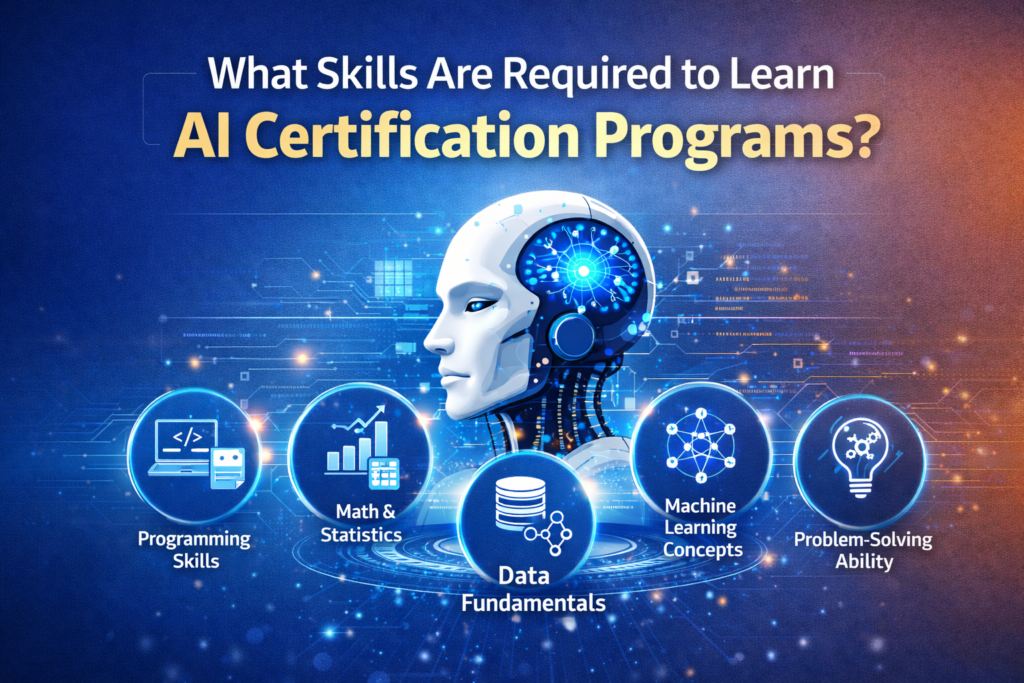
Technical Skills
| Skill | Why It Matters |
|---|---|
| Python Programming | Primary language for AI |
| Mathematics Basics | Understanding model logic |
| Statistics | Model accuracy evaluation |
| Data Handling | Processing datasets |
| Problem-Solving | Designing AI solutions |
Supporting Skills
- Logical thinking
- Analytical reasoning
- Debugging skills
- Understanding of algorithms
These skills can be developed progressively during certification programs.
How Is AI Used in Enterprise Environments?
AI is integrated into many enterprise systems to automate decision-making, improve efficiency, and analyze data.
Common Enterprise Applications
1. Customer Service Automation
AI chatbots handle customer support requests using natural language processing.
Tools used:
- NLP frameworks
- AI chat interfaces
2. Recommendation Systems
Platforms recommend products or services based on user behavior.
Example:
- E-commerce product recommendations
3. Predictive Analytics
Organizations use AI to predict trends such as:
- Sales forecasting
- Customer churn prediction
4. Cybersecurity Threat Detection
AI models detect abnormal network activity.
What Job Roles Use AI Skills Daily?
Fresh graduates completing the best AI certification courses can pursue multiple entry-level roles.
Entry-Level AI Job Roles
| Role | Responsibilities |
|---|---|
| AI Engineer | Develop AI models |
| Machine Learning Engineer | Train predictive models |
| Data Analyst | Analyze datasets |
| AI Developer | Build AI applications |
| Junior Data Scientist | Perform data modeling |
Example Role: AI Developer
Daily tasks include:
- Writing Python scripts
- Preparing datasets
- Running machine learning experiments
- Testing AI models
What Careers Are Possible After Learning AI Certified Courses?
AI certifications can support entry into multiple IT career paths.
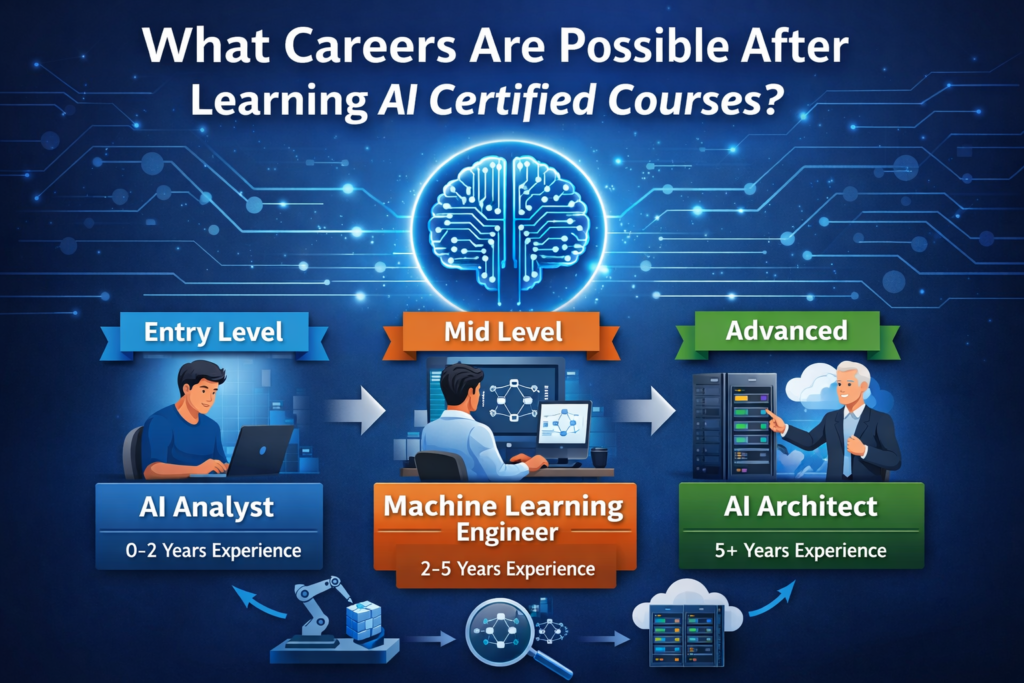
Career Path Progression
| Level | Role | Experience |
|---|---|---|
| Entry Level | AI Analyst | 0–2 years |
| Mid Level | Machine Learning Engineer | 2–5 years |
| Advanced | AI Architect | 5+ years |
What Should Fresh Graduates Look for in the Best AI Certification Courses?
Not all certification programs offer equal value. Fresh graduates should evaluate programs carefully.
Important Evaluation Criteria
1. Hands-On Training
Programs should include practical labs and real datasets.
2. Tool Coverage
Essential tools include:
- Python
- TensorFlow
- Cloud deployment platforms
3. Project-Based Learning
Projects help demonstrate applied knowledge.
4. Deployment Training
Understanding deployment is critical for enterprise environments.
How Long Does It Take to Complete AI Certification Programs?
Completion time varies depending on program depth and learning pace.
| Learning Type | Duration |
|---|---|
| Basic Certification | 3–6 months |
| Intermediate Certification | 6–9 months |
| Advanced Certification | 9–12 months |
Fresh graduates often complete beginner programs first.
What Tools Are Commonly Covered in AI Certified Courses?
AI Tool Comparison Table
| Tool | Purpose |
|---|---|
| Python | Programming |
| TensorFlow | Deep learning |
| PyTorch | Neural network training |
| Scikit-learn | Machine learning |
| Pandas | Data processing |
| AWS | Model deployment |
These tools are widely used in enterprise environments.
What Challenges Do Fresh Graduates Face When Learning AI?
Common challenges include:
1. Lack of Practical Experience
Solution:
- Hands-on labs
- Real-world projects
2. Understanding Model Concepts
Solution:
- Step-by-step training
- Guided projects
3. Deployment Knowledge Gap
Solution:
- Learning cloud deployment
How Do AI Certifications Complement Academic Degrees?
University degrees provide theoretical knowledge, while certifications focus on applied skills.
Comparison
| Academic Degree | Certification Program |
|---|---|
| Theory focused | Practical focused |
| Long duration | Short duration |
| Research oriented | Industry oriented |
Both are valuable when combined.
Real-World Example: AI in E-Commerce Recommendation System
Workflow example:
- Collect customer browsing data
- Process customer preferences
- Train recommendation model
- Deploy model in website
Result:
Personalized product recommendations improve user experience.
FAQ Section
Are AI certification programs suitable for non-CS graduates?
Yes, but non-CS graduates may need to learn programming fundamentals first.
Do AI certifications guarantee a job?
Certifications improve job readiness but do not guarantee employment. Employers evaluate skills, projects, and experience.
Which programming language is most important for AI?
Python is the most widely used programming language for AI development.
Can fresh graduates become AI engineers directly?
Most graduates start with entry-level roles such as AI analyst or junior developer.
Are AI certification programs recognized by employers?
Many employers consider certifications valuable when combined with hands-on skills and projects.
How Fresh Graduates Can Start Learning AI: Step-by-Step Roadmap
Step 1: Learn Programming
Focus on Python fundamentals.
Step 2: Learn Data Processing
Understand data cleaning and analysis.
Step 3: Learn Machine Learning
Train predictive models.
Step 4: Build Projects
Develop real-world AI projects.
Step 5: Learn Deployment
Deploy models using cloud platforms
Key Takeaways
- AI certification programs are suitable for fresh graduates with foundational programming knowledge
- The best AI certification courses teach practical, enterprise-level skills
- AI certified courses help bridge academic learning and real-world job requirements
- Hands-on projects and deployment training are critical for job readiness
- Entry-level AI roles include AI developer, AI analyst, and machine learning engineer
- AI certifications complement academic degrees by focusing on applied implementation
Explore H2K Infosys AI certification programs to gain hands-on experience with real-world AI tools and enterprise workflows. Build practical AI skills aligned with modern IT job roles and industry requirements.