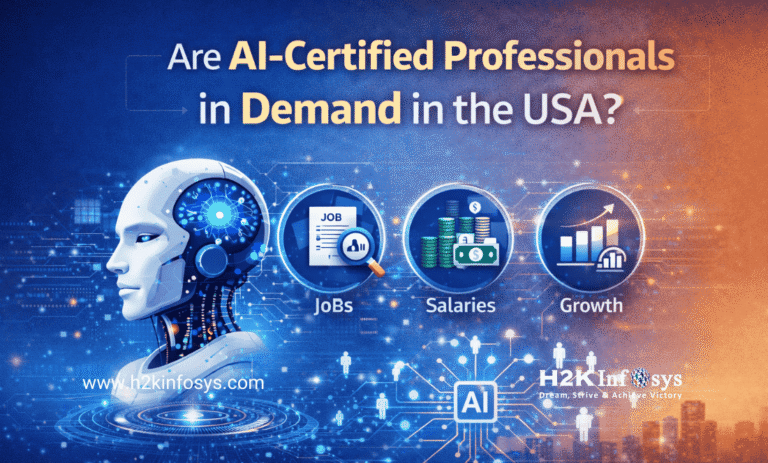
Yes, AI certified professionals are in strong demand in the USA, and structured learning through platforms like H2K Infosys is helping professionals build the practical skills needed to meet this growing enterprise demand. Organizations across healthcare, finance, retail, cybersecurity, and manufacturing are integrating artificial intelligence into core business operations. Employers increasingly prioritize candidates with verified credentials from structured Ai Training Online and recognized certifications, as they demonstrate validated technical knowledge, practical skills, and readiness to work with real-world AI systems.
This demand is driven by the expansion of machine learning, generative AI, data analytics, automation, and predictive modeling across enterprise environments.
What Is AI Certification and What Does It Validate?
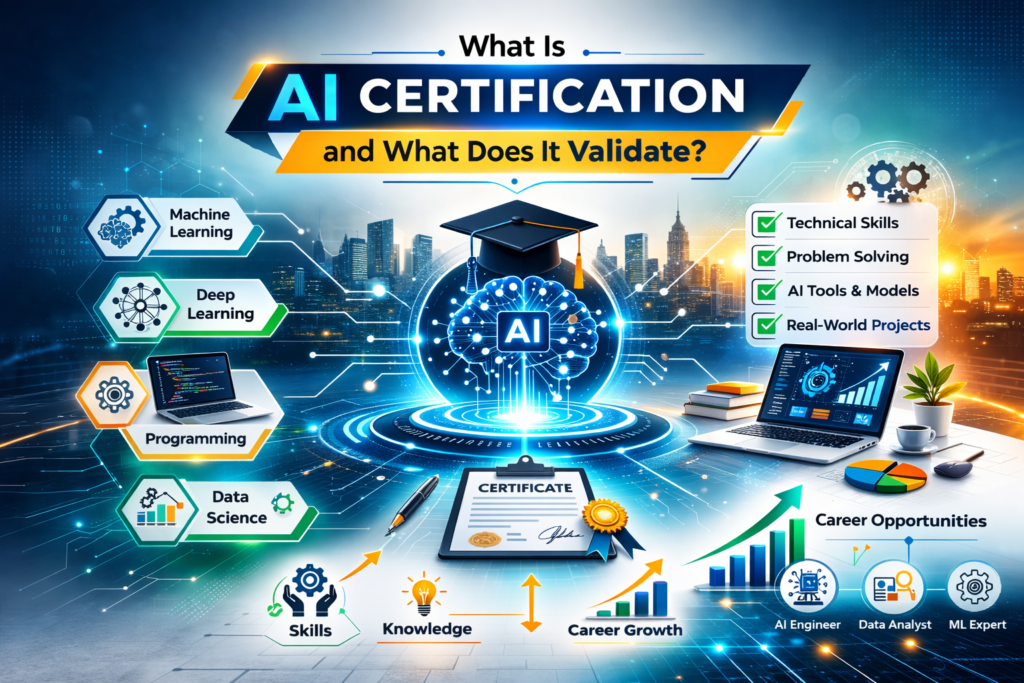
AI certification is a structured credential that verifies an individual’s understanding of artificial intelligence concepts, tools, workflows, and practical implementation. Unlike general IT certifications, AI certifications focus on building and validating skills in areas such as:
- Machine learning algorithms
- Data preprocessing and feature engineering
- Model training and evaluation
- Neural networks and deep learning
- Natural language processing (NLP)
- AI deployment and monitoring
AI certification demonstrates that a professional can work with real tools such as:
| Category | Common Tools Used |
|---|---|
| Programming | Python, R |
| ML Frameworks | TensorFlow, PyTorch, Scikit-learn |
| Data Tools | Pandas, NumPy, SQL |
| Visualization | Matplotlib, Tableau |
| Cloud AI | AWS SageMaker, Azure AI, Google Vertex AI |
| Generative AI | OpenAI APIs, Hugging Face |
Certifications are often obtained through structured Ai Training Programs, which include practical labs, assignments, and project-based learning.
Why Are AI-Certified Professionals in High Demand in the USA?
Rapid Enterprise Adoption of Artificial Intelligence
AI is no longer limited to research or experimental use. It is integrated into core enterprise workflows such as:
- Fraud detection in financial institutions
- Predictive maintenance in manufacturing
- Customer support automation using chatbots
- Medical image analysis in healthcare
- Recommendation engines in e-commerce
Companies require professionals who can design, deploy, and maintain these systems reliably.
AI Skills Gap in the Workforce
Many organizations face challenges finding professionals who can:
- Build machine learning models
- Work with large datasets
- Deploy AI systems securely
- Integrate AI into existing applications
This gap makes certified professionals valuable because certification provides structured validation of skills.
Increased Adoption of Generative AI Technologies
Generative AI technologies such as large language models are being used in:
- Software development assistance
- Automated documentation
- Chatbot systems
- Data summarization
- Customer support automation
This expansion has created new job roles requiring specialized knowledge gained through ai training online and hands-on training.
How Does AI Work in Real-World IT Projects?
Artificial intelligence projects follow structured workflows similar to other software development projects but include additional data science components.
Step-by-Step Enterprise AI Workflow
Step 1: Problem Definition
Example: Predict customer churn in a telecom company.
Define:
- Business objective
- Success metrics
- Data requirements
Step 2: Data Collection
Data sources may include:
- Databases
- APIs
- Logs
- CSV files
- Cloud storage
Example using Python:
import pandas as pd
data = pd.read_csv("customer_data.csv")
Step 3: Data Cleaning and Preparation
Remove missing values, normalize data, and engineer features.
Example:
data.fillna(method="ffill", inplace=True)
Step 4: Model Training
Use machine learning algorithms such as:
- Logistic regression
- Decision trees
- Neural networks
Example:
from sklearn.linear_model import LogisticRegression
model = LogisticRegression()
model.fit(X_train, y_train)
Step 5: Model Evaluation
Metrics used include:
- Accuracy
- Precision
- Recall
- F1 score
Step 6: Deployment
Deploy model using:
- Cloud services
- APIs
- Web applications
Step 7: Monitoring and Maintenance
Monitor performance, retrain models, and update based on new data.
How Is AI Used in Enterprise Environments?
Artificial intelligence is integrated into enterprise systems in multiple ways.
Common Enterprise AI Applications
1. Fraud Detection
Used in banks to detect suspicious transactions.
Tools used:
- Python
- Machine learning models
- Real-time data processing
2. Recommendation Systems
Used by e-commerce platforms.
Example:
- Product recommendations
- Content suggestions
3. Customer Support Automation
AI chatbots handle customer queries.
Tools used:
- NLP models
- Conversational AI platforms
4. Cybersecurity Threat Detection
AI identifies abnormal patterns and potential attacks.
5. Predictive Analytics
Used in:
- Supply chain optimization
- Demand forecasting
- Risk analysis
What Skills Are Required to Learn AI?
Professionals pursuing ai training programs typically develop the following core skills:
Technical Skills
| Skill | Purpose |
|---|---|
| Python programming | Core language for AI development |
| Statistics | Understanding data relationships |
| Machine learning | Model building |
| Data analysis | Data processing and insights |
| Deep learning | Neural networks |
| SQL | Data retrieval |
Tools and Framework Skills
| Tool | Usage |
|---|---|
| TensorFlow | Deep learning |
| PyTorch | Neural network development |
| Scikit-learn | Machine learning |
| Pandas | Data analysis |
| Jupyter Notebook | Experimentation |
Cloud Skills
Cloud platforms used include:
- AWS
- Microsoft Azure
- Google Cloud
Cloud skills are important for deploying AI models.
What Job Roles Use AI Daily?
AI-certified professionals work in multiple roles.
Common AI Job Roles
| Job Role | Responsibilities |
|---|---|
| AI Engineer | Build AI models |
| Machine Learning Engineer | Train and deploy ML systems |
| Data Scientist | Analyze and model data |
| AI Developer | Integrate AI into applications |
| AI Analyst | Analyze AI-driven insights |
| Automation Engineer | Implement intelligent automation |
What Careers Are Possible After AI Training Programs?
AI certification opens multiple career paths.
Entry-Level Roles
- Junior AI Engineer
- Data Analyst
- AI Support Engineer
Mid-Level Roles
- Machine Learning Engineer
- AI Developer
- Data Scientist
Advanced Roles
- AI Architect
- AI Solutions Engineer
- AI Research Engineer
What Industries in the USA Hire AI Professionals?
AI is used across industries.
Major Hiring Industries
Healthcare
Applications:
- Medical imaging analysis
- Disease prediction
Finance
Applications:
- Fraud detection
- Risk analysis
Retail
Applications:
- Recommendation engines
- Demand forecasting
Manufacturing
Applications:
- Predictive maintenance
- Automation
Technology Companies
Applications:
- Software development
- AI products
How Do AI Training Online Programs Prepare Professionals?
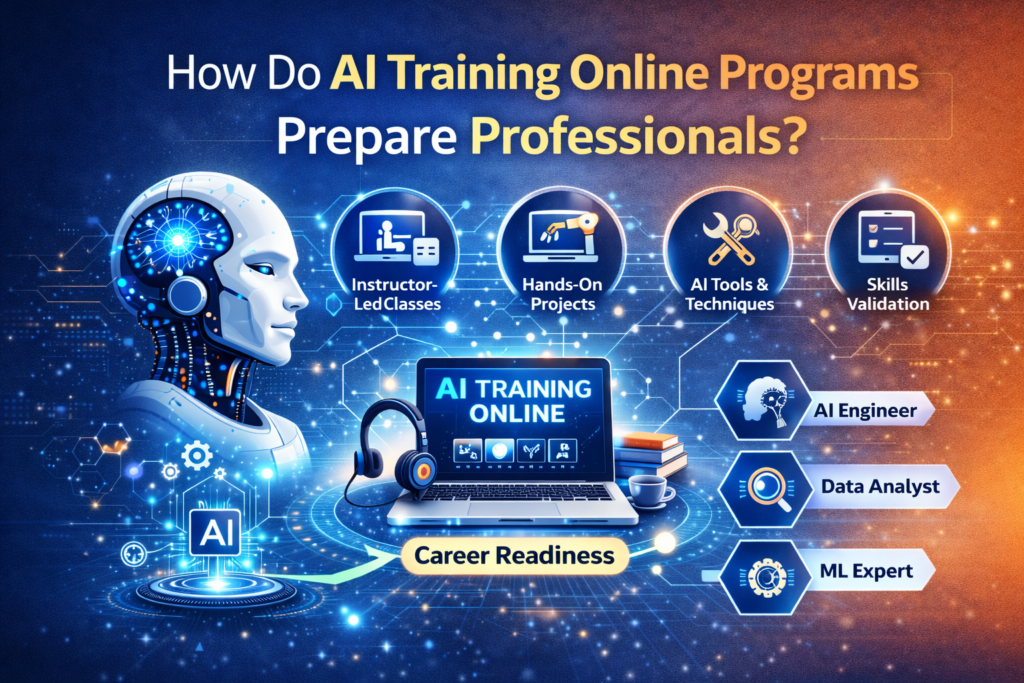
Structured ai training online helps professionals develop real-world skills through hands-on learning.
Typical Learning Path
| Stage | Focus |
|---|---|
| Beginner | Python, statistics |
| Intermediate | Machine learning |
| Advanced | Deep learning |
| Expert | AI deployment |
Practical Training Components
- Hands-on projects
- Model development
- Deployment exercises
- Data analysis tasks
What Are Common Challenges AI Professionals Face?
Data Quality Issues
Poor data affects model performance.
Model Deployment Complexity
Deploying models requires integration with production systems.
Scalability Issues
AI systems must handle large data volumes.
Security and Privacy
Protecting sensitive data is critical.
How Certification Improves Career Opportunities
AI certification helps professionals:
- Validate technical skills
- Demonstrate expertise
- Improve employability
- Gain practical experience
Employers prefer certified candidates because certification shows structured learning and verified capability.
Real Enterprise AI Workflow Example
Example: AI chatbot deployment.
Steps:
- Collect conversation data
- Train NLP model
- Test model
- Deploy to chatbot platform
- Monitor performance
Comparison: Certified vs Non-Certified AI Professionals
| Factor | Certified | Non-Certified |
|---|---|---|
| Skill validation | Verified | Not verified |
| Hiring preference | Higher | Lower |
| Structured learning | Yes | Often self-taught |
| Career progression | Faster | Slower |
FAQ: AI Certification and Career Demand
Are AI-certified professionals in demand in the USA?
Yes. Companies across industries actively hire AI-certified professionals to build, deploy, and maintain AI systems.
Do employers prefer certified AI professionals?
Certification provides structured validation of skills and is commonly preferred.
Can beginners learn AI through training programs?
Yes. Structured learning paths help beginners build skills progressively.
How long does it take to learn AI?
Typically:
- Beginner level: 3–6 months
- Intermediate level: 6–12 months
- Advanced level: 12+ months
Is AI a stable career path?
AI is widely adopted across industries, making it a stable and growing career field.
Key Takeaways
- AI-certified professionals are in strong demand across multiple industries in the USA.
- AI certification validates practical skills in machine learning, data analysis, and AI deployment.
- Enterprise organizations rely on AI for automation, analytics, and decision-making.
- Structured ai training online helps professionals gain job-ready skills.
- AI roles include AI Engineer, Machine Learning Engineer, and Data Scientist.
- AI adoption continues expanding across healthcare, finance, retail, and technology sectors.
To build practical AI skills and understand enterprise workflows, structured learning through H2K Infosys training programs can provide hands-on experience and real-world exposure.
Explore H2K Infosys AI training programs to strengthen your technical foundation and prepare for AI-focused career opportunities.