At H2K Infosys, we recognize the rapid evolution of Artificial Intelligence (AI) and its increasing applications across industries. Many online training platforms, including H2K Infosys, offer AI courses that not only teach the fundamentals but also include hands on projects and career support. These courses are designed to help professionals build the skills required to succeed in AI-related job roles. This provides an overview of AI Training Programs that offer real world projects and career assistance for job seekers.
What is AI (Artificial Intelligence)?
Artificial Intelligence refers to the simulation of human intelligence processes by machines, particularly computer systems. These processes include learning (acquiring information), reasoning (using rules to reach conclusions), and self-correction. AI is widely used in industries such as healthcare, finance, automotive, and marketing, where it enhances decision-making, automates processes, and optimizes performance. AI training typically covers a broad range of topics, from machine learning and natural language processing to neural networks and deep learning.
How Does AI Work in Real-World IT Projects?
In real-world IT projects, AI is often used to solve complex problems that involve large amounts of data and require automation or advanced decision-making. Common use cases include:
- Predictive analytics: AI can analyze historical data to predict future trends, such as customer behavior, market conditions, or equipment failures.
- Natural language processing (NLP): NLP is used in chatbots, sentiment analysis, and automatic translation services.
- Machine learning (ML): ML algorithms are widely used to automate processes like fraud detection, anomaly detection, and recommendation systems.
- Robotic Process Automation (RPA): AI can automate repetitive tasks like data entry, email responses, and invoice processing.
In enterprise environments, AI solutions often integrate with existing systems to enhance efficiency and decision-making.
Why is AI Important for Working Professionals?
AI is increasingly becoming a core competency in many industries, making it essential for working professionals to gain a solid understanding of AI technologies. Here’s why AI is important for professionals today:
- Job market demand: As businesses across various industries adopt AI technologies, the demand for AI-trained professionals has grown significantly. AI skills are now required in various roles, from data scientists and machine learning engineers to AI project managers.
- Career advancement: Professionals with AI expertise are well-positioned for career growth, as AI-driven solutions are becoming integral to many business strategies.
- Business innovation: AI helps companies innovate and stay competitive by automating tasks, improving decision-making, and providing valuable insights from data.
What Skills are Required to Learn AI?
To succeed in AI courses and apply AI in real-world projects, learners need to develop a broad skill set. Key skills include:
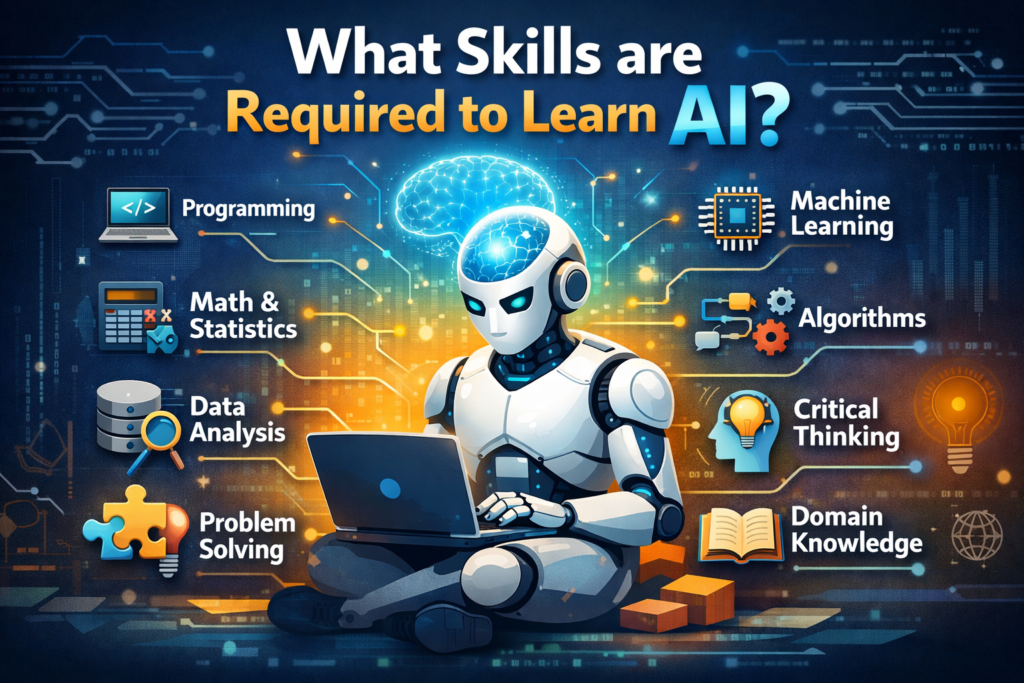
- Programming: Proficiency in programming languages such as Python, R, and Java is essential for building AI models.
- Mathematics and Statistics: A strong foundation in algebra, calculus, probability, and statistics is crucial for understanding algorithms and building predictive models.
- Data Science: AI relies heavily on data, so skills in data collection, preprocessing, and visualization are important.
- Machine Learning (ML): Familiarity with machine learning algorithms, supervised and unsupervised learning, and model evaluation techniques is essential.
- Deep Learning: Knowledge of deep learning frameworks such as TensorFlow, PyTorch, and Keras is required for complex AI applications like computer vision and natural language processing.
- Problem-solving: AI professionals need strong problem-solving skills to design, develop, and implement AI solutions effectively.
How is AI Used in Enterprise Environments?
In enterprise environments, AI plays a significant role in automating processes, optimizing operations, and enhancing decision-making. Key applications include:
- Supply chain optimization: AI helps enterprises predict demand, optimize inventory, and improve delivery schedules.
- Customer support: AI-driven chatbots and virtual assistants provide 24/7 customer service and automate common inquiries.
- Fraud detection: Financial institutions use AI to detect fraud patterns and anomalies in real-time, reducing the risk of financial loss.
- Personalization: AI helps businesses personalize marketing campaigns, product recommendations, and customer experiences.
In all these use cases, AI tools and platforms like IBM Watson, Google Cloud AI, and AWS AI are widely used to integrate AI into business workflows.
What Job Roles Use AI Daily?
There are several job roles where professionals use AI technologies daily. Some of these roles include:
- Data Scientist: Data scientists design and implement AI models, interpret large datasets, and extract actionable insights to help businesses make data-driven decisions.
- Machine Learning Engineer: ML engineers build, train, and optimize machine learning models to solve business problems like prediction, classification, and recommendation.
- AI Researcher: AI researchers work on developing new algorithms and techniques to advance the field of AI.
- AI Developer: AI developers write the software that powers AI applications, such as intelligent systems and autonomous robots.
- Business Analyst: Business analysts use AI-powered tools to analyze data and provide actionable insights for business improvement.
- AI Product Manager: AI product managers oversee the development of AI-powered products, from inception to deployment, ensuring they meet business needs and align with market trends.
What Careers are Possible After Learning AI?
After completing an AI course and gaining hands-on experience with real world projects, professionals can pursue various career paths, such as:
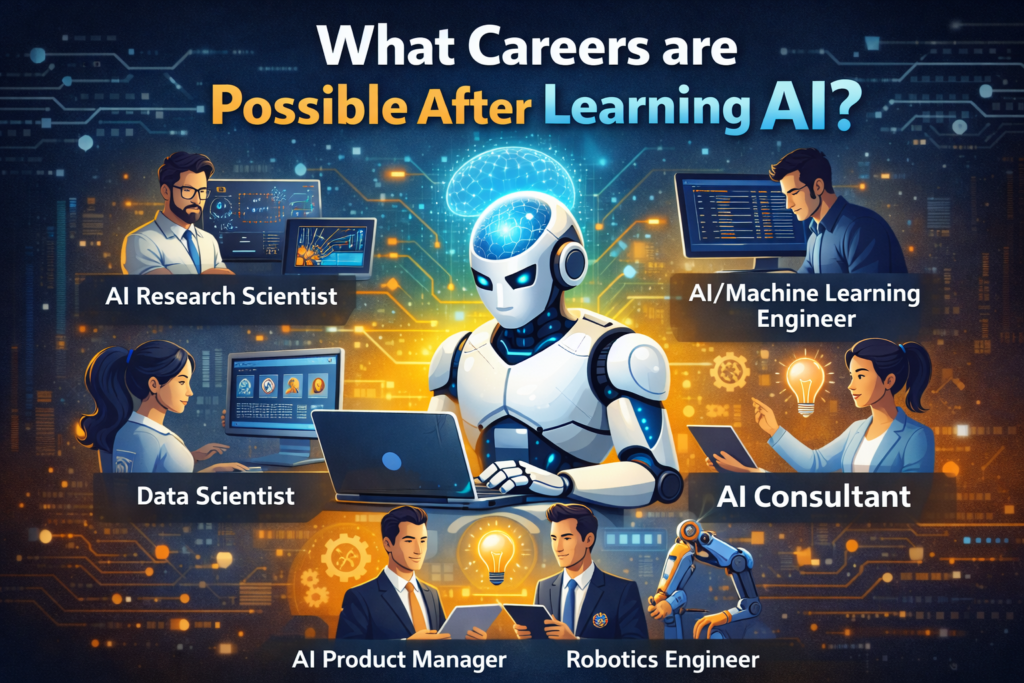
- AI Engineer: AI engineers design and implement AI systems, ensuring they are scalable, reliable, and secure for enterprise environments.
- Data Scientist: Data scientists analyze complex datasets and create models that drive business decisions using AI techniques.
- Machine Learning Specialist: These specialists focus on building and deploying machine learning models that solve specific business challenges.
- AI Consultant: AI consultants advise companies on how to integrate AI into their operations and ensure successful implementation.
- AI Researcher: Researchers work in academia or research institutions, pushing the boundaries of AI through innovative research.
- AI Developer: AI developers focus on building AI applications and deploying them in real-world environments.
- Robotics Engineer: Robotics engineers design AI-driven robots for automation, manufacturing, and other industrial applications.
What are the Benefits of AI Courses with Real World Projects and Career Support?
AI courses that incorporate real-world projects and career support offer distinct advantages for learners, including:
- Practical experience: Working on industry-relevant projects allows learners to apply theoretical concepts in real-world scenarios, building practical experience.
- Portfolio development: Completing hands-on projects allows students to build a portfolio of work that can be showcased to potential employers, demonstrating their ability to solve real-world problems.
- Networking opportunities: Career support often includes access to industry connections, job fairs, and mentoring, helping students expand their professional networks.
- Job placement assistance: Many AI courses offer job placement services, including resume workshops, interview preparation, and job search guidance to help students land their first AI-related job.
- Industry-standard tools: Real-world projects often require the use of industry-standard tools and technologies, providing learners with exposure to platforms like TensorFlow, Keras, and Apache Spark.
FAQ
1. What is the best AI course for professionals looking to enhance their career prospects?
The best AI course for professionals will depend on individual learning goals, current skill level, and career aspirations. Look for AI courses that offer practical projects, access to industry tools, and career support like job placement assistance, resume reviews, and interview coaching.
2. Can I learn AI without a technical background?
While some familiarity with programming and mathematics is helpful, many AI courses are designed for professionals with a beginner-to-intermediate technical background. If you have a background in software development, data analysis, or engineering, you may find it easier to learn AI. Some courses also offer introductory modules that teach the basics.
3. How long does it take to learn AI?
The time it takes to learn AI varies depending on the course format and the learner’s commitment. A typical AI course can take anywhere from 8 weeks to several months. However, mastering AI and gaining real-world experience may take a year or more, depending on the depth of the material and hands-on practice.
4. How do AI courses help with job placement?
AI courses often provide job placement assistance through resume workshops, mock interviews, and connections with employers looking for AI talent. Many programs also partner with companies and offer career fairs or direct job placement opportunities.
5. What tools and technologies are used in AI courses?
AI courses teach industry-standard tools and frameworks such as TensorFlow, Keras, PyTorch, and Scikit-learn. Courses also cover cloud platforms like AWS, Azure, and Google Cloud, which are widely used for deploying AI models and applications.
Key Takeaways:
- AI courses that include real-world projects provide hands-on experience, which is critical for building a professional portfolio.
- Career support in AI courses can help learners gain the necessary job search skills, such as resume writing, interview preparation, and networking.
- The demand for AI professionals is growing across various industries, making AI Training Online valuable for career advancement.
- Essential skills for learning AI include programming, mathematics, data science, machine learning, and deep learning.
Explore H2K Infosys AI courses to gain hands-on experience and career support in your journey to becoming an AI professional. Start your path to success today!