The best Java Certifications Online path in 2026 is the one that combines Core Java knowledge with full-stack development, hands-on projects, and training to get a job. H2K Infosys prepares learners with hands-on skills on Java, Spring Boot, REST APIs, databases, testing, and frontend technologies to get real development jobs.
If you want to become a java full stack developer, the goal should be more than earning a certificate. A good program should teach you how Java actually works in applications, from backend logic, APIs, to databases, testing, and front-end integration. This is what makes java online certification more useful for career growth.
Learners who are looking for Java Certifications Online training and placement should also look for project practice, interview preparation and career support. That’s what employers want in 2026: someone who can explain what they’ve built, solve practical coding problems, and understand how the different parts of an application fit together.
What Are the Best Java Certifications Online in 2026?
The right java online certification depends on your career goal. A beginner may need a structured course covering Core Java, while someone targeting full-stack development should look for training that also covers Spring Boot, REST APIs, SQL, frontend technologies, and deployment concepts.
Here are some areas worth checking before enrolling:
- Core Java and Object-Oriented Programming
- Collections, Exception Handling, and Multithreading
- JDBC and SQL
- Spring and Spring Boot
- RESTful APIs
- HTML, CSS, and JavaScript
- Git and version control
- Database integration
- Real-time projects
- Interview and career preparation
A certificate by itself won’t make someone job-ready. The practical work behind it matters much more.
Which Java Certification Is Best for Beginners?
For beginners, a Java Certification Online program with a clear learning path is usually easier to follow than jumping between individual tutorials.
Full-stack developers often benefit from completing Java certifications online to broaden their skill set.
A good starting sequence looks something like this:
Core Java → OOP → Collections → SQL → Spring Boot → REST APIs → Frontend basics → Project
For example, a learner might start by building a simple banking application in Java. Later, the same project can be expanded into a Spring Boot application with a database and REST API. That progression makes the learning much more practical.
Can Java Certification Help You Become a Full-Stack Developer?
Yes. Java Certifications Online remains widely used on the backend, while full-stack development requires knowledge of both server-side and client-side technologies.
Someone targeting a java full stack developer role should ideally learn:
| Skill Area | Technologies to Consider |
|---|---|
| Programming | Java |
| Backend | Spring, Spring Boot |
| APIs | REST |
| Database | SQL, MySQL/PostgreSQL |
| Frontend | HTML, CSS, JavaScript |
| Version Control | Git/GitHub |
| Build Tools | Maven/Gradle |
| Testing | JUnit, Mockito |
| Deployment | Cloud and CI/CD fundamentals |
The exact technology stack varies between companies, so it is better to understand the concepts rather than memorize one tool.
Is Java Training With Placement Worth It?
If you’re changing careers or applying for your first developer position, java training and placement programs can be useful when the placement component includes actual career preparation.
Look for programs that provide:
- Resume preparation
- Mock technical interviews
- Project guidance
- Interview question practice
- Career mentoring
- Job-search guidance
- Practical development assignments
Be careful with programs that make unrealistic job guarantees. Placement assistance and guaranteed employment are not the same thing.
What Should You Learn Alongside Java in 2026?
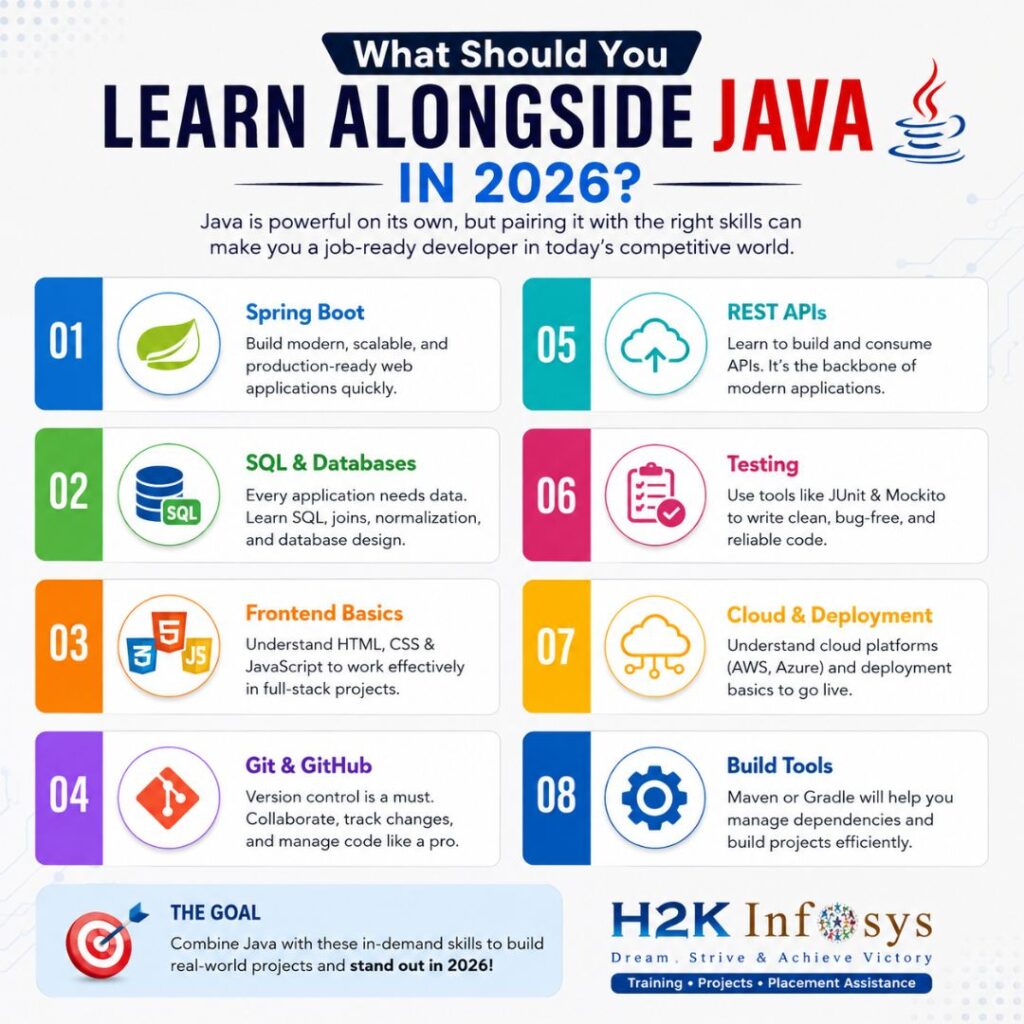
Java development continues to evolve, so learning only Core Java can leave gaps in your preparation.
A modern Java learning path should include:
1. Spring Boot
Spring Boot is widely used for building Java-based backend applications. Understanding dependency injection, REST APIs, configuration, and database integration is particularly useful.
2. SQL and Databases
Most business applications interact with databases. You should be comfortable writing queries, using joins, filtering data, and understanding basic database design.
3. JavaScript and Frontend Fundamentals
If your goal is full-stack development, you don’t need to become a frontend specialist immediately. But you should understand how browsers, JavaScript, APIs, and frontend applications interact with a Java backend.
4. Testing
JUnit, Mockito, integration testing, and basic automation concepts can make your development skills more complete.
5. Git and GitHub
Version control is a practical requirement for collaborative software development. Even personal projects should ideally be maintained with Git.
How Do You Choose the Right Java Online Certification?
Before paying for any java online certification, compare the curriculum rather than focusing only on the certificate name.
Ask these questions:
- Does the course include hands-on projects?
- Is the Java version and curriculum reasonably current?
- Does it cover Spring Boot?
- Are SQL and database concepts included?
- Does it teach REST APIs?
- Is there interview preparation?
- Are instructors available for questions?
- Does the program provide career or placement assistance?
- Can you access practical assignments?
- Does the course match your target job role?
This checklist can help you avoid choosing a course simply because it has a flashy title.
Java Certification vs Java Full-Stack Training
These terms are often used interchangeably, but they aren’t exactly the same.
| Java Certification | Java Full-Stack Training |
|---|---|
| Usually focuses on Java skills | Covers frontend + backend |
| May emphasize exams or assessments | Usually emphasizes projects |
| Can validate specific knowledge | Builds broader development skills |
| Suitable for Java-focused roles | Suitable for full-stack roles |
| Scope can be relatively narrow | Typically has a wider technology stack |
If your goal is specifically to become a java full stack developer, look for a program that teaches the complete application-development workflow rather than Java alone.
What Projects Should You Build After Java Training?
Projects are one of the best ways to turn theoretical knowledge into something you can demonstrate during interviews.
Some useful project ideas include:
- Employee Management System
- Online Bookstore
- Banking Application
- E-commerce Backend
- Appointment Booking System
- Inventory Management System
- Online Learning Platform
For example, an e-commerce project could use Java and Spring Boot for the backend, SQL for data storage, REST APIs for communication, and JavaScript for the frontend.
That gives you something concrete to discuss when an interviewer asks, “What have you actually built?”
Is Java Still a Good Career Choice in 2026?
Java remains a strong option for developers because it is deeply established in enterprise software, backend systems, APIs, financial applications, and large-scale business platforms.
The bigger shift is in what developers are expected to know. Companies increasingly value developers who can work across APIs, databases, cloud environments, testing, automation, and AI-assisted development rather than someone who only knows Java syntax.
So, if you’re starting now, think beyond the certificate.
Learn Java deeply, build applications, understand modern development practices, and keep expanding your stack.
Final Thoughts
The best Java certifications online in 2026 are not necessarily the ones with the longest course descriptions or the most impressive certificate names. Look for practical curriculum, current technologies, hands-on projects, instructor support, and career preparation.
If your goal is a broader development career, combining Java with Spring Boot, SQL, REST APIs, frontend fundamentals, Git, testing, and cloud concepts can give you a much stronger foundation for java full stack developer roles.
FAQs : Java certifications online
1. What should I learn alongside Java in 2026?
Alongside Java, focus on Spring Boot, SQL, REST APIs, Git, testing, frontend basics, cloud deployment, and build tools such as Maven or Gradle.
2. Is Java enough to become a full-stack developer?
Not by itself. For a Java full-stack developer role, you should also learn frontend technologies such as HTML, CSS, and JavaScript, along with Spring Boot, databases, and REST APIs.
3. Should I learn Spring Boot after Core Java?
Yes. Once you understand Core Java and OOP concepts, Spring Boot is a practical next step for building modern backend and web applications.
4. Is SQL important for Java developers?
Yes. Most enterprise Java applications work with databases, so understanding SQL, joins, queries, and basic database design is highly useful.
5. Should Java developers learn cloud technologies?
Yes. Basic knowledge of platforms such as AWS or Azure and deployment concepts can help Java developers understand how applications are hosted and maintained in real-world environments.