Before diving into tools or coding, every AI beginner should understand a few core ideas first, how machines learn from data, the difference between AI, machine learning, and deep learning, what data quality means, how models make predictions, and the ethical implications of AI. Once these basics click, everything else from chatbots to self-driving cars starts making a lot more sense.
What Are the Core Concepts Every AI Beginner Should Understand First?
If you’re just starting out in AI, the landscape can feel… messy. One minute you’re hearing about neural networks, the next minute someone is talking about prompt engineering or generative models. It’s exciting, sure but also confusing.
The truth is, you don’t need to learn everything at once. Most people who successfully transition into AI especially those enrolling in AI courses for beginners start with a small set of core concepts. Think of them as the “mental framework” that makes the whole field understandable.
Let’s break them down in plain language.
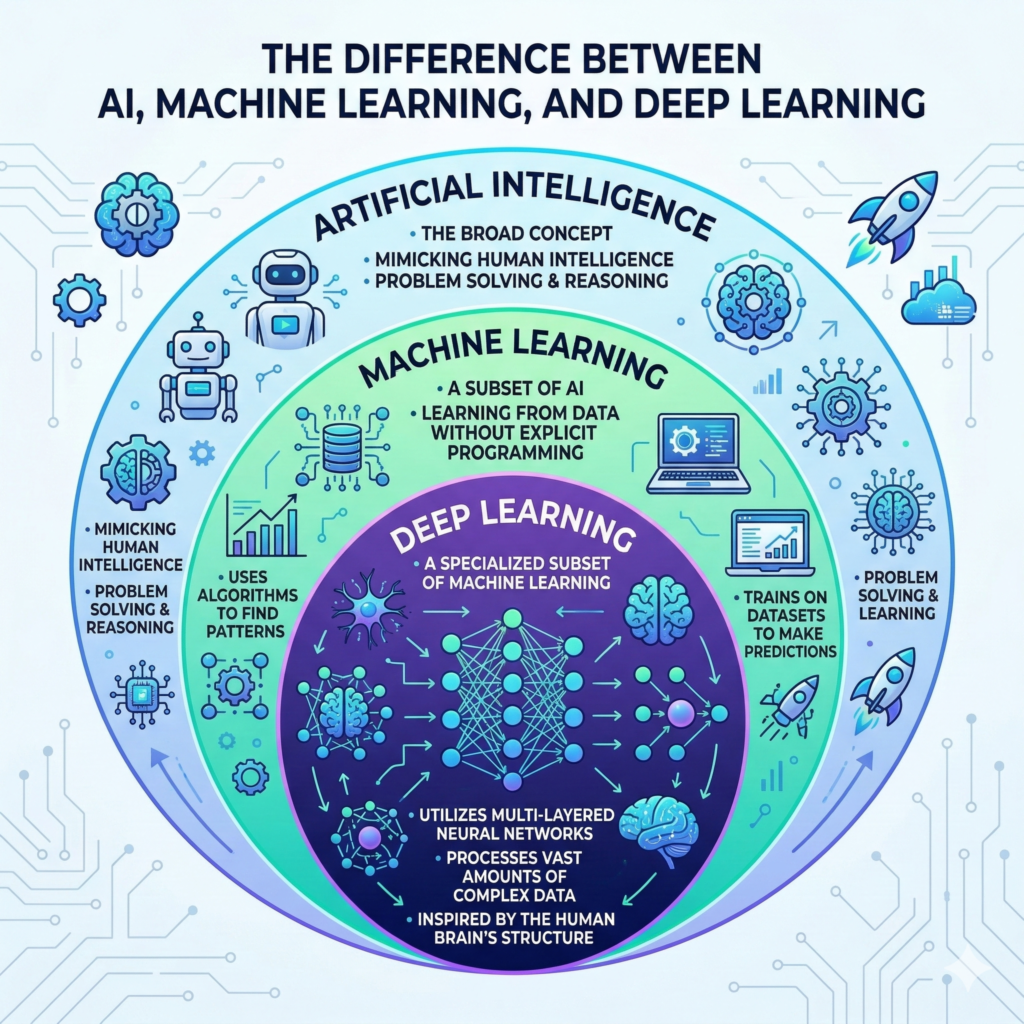
1. The Difference Between AI, Machine Learning, and Deep Learning
This is where many AI beginners get tripped up.
People often use these terms interchangeably, but they’re not the same thing.
- Artificial Intelligence – the broad goal of making machines perform tasks that normally require human intelligence.
- Machine Learning – a subset of AI where systems learn patterns from data instead of following fixed rules.
- Deep Learning – a specialized form of machine learning that uses neural networks with many layers.
Here’s a simple way I usually explain it to beginners:
AI is the entire field.
Machine learning is the engine powering most modern AI.
Deep learning is the turbocharged version used for complex tasks like image recognition.
When you explore AI courses online, you’ll notice that most of them actually focus heavily on machine learning first. That’s because it’s the practical core of modern AI systems.
2. Data Is the Real Fuel Behind AI
A common misconception is that AI is all about algorithms.
In reality, data matters far more.
A model trained on messy, biased, or incomplete data will produce unreliable results even if the algorithm itself is brilliant.
A good real-world example is facial recognition systems. Early models struggled because the training datasets lacked diversity. As more representative datasets were introduced, accuracy improved dramatically.
This is why beginners should understand:
- Data collection
- Data cleaning
- Bias in datasets
- Training vs testing data
Honestly, many AI professionals will tell you that 70–80% of the work in real projects is data preparation, not fancy modeling.
3. How Machine Learning Models Actually Learn
When people hear “machine learning”, they sometimes imagine machines thinking like humans.
That’s not really what’s happening.
Instead, models learn patterns by minimizing errors over many iterations.
A simple example:
Imagine training a model to predict house prices. You feed it thousands of examples size, location, number of rooms, price and the algorithm gradually adjusts its internal parameters until predictions become accurate.
Beginners should understand a few core ideas here:
- Training
- Validation
- Testing
- Overfitting
- Underfitting
If you join structured AI training and job placement programs from platform like H2K Infosys, this is usually the point where you start building your first real models.
And honestly? That’s when things finally start feeling real.
4. Neural Networks
Neural networks sound complicated, but the concept is surprisingly intuitive.
They’re loosely inspired by the human brain layers of nodes passing information forward and adjusting connections as they learn.
These networks power many modern AI breakthroughs, including:
- Voice assistants
- Image recognition
- Recommendation systems
- Large language models like ChatGPT
The reason neural networks matter so much today is simple: they scale well with large datasets and computing power.
That’s exactly why the recent explosion of Generative AI tools happened in the last few years.
5. Prompting and Human-AI Interaction
This is one of the newer skills beginners are learning today.
With the rise of generative AI systems, knowing how to communicate effectively with AI models has become valuable.
This skill often called prompt engineering is now included in many modern AI courses for beginners.
For example, small tweaks in prompts can dramatically change outputs:
- vague prompt → generic response
- structured prompt → precise output
It’s not traditional programming, but it’s becoming a key skill in the AI workforce.
6. Ethics, Bias, and Responsible AI
This topic used to be optional.
Now it’s essential.
AI systems influence hiring decisions, financial approvals, healthcare recommendations, and even criminal justice systems. If models are biased, the impact can be serious.
AI Beginner learners should understand concepts like:
- Algorithmic bias
- Transparency
- Model accountability
- Responsible AI design
In fact, many modern AI courses online now include ethics modules because companies increasingly expect developers to understand these issues.
7. Real-World AI Applications
Theory is useful, but beginners learn fastest when they connect concepts to real problems.
Some common AI beginner-level applications include:
- Spam detection
- Movie recommendation systems
- Chatbots
- Image classification
- Fraud detection
What’s interesting is that these “simple” projects are actually used by massive companies like Netflix, Amazon, and Google just at a much larger scale.
This is exactly why H2K Infosys structured AI training and job placement programs emphasize project-based learning.
Employers want proof that you can apply concepts, not just define them.
8. The AI Tools Ecosystem
Another thing beginners quickly notice: the AI ecosystem moves fast.
A few tools you’ll constantly see in learning environments include:
- Python
- TensorFlow
- PyTorch
- Jupyter Notebook
Most AI beginner courses online introduce these gradually, usually starting with Python because it has the largest AI community and library support.
And yes, almost every AI professional I know started exactly the same way.
A Small Reality Check for Beginners
Here’s something I often tell people who are just entering the field:
You don’t need to become a math genius overnight.
What matters more in the beginning is conceptual clarity understanding what problems AI can solve, how models learn, and how to interpret results.
Once that foundation is strong, the technical pieces become much easier to learn.
That’s why the best AI courses for beginners focus on concepts first, tools second.