Yes, many online platforms like H2k Infosys offer AI online training with job placement support for USA jobs, but the scope and effectiveness of that support vary significantly by institute. Placement support typically includes resume preparation, interview coaching, portfolio development, networking guidance, and referrals rather than guaranteed employment. For learners pursuing Ai learning for Beginners job placement assistance helps bridge the gap between training and real-world employment by aligning technical skills with industry hiring requirements.
What Is AI Online Training and Job Placement Support?
AI online training refers to structured educational programs delivered remotely that teach artificial intelligence concepts, machine learning algorithms, and practical implementation using industry tools. These programs often include job placement support to help learners transition into AI-related roles.
Job placement support typically includes:
- Resume and LinkedIn profile optimization
- Mock interviews and technical interview preparation
- Portfolio and project guidance
- Job search strategy training
- Networking opportunities with industry professionals
- Career mentorship and referrals
It is important to distinguish between:
| Placement Support Type | Description |
|---|---|
| Career Assistance | Resume reviews, interview coaching, and job search guidance |
| Referral Support | Recommendations or referrals to hiring partners |
| Internship Placement | Assistance securing internships or project-based work |
| Job Guarantee (rare) | Conditional guarantee based on performance and eligibility |
Most reputable institutes provide career assistance rather than guaranteed employment.
How Does Artificial Intelligence Work in Real-World IT Projects?
Artificial intelligence involves systems that analyze data, identify patterns, and make decisions or predictions without explicit programming for each scenario.
Core Components of AI Systems in Enterprise Environments
1. Data Collection
AI systems require structured or unstructured data such as:
- Customer transactions
- Sensor data
- User behavior logs
- Images and videos
- Text documents
Example sources:
- Databases (PostgreSQL, MySQL)
- Cloud storage (AWS S3, Azure Blob Storage)
- Streaming systems (Apache Kafka)
2. Data Preprocessing
Raw data must be cleaned and prepared before training AI models.
Common preprocessing tasks:
- Removing missing values
- Normalizing numerical data
- Encoding categorical variables
- Tokenizing text
Example using Python and Pandas:
import pandas as pddata = pd.read_csv("customer_data.csv")
data = data.dropna()
data['age'] = data['age'] / 100
3. Model Training
AI models learn patterns from data using algorithms such as:
- Linear regression
- Decision trees
- Neural networks
- Random forests
- Deep learning models
Common frameworks:
- TensorFlow
- PyTorch
- Scikit-learn
4. Model Deployment
Trained models are deployed into production systems using:
- REST APIs
- Cloud platforms
- Microservices architecture
Example deployment workflow:
| Step | Tool |
|---|---|
| Model training | Python, TensorFlow |
| Containerization | Docker |
| Deployment | Kubernetes |
| Monitoring | Prometheus |
Why Is AI Training Important for Working Professionals?
Artificial intelligence is widely adopted across industries including healthcare, finance, retail, cybersecurity, and manufacturing.
Professionals pursue AI and machine learning courses to:
- Transition into AI-focused roles
- Automate repetitive tasks
- Improve decision-making using data
- Enhance career stability in technology-driven environments
Enterprise Use Cases
Financial Services
- Fraud detection
- Risk analysis
- Automated trading systems
Healthcare
- Medical image analysis
- Predictive diagnostics
- Patient data analysis
Retail
- Recommendation engines
- Demand forecasting
- Customer segmentation
Cybersecurity
- Threat detection
- Intrusion detection systems
- Behavioral analytics
What Skills Are Required to Learn AI and Machine Learning Courses?
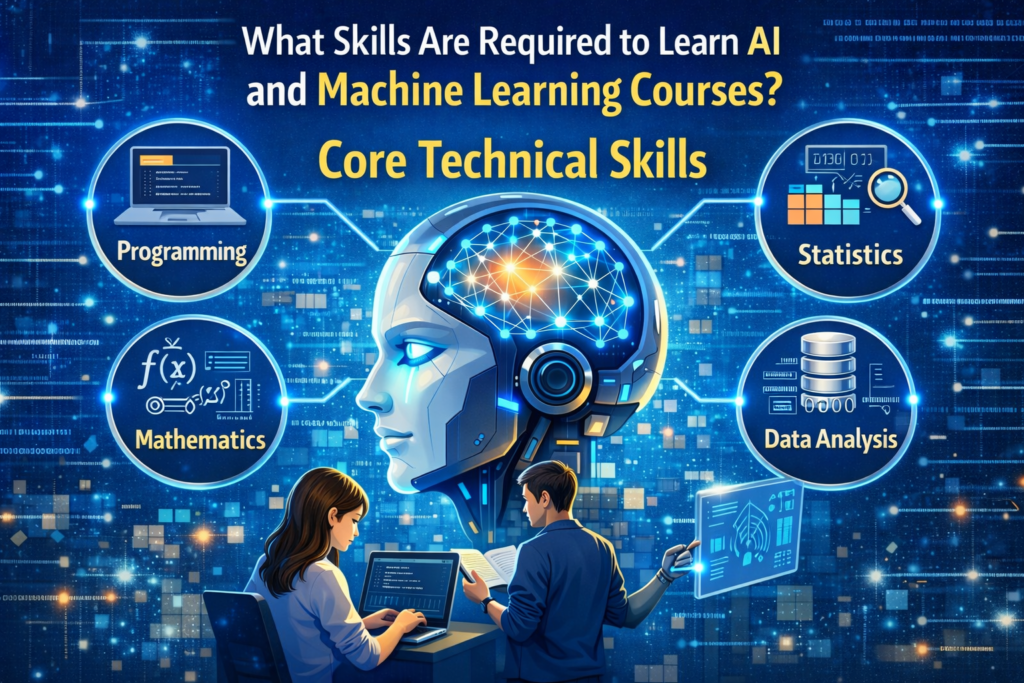
AI learning requires both technical and analytical skills.
Core Technical Skills
| Skill | Description |
|---|---|
| Python Programming | Primary language for AI development |
| Statistics | Understanding probability and data analysis |
| Machine Learning Algorithms | Model training and evaluation |
| Data Analysis | Using Pandas, NumPy |
| SQL | Accessing and managing data |
| Cloud Computing | AWS, Azure, Google Cloud |
| Deep Learning | Neural networks, CNN, RNN |
Tools Used in Real AI Projects
| Tool | Purpose |
|---|---|
| Python | Programming language |
| TensorFlow | Deep learning framework |
| PyTorch | AI research and production |
| Scikit-learn | Machine learning library |
| Jupyter Notebook | Interactive development |
| Docker | Deployment |
| Kubernetes | Scalability |
| Git | Version control |
How Is AI Used in Enterprise Environments?
Enterprise AI systems operate within structured software ecosystems.
Typical Enterprise AI Workflow
- Data collection from enterprise systems
- Data preprocessing and feature engineering
- Model training and validation
- Model deployment to production
- Monitoring and maintenance
Example: Customer Churn Prediction System
Step 1: Collect Customer Data
- Subscription history
- Usage patterns
- Support tickets
Step 2: Train Machine Learning Model
from sklearn.ensemble import RandomForestClassifiermodel = RandomForestClassifier()
model.fit(X_train, y_train)
Step 3: Deploy Model
- Integrate with CRM system
- Predict churn risk in real time
What Job Roles Use AI Daily?
AI skills are used across multiple job roles.
Common AI Job Roles
| Job Role | Responsibilities |
|---|---|
| Machine Learning Engineer | Build and deploy models |
| Data Scientist | Analyze and interpret data |
| AI Engineer | Develop AI applications |
| Data Analyst | Analyze trends |
| AI Researcher | Develop new algorithms |
| Business Intelligence Developer | Create analytics systems |
Entry-Level Roles Suitable for Beginners
- Junior Data Analyst
- Associate Machine Learning Engineer
- AI Support Engineer
- Data Engineer (Entry Level)
These roles are often accessible to learners completing structured ai learning for beginners programs.
What Careers Are Possible After Learning AI and Machine Learning Courses?
AI training opens multiple career pathways.
Career Path Progression
| Level | Role |
|---|---|
| Beginner | Data Analyst |
| Intermediate | Machine Learning Engineer |
| Advanced | AI Architect |
| Expert | AI Research Scientist |
Industries Hiring AI Professionals in the USA
- Technology companies
- Financial institutions
- Healthcare organizations
- Retail companies
- Government agencies
- Cybersecurity firms
What Kind of Job Placement Support Do AI Training Institutes Provide?
AI training institutes provide structured career support programs.
Common Career Support Services
Resume Preparation
Focus areas:
- Highlighting AI projects
- Including technical skills
- Demonstrating real-world applications
Example resume sections:
- AI Projects
- Technical Skills
- Cloud Experience
- Machine Learning Experience
Mock Interviews
Interview preparation includes:
- Coding interviews
- Machine learning questions
- System design interviews
- Behavioral interviews
Portfolio Development
Students build portfolios with:
- AI models
- Machine learning projects
- GitHub repositories
- Real-world datasets
Example portfolio projects:
- Fraud detection system
- Recommendation engine
- Predictive analytics model
Job Search Strategy Training
Training covers:
- Where to find AI jobs
- How to apply effectively
- How to communicate with recruiters
Platforms used:
- Indeed
- Glassdoor
How Do AI Training Institutes Help With USA Job Requirements?
AI job placement support is aligned with US hiring standards.
USA Hiring Expectations
Employers typically evaluate:
- Practical experience
- Project portfolio
- Programming skills
- Problem-solving ability
Training institutes help learners meet these expectations by providing:
- Hands-on projects
- Real-world use cases
- Interview preparation
How Beginners Can Transition Into AI Careers
Step-by-Step Learning Path
Step 1: Learn Python
Key topics:
- Variables
- Functions
- Data structures
Step 2: Learn Data Analysis
Tools:
- Pandas
- NumPy
Step 3: Learn Machine Learning
Concepts:
- Supervised learning
- Unsupervised learning
Step 4: Work on Projects
Examples:
- Sales prediction model
- Customer segmentation
Step 5: Build Portfolio
Platforms:
- GitHub
- Kaggle
Step 6: Prepare for Interviews
Practice:
- Coding problems
- Machine learning theory
How AI and Machine Learning Courses Prepare Students for Real Jobs
AI training focuses on real-world scenarios.
Typical Course Structure
| Module | Topics |
|---|---|
| Programming | Python |
| Data Analysis | Pandas, NumPy |
| Machine Learning | Algorithms |
| Deep Learning | Neural networks |
| Deployment | Cloud platforms |
| Projects | Real-world scenarios |
Challenges Learners Face When Transitioning to AI Careers
Common challenges include:
Lack of Practical Experience
Solution:
- Work on real projects
Difficulty Understanding Algorithms
Solution:
- Practice implementation
Interview Preparation
Solution:
- Mock interviews
FAQ: AI Online Training and Job Placement Support
Do AI training institutes guarantee USA jobs?
No. Most institutes provide job placement support but do not guarantee employment. Success depends on skills, experience, and job market conditions.
What kind of placement support is typically offered?
Support includes:
- Resume building
- Interview preparation
- Portfolio guidance
- Job search assistance
Is AI learning suitable for beginners?
Yes. Many programs offer ai learning for beginners starting with basic programming and data analysis.
How long does it take to become job-ready?
Typical timelines:
- Beginner to intermediate: 6–12 months
- Intermediate to advanced: 12–24 months
What is the average entry-level AI job role?
Common entry-level roles include:
- Data analyst
- Junior machine learning engineer
- AI support engineer
Do USA companies hire candidates trained online?
Yes. Many companies hire candidates trained online if they demonstrate:
- Practical skills
- Strong project portfolio
- Interview readiness
Best Practices for Choosing an AI Training Institute
Consider the following factors:
Curriculum Quality
Should include:
- Python programming
- Machine learning
- Real-world projects
Hands-on Training
Look for:
- Project-based learning
- Real datasets
Career Support
Important services:
- Resume preparation
- Mock interviews
Industry-Relevant Tools
Programs should include:
- TensorFlow
- PyTorch
- Cloud deployment
Key Takeaways
- AI online training institutes commonly provide job placement support such as resume assistance, interview preparation, and portfolio development.
- Placement support helps learners align their skills with USA job market requirements but does not guarantee employment.
- AI and machine learning courses teach practical skills used in enterprise environments.
- Beginners can transition into AI careers through structured learning, projects, and interview preparation.
- Real-world skills, hands-on experience, and strong portfolios are critical for securing AI jobs.
Explore H2K Infosys AI and Machine learning Courses to build hands-on skills aligned with real-world industry workflows.
Enroll in structured training programs designed to support career readiness and professional growth in artificial intelligence.