H2K Infosys AI courses are structured to combine controlled practice assignments with staged, real-world–style industry projects. Learners typically move from guided labs that teach core concepts to scenario-based projects that simulate enterprise workflows, including data ingestion, model deployment, and system integration. The emphasis is on applying AI skills within realistic business and technical constraints rather than only completing isolated exercises.
This reflects a common concern among working professionals evaluating Best Ai Certification Courses whether the learning experience translates into skills that can be applied directly in a production environment.
In practical terms, the distinction is between:
- Practice Assignments
- Short, focused tasks
- Designed to teach specific tools or concepts
- Often self-contained (e.g., training a model on a sample dataset)
- Industry-Style Projects
- Multi-step workflows
- Involve realistic data, business objectives, and system constraints
- Require integration across tools, platforms, and stakeholders
H2K Infosys positions its AI learning path to include both, with projects designed to resemble how AI is implemented in enterprise IT and business teams.
How Does AI Work in Real-World IT Projects?
In production environments, AI is rarely a standalone system. It typically exists as part of a larger data and application ecosystem.
A common enterprise AI workflow looks like this:
- Data Collection and Ingestion
- Data from databases, APIs, logs, or cloud storage
- Structured and unstructured sources (CSV, JSON, text, images)
- Data Cleaning and Validation
- Handling missing values
- Standardizing formats
- Removing duplicates and outliers
- Feature Engineering
- Transforming raw data into model-ready inputs
- Encoding categorical values, scaling numeric features
- Model Training and Evaluation
- Using frameworks such as TensorFlow, PyTorch, or scikit-learn
- Testing performance with validation datasets
- Deployment
- Hosting models via APIs or cloud platforms
- Integrating with web or internal applications
- Monitoring and Maintenance
- Tracking accuracy, drift, and system performance
- Updating models as data changes
Industry-style projects aim to walk learners through this entire lifecycle rather than focusing only on one stage.
Why Is This Topic Important for Working Professionals?
Professionals switching into AI roles or upskilling within their current jobs often face three practical challenges:
- Transferability of Skills
Employers look for evidence that a candidate can operate within real systems, not just run models in isolation. - Cross-Team Collaboration
AI projects often involve IT operations, data engineering, and business stakeholders. - Operational Constraints
Security, scalability, compliance, and performance requirements shape how AI solutions are built.
Courses that only provide small, disconnected exercises may leave gaps in these areas. Industry-style projects help expose learners to how AI fits into enterprise workflows.
What Skills Are Required to Learn an AI Course Effectively?
AI courses designed for professional environments typically expect learners to develop skills across multiple domains:
Technical Foundations
- Basic programming (commonly Python)
- Data structures and file handling
- SQL or database fundamentals
Data Handling
- Data preprocessing techniques
- Visualization and exploratory analysis
- Understanding of data pipelines
Machine Learning Concepts
- Supervised and unsupervised learning
- Model evaluation metrics
- Overfitting and bias mitigation
Systems and Deployment
- APIs and web services
- Cloud platforms
- Containerization basics (e.g., Docker concepts)
Professional Practices
- Documentation
- Version control
- Team-based workflows
Real-world projects often require learners to apply these skills together rather than in isolation.
How Is AI Used in Enterprise Environments?
In many organizations, AI supports operational and decision-making systems rather than experimental research. Common use cases include:
- Customer Support Automation
Chatbots and ticket classification systems integrated with CRM platforms - Fraud Detection and Risk Scoring
Models connected to transaction processing systems - Forecasting and Analytics
Predictive models embedded in business intelligence tools - Document Processing
Optical character recognition and text analysis in compliance workflows
Enterprise deployments usually require:
- Role-based access control
- Data privacy compliance
- Logging and monitoring systems
- Integration with existing IT infrastructure
Industry-style training projects often mirror these conditions.
How Are Practice Assignments Typically Structured?
Practice assignments in AI courses are generally designed to teach specific components of the workflow:
Examples of Practice Tasks
- Training a classification model on a pre-cleaned dataset
- Writing a script to visualize trends in a CSV file
- Creating a simple REST API for a trained model
Purpose
- Build confidence with tools and libraries
- Reinforce theoretical concepts
- Allow for quick feedback
These assignments are important but do not usually reflect the complexity of enterprise systems on their own.
What Makes a Project “Industry-Style” in AI Training?
An industry-style project typically includes:
- A Business Objective
For example, reducing customer churn or automating document review - Realistic Data Challenges
Incomplete or inconsistent datasets
Mixed data formats - System Integration
Connecting the model to a web interface, dashboard, or API - Operational Considerations
Logging, error handling, and performance monitoring - Documentation and Presentation
Explaining technical decisions in business terms
Such projects require learners to think beyond code and models.
How Do H2K Infosys AI Courses Balance Both Approaches?
H2K Infosys AI courses generally follow a layered structure:
Phase 1: Guided Learning
- Core concepts
- Tool familiarity
- Short assignments
Phase 2: Workflow Integration
- Combining data handling, modeling, and deployment
- Team-based or scenario-driven tasks
Phase 3: Capstone or Enterprise Simulation
- End-to-end project
- Business context
- System deployment and review
This structure is designed to ensure learners develop both foundational skills and applied experience.
What Tools Are Commonly Used in Realistic AI Projects?
| Category | Common Tools | Enterprise Use Case |
|---|---|---|
| Programming | Python | Scripting, automation |
| ML Frameworks | TensorFlow, PyTorch, scikit-learn | Model development |
| Data Storage | SQL, cloud storage | Data management |
| Visualization | Power BI, Matplotlib | Reporting |
| Deployment | REST APIs, cloud services | Application integration |
| Version Control | Git | Team collaboration |
Projects that use a combination of these tools more closely resemble professional environments.

How Do AI Projects Reflect Enterprise Workflow Constraints?
Security
- Access control for data and APIs
- Secure credential handling
Scalability
- Handling large datasets
- Managing model response times
Compliance
- Data privacy considerations
- Logging and audit trails
Industry-style projects introduce these constraints in simplified but realistic ways.
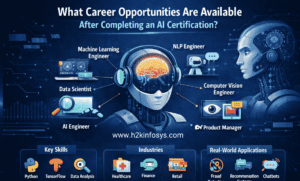
What Job Roles Use AI Skills Daily?
AI skills are applied across multiple roles:
- Machine Learning Engineer
- Data Scientist
- AI Application Developer
- Business Intelligence Analyst
- Automation Specialist
Each role interacts with AI systems differently, and project-based learning helps clarify these distinctions.
What Careers Are Possible After Learning AI?
Professionals who complete structured AI training and projects may pursue roles such as:
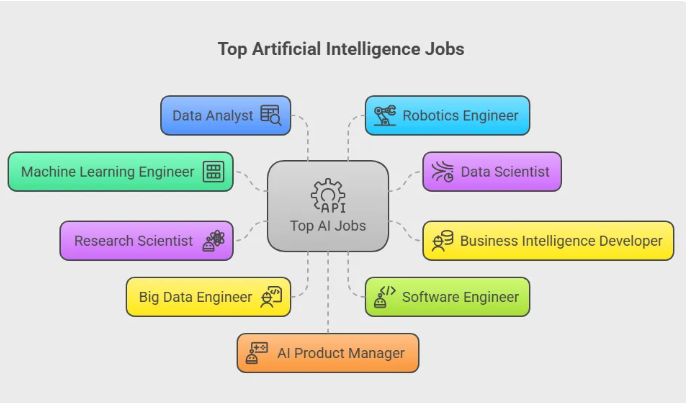
- Junior Data Scientist
- AI Support Engineer
- Analytics Consultant
- ML Operations Assistant
Career progression often depends on the ability to demonstrate applied, real-world problem-solving.
Learning Path Comparison: Assignments vs Industry Projects
| Learning Element | Practice Assignments | Industry-Style Projects |
|---|---|---|
| Scope | Narrow | Broad |
| Context | Technical | Business + Technical |
| Integration | Minimal | Multi-system |
| Documentation | Optional | Required |
| Evaluation | Automated | Review-based |
Both elements contribute to skill development, but projects offer stronger professional alignment.
How Employers Evaluate AI Project Experience
Hiring teams often look for:
- Clear problem definition
- Understanding of data limitations
- Evidence of deployment or integration
- Communication skills
Projects that demonstrate these aspects are typically more impactful than standalone exercises.
FAQ: Common Questions About AI Course Projects
Do learners work with real company data?
Most training environments use anonymized or simulated datasets that reflect real-world structure without exposing sensitive information.
Are projects completed individually or in teams?
Many programs include both, reflecting how enterprise AI teams operate.
How are projects assessed?
Assessments often include code reviews, documentation checks, and presentation of results.
Do projects include deployment steps?
In many cases, learners deploy models using APIs or cloud-based platforms to simulate production use.
How This Aligns With Best AI Certification Courses
Programs recognized as best ai certification often share these characteristics:
- Structured progression from basics to applied projects
- Exposure to enterprise tools
- Emphasis on documentation and workflow integration
- Assessment beyond automated grading
This aligns closely with how H2K Infosys structures its AI learning model.
What to Look for in Online AI Certification Courses
When evaluating Online Ai Certification Courses, professionals should consider:
- Presence of multi-stage projects
- Use of industry-standard tools
- Instructor feedback on project work
- Realistic deployment scenarios
These factors often indicate whether a course prioritizes practical skill development.
Key Takeaways
- Practice assignments build foundational skills and tool familiarity.
- Industry-style projects simulate enterprise workflows and constraints.
- H2K Infosys AI courses use a phased approach combining both methods.
- Real-world projects emphasize integration, documentation, and deployment.
- Applied experience is critical for career transition and role readiness.