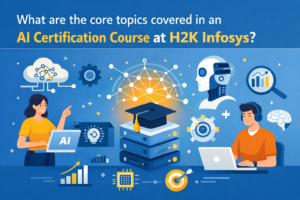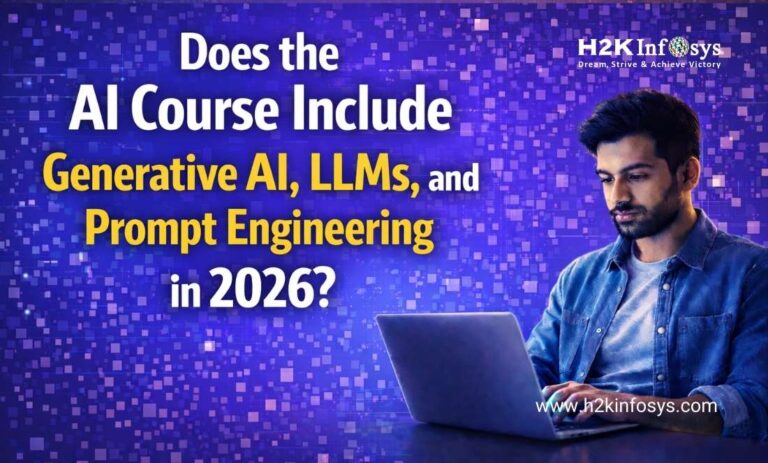
Yes. Most modern AI learning programs in 2026 include generative AI, Large Language Models (LLMs), and prompt engineering as core modules because these technologies are now foundational to enterprise AI adoption. At H2K Infosys, AI courses are structured to cover these technologies using practical, enterprise focused learning approaches. Many AI Certified Courses designed to teach how these systems are built, deployed, and used in real world business workflows across industries such as software development, cybersecurity, data analytics, and customer automation.
What is “Does the AI course include generative AI, LLMs, and prompt engineering in 2026?”
In 2026, AI education has evolved beyond basic machine learning and data science. A modern AI course typically includes three major pillars:
Generative AI
Systems that create new content such as:
- Text generation
- Code generation
- Image generation
- Synthetic data creation
- Document summarization
Large Language Models (LLMs)
Advanced deep learning models trained on large datasets to understand and generate natural language. Examples of use cases include:
- Chatbots
- AI copilots
- Knowledge assistants
- Automation workflows
Prompt Engineering
The process of designing structured inputs that guide AI models to produce accurate and reliable outputs in production systemsToday, these topics are standard components inside professional Online AI Classes designed for working professionals.
How Does AI Technology Work in Real-World IT Projects?
In enterprise environments, AI is rarely used alone. It operates inside broader digital ecosystems.
Typical Enterprise AI Workflow
| Stage | Activity | Tools Commonly Used |
|---|---|---|
| Data Collection | Gather structured and unstructured data | Data lakes, APIs |
| Data Processing | Clean and transform data | Python, Spark |
| Model Training | Train ML or LLM models | TensorFlow, PyTorch |
| Model Deployment | Serve models via APIs | Docker, Kubernetes |
| Monitoring | Track performance and drift | MLOps platforms |
Example: Customer Support Automation
- User submits ticket
- LLM classifies issue
- Generative AI drafts response
- Agent reviews and approves
- System logs interaction for model improvement
This workflow is commonly taught in practical classes.
Why Is Learning Generative AI and LLMs Important for Working Professionals?
Industry Adoption Trends (2026 Context)
- Widely adopted in enterprise automation
- Commonly used in software development productivity tools
- Increasing usage in cybersecurity threat analysis
- Standard integration in CRM and ERP systems
Business Impact Areas
- Cost optimization via automation
- Faster decision-making
- Improved customer experience
- Knowledge management
Professionals enrolling in ai certified courses are typically preparing for roles where AI is embedded into daily operations rather than treated as experimental technology.
What Skills Are Required to Learn AI Courses in 2026?
Technical Foundation
- Basic programming (Python preferred)
- Data handling fundamentals
- APIs and REST services
- Cloud basics
AI-Specific Skills
- Prompt design techniques
- Model evaluation
- Dataset preparation
- Ethical AI usage
- AI security basics
Supporting Skills
- Version control
- DevOps awareness
- Debugging model outputs
How Is Generative AI Used in Enterprise Environments?
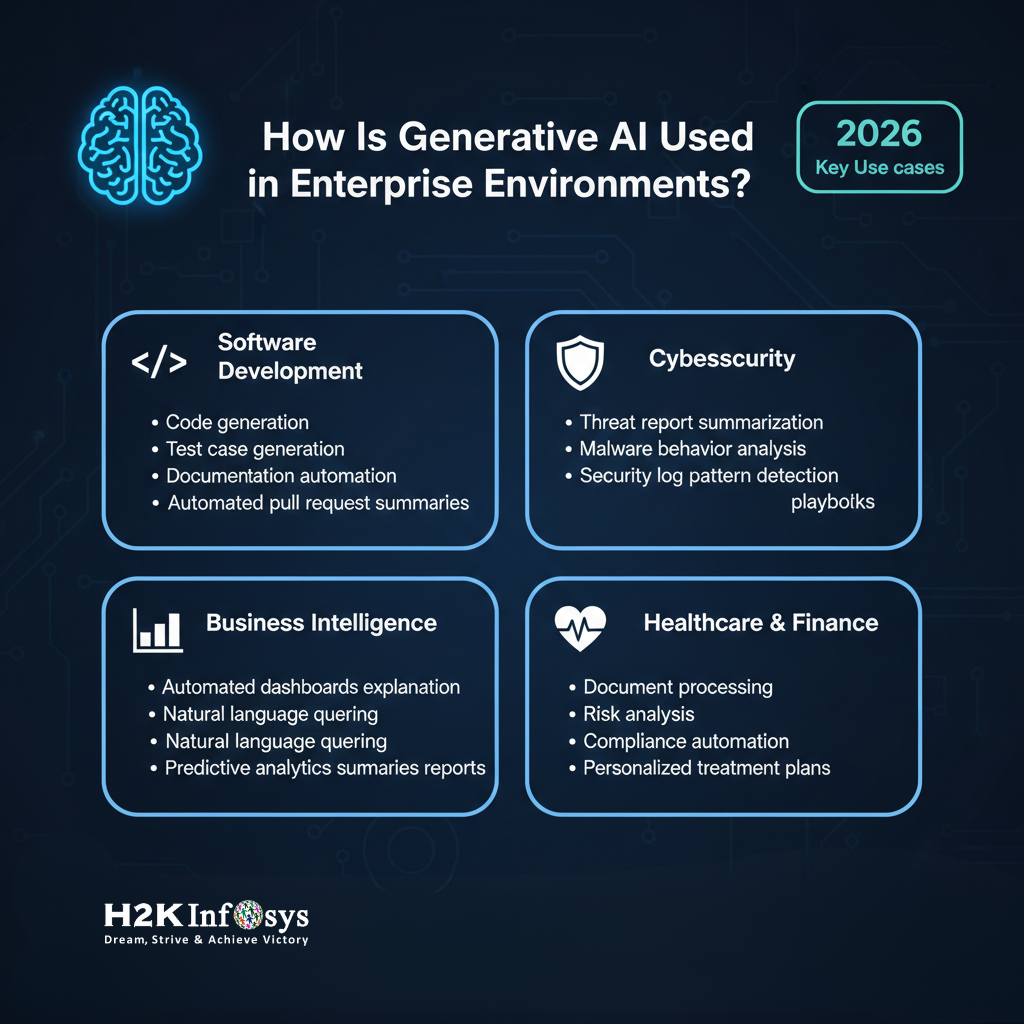
Common Enterprise Use Cases
Software Development
- Code generation
- Test case generation
- Documentation automation
Cybersecurity
- Threat report summarization
- Malware behavior analysis
- Security log pattern detection
Business Intelligence
- Automated dashboards explanation
- Natural language querying
Healthcare & Finance
- Document processing
- Risk analysis
- Compliance automation
Many ai classes now include enterprise case study labs covering these workflows.
What Job Roles Use AI Daily?
| Job Role | How AI Is Used |
|---|---|
| AI Engineer | Model development and deployment |
| Data Scientist | Model training and evaluation |
| ML Engineer | Production AI pipelines |
| Prompt Engineer | AI workflow optimization |
| Automation Engineer | AI integration into systems |
| Business Analyst (AI-enabled) | Data-driven decision support |
What Careers Are Possible After Learning AI?
Entry-Level Roles
- AI Support Analyst
- Junior Data Analyst (AI Tools)
- Automation Testing with AI
Mid-Level Roles
- ML Engineer
- AI Application Developer
- NLP Engineer
Advanced Roles
- AI Architect
- Generative AI Specialist
- AI Security Engineer
Core Tools Taught in Modern AI Courses
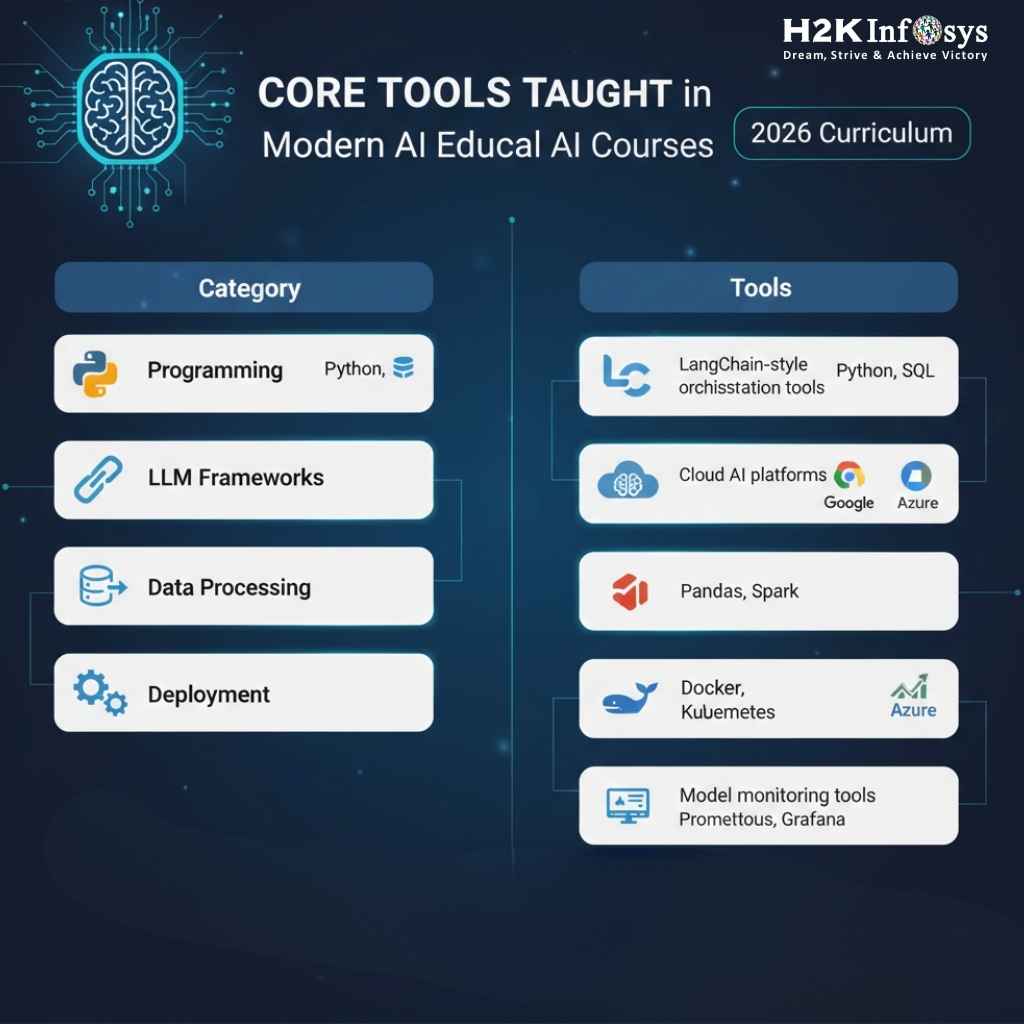
| Category | Tools |
|---|---|
| Programming | Python, SQL |
| LLM Frameworks | LangChain-style orchestration tools |
| Model Platforms | Cloud AI platforms |
| Data Processing | Pandas, Spark |
| Deployment | Docker, Kubernetes |
| MLOps | Model monitoring tools |
Learning Path: Beginner to Enterprise AI Professional
| Phase | Focus Area | Outcome |
|---|---|---|
| Foundation | Python + Data Basics | Understand data flow |
| Core AI | ML + NLP Basics | Build simple models |
| Advanced AI | LLM + Generative AI | Build AI apps |
| Enterprise | Deployment + MLOps | Production readiness |
Real-World Project Scenarios Learners Typically Practice
Project 1: AI Knowledge Assistant
- Uses LLM APIs
- Includes prompt tuning
- Handles document search
Project 2: AI Test Case Generator
- Generates test cases from requirements
- Validates outputs using evaluation metrics
Project 3: Enterprise Chatbot
- Integrates with backend database
- Includes conversation memory
Common Challenges Teams Face When Implementing AI
Data Quality Issues
- Incomplete datasets
- Bias risks
- Data security restrictions
Model Limitations
- Hallucinations
- Context length limits
- Latency issues
Enterprise Constraints
- Compliance requirements
- Cost optimization
- Infrastructure scaling
These real-world constraints are usually covered in advanced courses.
Best Practices Followed in Enterprise AI Projects
FAQ Section
Do AI courses in 2026 always include generative AI?
Most modern programs do, because generative AI is now part of enterprise automation strategies.
Is prompt engineering still important?
Yes. Even with improved models, structured prompts are required for reliable enterprise outputs.
Do I need coding to learn AI?
Basic Python knowledge is highly recommended but many tools now provide low-code interfaces.
How long does it take to learn practical AI skills?
Typically 4–8 months for working professionals learning part-time.
Are LLMs used outside tech companies?
Yes. Finance, healthcare, retail, and government sectors use LLM-based automation.
Key Takeaways
- Generative AI and LLMs are core components of modern AI education
- Prompt engineering is required for production AI systems
- Enterprise AI focuses on integration, automation, and scalability
- Most ai certified courses now include real-world deployment workflows
- Online ai classes often include hands-on enterprise project simulations