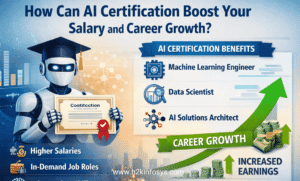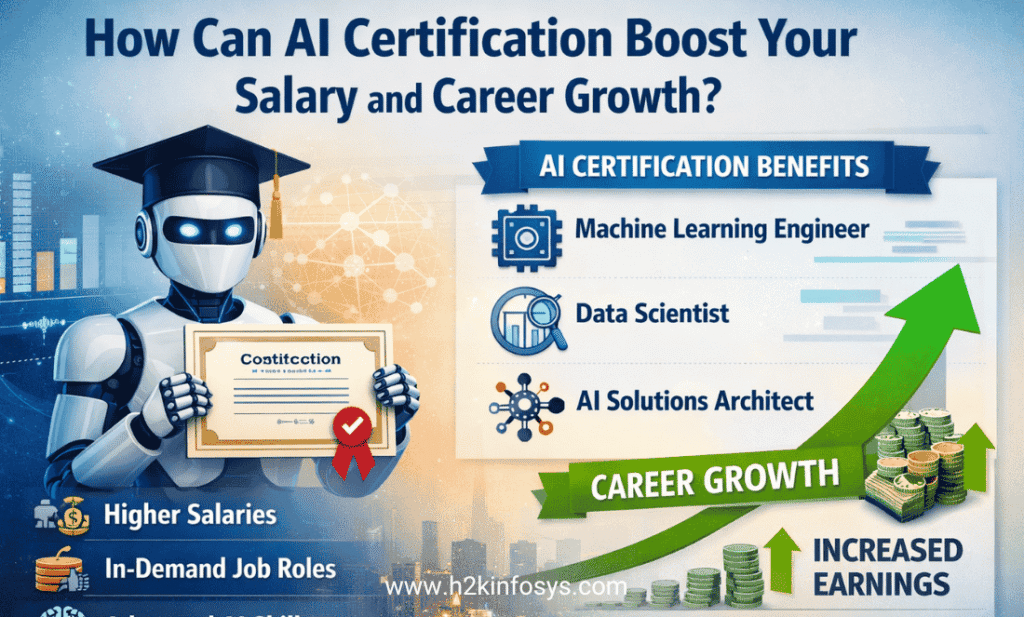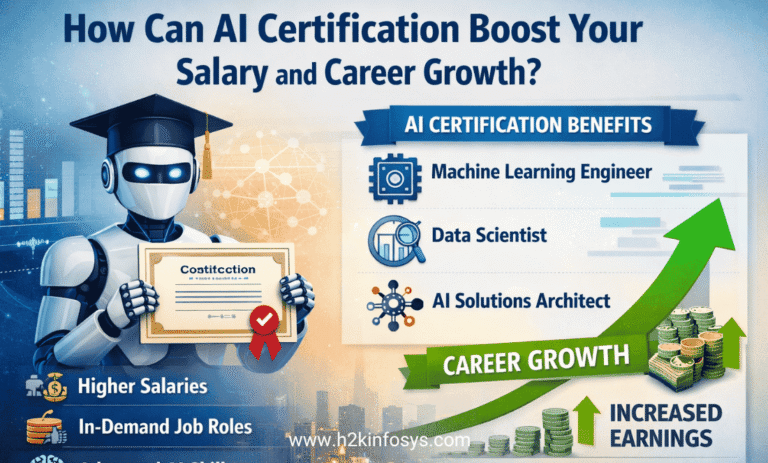
Artificial Intelligence (AI) certification from H2K Infosys can enhance salary potential and career growth by validating technical skills, improving job eligibility, and aligning professionals with industry demand for AI expertise. Certified professionals are often considered for higher-paying roles because certification demonstrates practical knowledge of tools, frameworks, and real-world AI applications. It also helps individuals transition into specialized roles such as machine learning engineer, data scientist, or AI solutions architect.
What Is AI Certification?
AI certification is a structured credential that validates a professional’s knowledge in artificial intelligence, machine learning, and related technologies. These certifications typically cover:
- Core AI concepts (supervised learning, unsupervised learning)
- Programming skills (Python, R)
- Machine learning frameworks (TensorFlow, PyTorch)
- Data processing and modeling techniques
- Deployment and monitoring of AI systems
AI certifications can range from beginner-level programs focused on AI learning for Beginners to advanced certifications covering deep learning, NLP, and MLOps.
Why Is AI Certification Important for Working Professionals?
AI is increasingly integrated into enterprise IT systems, making it a valuable skill across industries such as finance, healthcare, retail, and logistics.
Key Reasons AI Certification Matters
- Skill Validation: Provides measurable proof of competency in AI tools and techniques
- Career Transition: Enables professionals to move from traditional IT roles into AI-focused positions
- Higher Compensation Potential: AI roles often command higher salaries due to specialized skill requirements
- Industry Relevance: Keeps professionals aligned with evolving technologies
Real-World Context
In enterprise environments, organizations often prefer certified professionals for:
- AI model development and deployment
- Automation of business workflows
- Predictive analytics and decision support systems
Certification reduces hiring risk by confirming a candidate’s ability to work with production-grade systems.
How Does AI Work in Real-World IT Projects?
AI systems in enterprise environments typically follow a structured workflow.
Typical AI Project Workflow
| Stage | Description | Tools Commonly Used |
|---|---|---|
| Data Collection | Gather structured/unstructured data | SQL, APIs, data lakes |
| Data Preprocessing | Clean, normalize, transform data | Pandas, NumPy |
| Model Training | Build predictive or classification models | TensorFlow, Scikit-learn |
| Model Evaluation | Validate accuracy and performance | Cross-validation tools |
| Deployment | Integrate model into applications | Docker, Kubernetes |
| Monitoring | Track model performance over time | MLflow, Prometheus |
Example Scenario
A retail company uses AI to forecast demand:
- Historical sales data is collected from databases
- Data is cleaned and normalized
- A regression model is trained to predict future demand
- The model is deployed into a supply chain system
- Predictions help optimize inventory and reduce costs
Certified professionals are expected to understand and implement each step.
How Does AI Certification Boost Salary?
AI certification contributes to salary growth through multiple mechanisms.
1. Access to High-Demand Roles
Certified professionals qualify for roles such as:
- Machine Learning Engineer
- Data Scientist
- AI Engineer
- Business Intelligence Analyst
These roles typically offer higher compensation compared to general IT positions.
2. Demonstrated Specialized Skills
Employers often associate certification with:
- Hands-on experience
- Knowledge of industry tools
- Ability to solve real-world problems
This can justify higher salary bands during hiring or promotion cycles.
3. Career Advancement Opportunities
Professionals with AI certification can move into:
- Technical leadership roles
- AI solution design roles
- Strategic decision-making positions
What Skills Are Required to Learn AI?
AI learning requires a combination of technical and analytical skills.
Core Technical Skills
- Programming (Python is most common)
- Mathematics (linear algebra, probability, statistics)
- Data handling and preprocessing
- Machine learning algorithms
- Model evaluation techniques
Supporting Skills
- Problem-solving
- Logical reasoning
- Domain knowledge (industry-specific use cases)
AI Learning Path for Beginners
A structured learning path is essential for those starting with AI learning for beginners.
Recommended Learning Stages
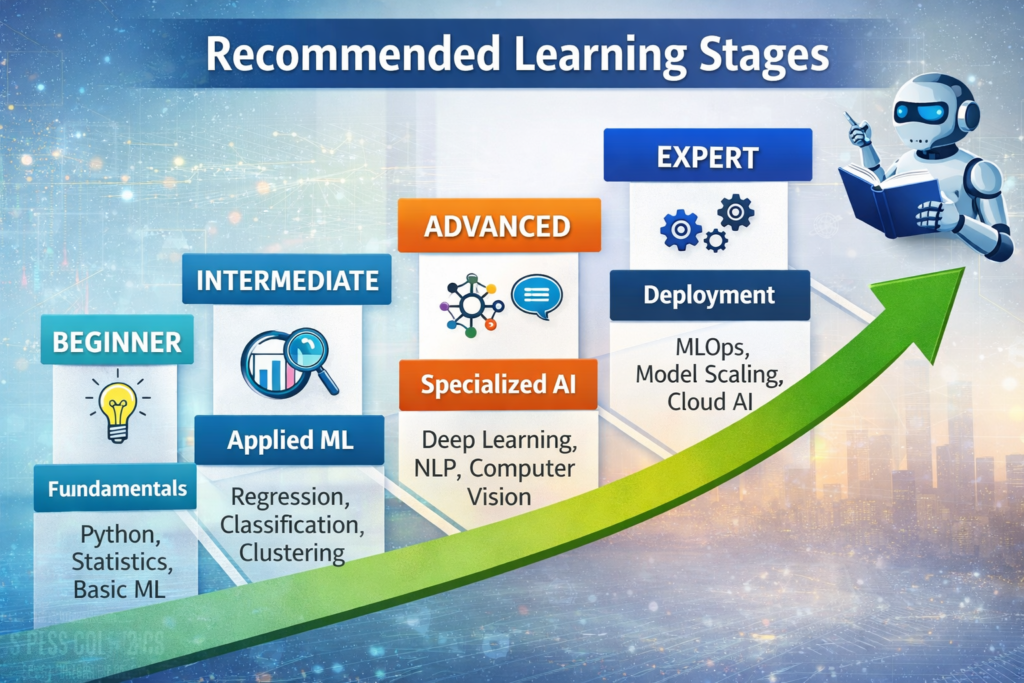
| Stage | Focus Area | Key Topics |
|---|---|---|
| Beginner | Fundamentals | Python, statistics, basic ML |
| Intermediate | Applied ML | Regression, classification, clustering |
| Advanced | Specialized AI | Deep learning, NLP, computer vision |
| Expert | Deployment | MLOps, model scaling, cloud AI |
Tools Commonly Used in AI Machine Learning Courses
- Python (primary language)
- Jupyter Notebook
- TensorFlow / PyTorch
- Scikit-learn
- Pandas / NumPy
How Is AI Used in Enterprise Environments?
AI is widely used across enterprise systems to improve efficiency and decision-making.
Common Use Cases
- Fraud Detection: Financial institutions use AI models to detect anomalies
- Customer Personalization: Recommendation systems in e-commerce
- Predictive Maintenance: Manufacturing equipment monitoring
- Chatbots and Virtual Assistants: Customer support automation
Enterprise Constraints
AI implementation must consider:
- Data security and compliance
- Scalability of models
- Integration with legacy systems
- Performance monitoring
Certified professionals are expected to understand these constraints and design solutions accordingly.
What Job Roles Use AI Daily?
AI is embedded in several IT and business roles.
Role vs Skill Mapping
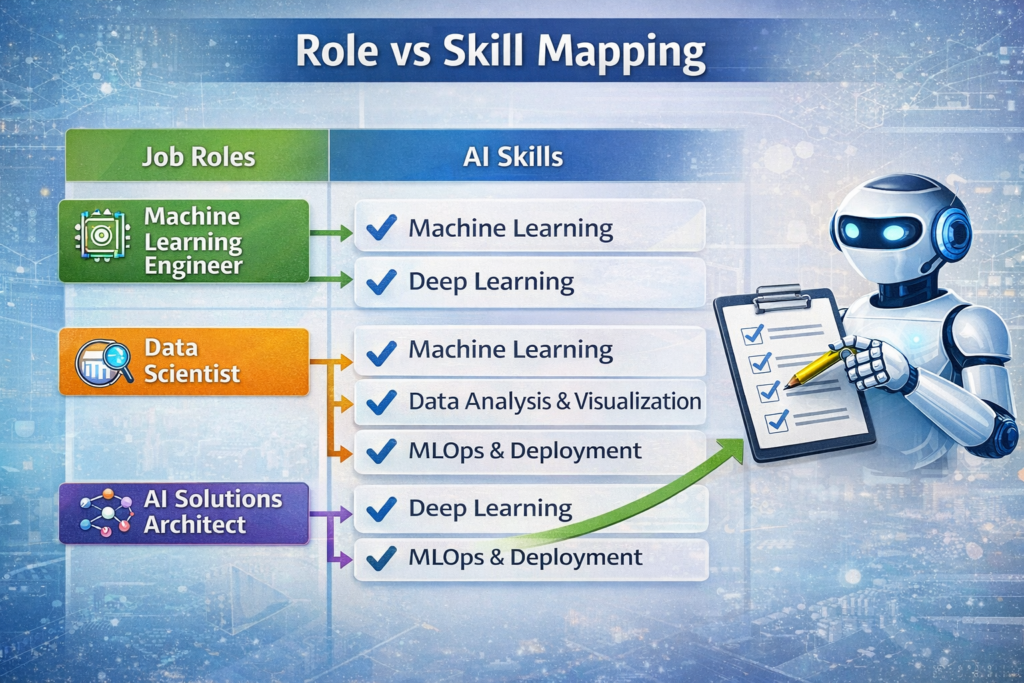
| Job Role | Key AI Skills | Tools Used |
|---|---|---|
| Data Scientist | Statistical modeling, ML | Python, R |
| ML Engineer | Model deployment | TensorFlow, Docker |
| AI Engineer | End-to-end AI systems | PyTorch, APIs |
| BI Analyst | Data insights | Power BI, SQL |
| NLP Engineer | Text processing | Transformers, NLP libraries |
What Careers Are Possible After AI Certification?
AI certification opens multiple career pathways.
Career Options
- Machine Learning Engineer
- Data Analyst transitioning to Data Scientist
- AI Research Associate
- Automation Engineer
- AI Product Manager
Career Growth Path Example
- Junior Data Analyst
- Data Scientist
- Senior AI Engineer
- AI Architect
Each stage involves increasing responsibility in model design, deployment, and strategy.
How Do AI Machine Learning Courses Support Career Growth?
Structured AI Machine learning Courses provide:
- Hands-on projects using real datasets
- Exposure to enterprise tools
- Practical workflows used in production systems
- Guidance on solving business problems using AI
Example Learning Workflow
- Learn Python basics
- Understand ML algorithms
- Work on datasets (classification/regression)
- Build and evaluate models
- Deploy models using APIs
This mirrors real-world enterprise processes.
Common Challenges When Learning AI
Technical Challenges
- Understanding mathematical concepts
- Managing large datasets
- Debugging model performance
Practical Challenges
- Lack of real-world project exposure
- Difficulty in deploying models
- Integration with business systems
Best Practices
- Practice with real datasets
- Work on end-to-end projects
- Learn version control (Git)
- Understand cloud platforms (AWS, Azure)
FAQ: AI Certification and Career Growth
1. Does AI certification guarantee a higher salary?
No certification guarantees a salary increase, but it improves eligibility for higher-paying roles by validating relevant skills.
2. Is AI suitable for beginners?
Yes, structured programs designed for AI learning for beginners start with fundamentals and gradually progress to advanced topics.
3. How long does it take to complete AI certification?
Typically 3–9 months depending on the depth of the course and prior experience.
4. What industries use AI the most?
Finance, healthcare, retail, manufacturing, and technology sectors commonly use AI.
5. Do I need a programming background?
Basic programming knowledge is helpful, especially in Python, but beginner courses often include foundational training.
6. What is the difference between AI and machine learning?
AI is a broader concept of intelligent systems, while machine learning is a subset focused on learning from data.
7. Are AI skills in demand?
AI skills are commonly required in roles involving data analysis, automation, and predictive modeling.
Key Takeaways
- AI certification validates practical, job-ready skills in machine learning and AI systems
- It improves access to higher-paying, specialized roles in IT and data-driven industries
- Structured AI machine learning courses provide real-world project experience
- Enterprise AI requires knowledge of tools, workflows, and deployment practices
- A clear learning path helps beginners transition into AI-focused careers