Introduction
Artificial Intelligence (AI) has emerged as one of the most transformative technologies in the modern workplace, impacting industries across the globe. AI training can help professionals advance their careers by equipping them with the knowledge and skills necessary to work with AI technologies, from machine learning to data analysis. With AI permeating various sectors, from healthcare to finance and logistics, learning AI is becoming an essential skill for future-proofing your career. This explores how AI training can significantly shape your career success, focusing on how professionals can leverage AI and Machine Learning Courses to enhance their capabilities in real-world IT environments.
What is AI Training and How Can it Shape Your Career?
AI training involves learning the principles, techniques, and tools associated with artificial intelligence, including machine learning, data science, natural language processing, and deep learning. These technologies enable machines to learn from data, recognize patterns, and make decisions autonomously. AI training can take various forms, including online courses, certifications, and hands-on projects, which teach professionals how to apply AI concepts in real-world scenarios.
For professionals looking to advance their careers, AI training provides an opportunity to acquire in-demand skills. As businesses increasingly rely on AI for tasks such as predictive analytics, process automation, and customer service, professionals who understand AI will have a competitive edge. AI training allows you to:
- Gain a deeper understanding of AI technologies and tools.
- Learn how to apply AI techniques to solve complex business problems.
- Become proficient in industry-standard frameworks like TensorFlow, PyTorch, and Scikit-learn.
- Position yourself for higher-paying roles in the growing AI job market.
By completing AI training, you open doors to a wide range of career opportunities that demand expertise in these cutting-edge technologies.
How Does AI Work in Real-World IT Projects?
AI applications in real-world IT projects can vary greatly depending on the industry and specific business needs. However, many AI systems are built on the foundation of machine learning algorithms that allow software systems to “learn” from data. These systems can be trained to analyze large datasets, recognize patterns, and make informed predictions or recommendations.
For example, in e-commerce, AI can be used for recommendation engines that suggest products based on user behavior. In healthcare, AI systems can analyze medical images to help diagnose conditions. AI training in these areas provides professionals with the hands-on skills necessary to implement and maintain such systems.
AI is also used in automation, where repetitive tasks are handled by AI systems, freeing up human resources for more complex work. AI training equips professionals to design, develop, and deploy automation solutions, driving efficiency in enterprise environments.
Why is AI Training Important for Working Professionals?
AI training is crucial for working professionals for several reasons:
- Industry Relevance: AI is being integrated into every sector, from finance to retail, healthcare to manufacturing. As industries evolve, the demand for AI skills continues to rise. Professionals who stay updated with AI technology can ensure their skills remain relevant and in demand.
- Career Advancement: Professionals who complete AI training can transition into roles with greater responsibility and higher salaries. AI skills are highly sought after in positions such as data scientists, machine learning engineers, AI specialists, and automation architects.
- Problem Solving: AI training provides professionals with the tools to solve complex business challenges. Whether it’s optimizing supply chains or improving customer service, AI-trained professionals can identify opportunities for automation, predictive analytics, and data-driven decision-making.
- Future-Proofing: As technology continues to advance, AI is expected to play an increasingly dominant role. By learning AI now, professionals can position themselves to thrive in the future job market.
What Skills are Required to Learn AI?
To successfully learn AI and make the most of training courses, professionals should have a foundational understanding of certain skills:
- Mathematics & Statistics: A strong grasp of algebra, calculus, linear algebra, and probability is essential for understanding AI algorithms and machine learning models.
- Programming: Python is the most commonly used programming language in AI development due to its simplicity and powerful libraries. Understanding Python is crucial for implementing AI solutions.
- Data Handling: AI projects typically involve large datasets. Professionals must be familiar with tools and techniques for data collection, preprocessing, and cleaning.
- Machine Learning Algorithms: A deep understanding of supervised and unsupervised learning, neural networks, decision trees, and clustering algorithms is important.
- AI Frameworks & Tools: Familiarity with AI frameworks such as TensorFlow, Keras, and PyTorch is key to developing machine learning models and AI applications.

AI training programs are designed to help professionals develop these skills, from beginner to advanced levels, through structured courses and hands-on experience.
How is AI Used in Enterprise Environments?
AI is increasingly used in enterprise environments to enhance decision-making, improve operational efficiency, and enable innovation. Here are some common AI applications in business settings:
- Predictive Analytics: AI can analyze historical data and predict future trends, such as customer behavior, product demand, and financial performance. This allows businesses to make more informed decisions.
- Automation: Routine tasks, such as data entry, report generation, and customer inquiries, can be automated using AI, reducing human error and increasing productivity.
- Customer Service: AI-powered chatbots and virtual assistants are used in customer service to handle inquiries, resolve issues, and provide support 24/7.
- Fraud Detection: In sectors like banking and finance, AI is used to detect fraudulent activities by analyzing transaction patterns and identifying anomalies.
By incorporating AI into their operations, enterprises can gain a competitive advantage, and professionals with AI training are instrumental in driving this transformation.
What Job Roles Use AI Daily?
AI skills are used daily in several job roles across different industries. Some of the key roles that require AI expertise include:
- Data Scientist: Data scientists use machine learning algorithms and statistical analysis to derive insights from data, build predictive models, and inform decision-making.
- Machine Learning Engineer: These engineers design and develop machine learning models, ensuring they are scalable, efficient, and capable of solving complex problems.
- AI Specialist: AI specialists focus on developing AI-powered solutions and technologies to automate tasks, improve efficiencies, and drive business innovation.
- AI Researcher: AI researchers explore new AI techniques, algorithms, and models to advance the field and create innovative solutions.
- Robotics Engineer: In industries like manufacturing and logistics, robotics engineers use AI to design intelligent robotic systems capable of performing tasks autonomously.
Professionals in these roles benefit from AI training by developing the practical skills needed to implement AI technologies effectively.
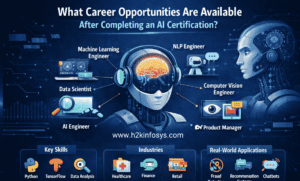
What Careers are Possible After Learning AI?
Learning AI opens up various career paths in industries ranging from tech to healthcare and finance. Some of the top careers after completing AI training include:
- Data Scientist: A role that involves using AI to analyze large datasets, create models, and generate insights to drive business decisions.
- Machine Learning Engineer: A role that focuses on designing and implementing machine learning algorithms to improve AI systems and business processes.
- AI Consultant: AI consultants advise organizations on how to implement AI solutions to enhance operations, reduce costs, and innovate.
- AI Researcher: Researchers work on developing new AI methodologies and advancing the state of AI in various fields such as healthcare, robotics, and natural language processing.
- AI Product Manager: These professionals oversee the development and deployment of AI-driven products, ensuring they align with business objectives.
AI training can also open the door to roles in automation, cybersecurity, and cloud computing, where AI plays an increasingly important role.
AI Training FAQs
Q1: Is AI training suitable for beginners?
Yes, many AI courses are designed for beginners and include foundational topics such as programming, machine learning basics, and data handling. It’s important to start with beginner-friendly courses and gradually move to more advanced topics.
Q2: How long does it take to complete AI training?
The duration of AI training can vary depending on the course structure and the learner’s experience level. Beginner courses may take a few weeks, while comprehensive programs or certifications may take several months.
Q3: What career support does H2K Infosys provide for AI professionals?
H2K Infosys offers job placement assistance and career support to help AI-trained professionals find relevant job opportunities in industries that are embracing AI technologies.
Q4: Do I need a background in mathematics to learn AI?
A basic understanding of mathematics is helpful for AI, but it’s not a requirement. Many AI training programs provide tutorials and resources to help learners build their mathematical foundation.
Q5: Can AI training help me switch careers?
Yes, AI training can be an excellent way for professionals from fields like business analysis, software development, or data science to transition into AI-focused roles.
Conclusion & Key Takeaways
AI training equips professionals with the knowledge and skills to thrive in an increasingly AI-driven world. Key points include:
- AI training opens doors to new career opportunities in fields like data science, machine learning, and AI research.
- Real-world applications of AI, such as predictive analytics and automation, drive business innovation.
- AI skills are highly sought after, making training essential for career advancement and job security.
- H2K Infosys offers comprehensive AI training programs that help professionals gain hands-on experience and secure career opportunities.
If you’re ready to shape your career with AI Training Programs, explore H2K Infosys’ offerings to gain practical, industry-relevant skills that will set you up for success. Secure your seat today and take the first step toward a future with endless possibilities.