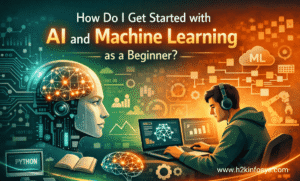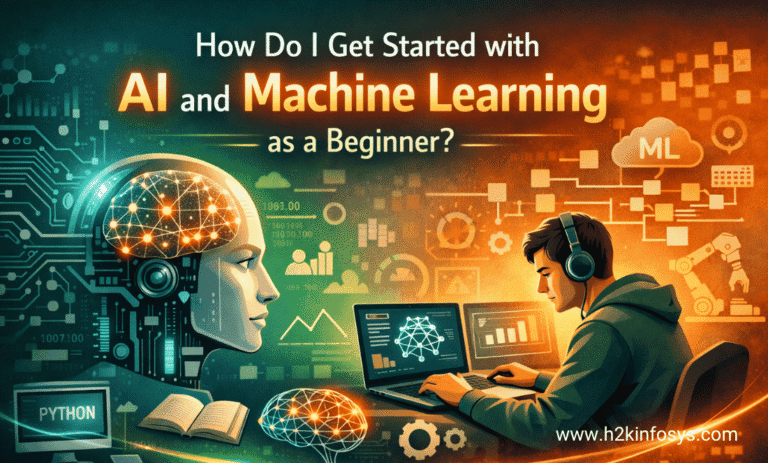
Artificial Intelligence (AI) and Machine Learning (ML) are transforming industries, offering opportunities to professionals seeking to adapt and grow their skill sets. For beginners, how these fields can seem daunting, but starting with foundational concepts and tools can make the learning journey more manageable. This guide will break down how to get started with AI and ML, focusing on the skills, resources, and real-world applications that will help professionals build a strong foundation, with insights from experts at H2K Infosys.
What is AI and Machine Learning?
Artificial Intelligence (AI) is the simulation of human intelligence processes by machines, particularly computer systems. These processes include learning (the ability to acquire and apply knowledge), reasoning (the ability to solve problems), and self-correction. AI is used in a wide range of applications, from recommendation systems (like Netflix and YouTube) to autonomous vehicles.
Machine Learning (ML) is a subset of AI focused on the development of algorithms that allow machines to learn from data and improve over time without explicit programming. ML enables systems to recognize patterns and make decisions based on historical data, which is essential in applications such as predictive analytics, fraud detection, and speech recognition.
How Does AI and Machine Learning Work in Real-World IT Projects?
In enterprise IT environments, AI and ML play crucial roles in enhancing decision making, automating processes, and improving overall system efficiency. Here’s how they are commonly implemented in real-world projects:
- Data Collection and Preprocessing: Data is the foundation of any AI/ML project. In the real world, professionals collect and preprocess large datasets to ensure they are clean, accurate, and suitable for model training.
- Model Training: Once the data is prepared, ML algorithms are trained using supervised learning (using labeled data) or unsupervised learning (using unlabeled data) techniques. In enterprise applications, popular models include decision trees, support vector machines, and deep neural networks.
- Model Deployment: After Ai learning Courses, models are deployed into production environments, where they can make real-time predictions or decisions. This phase involves integrating AI models into existing software systems and ensuring scalability, security, and performance.
- Model Monitoring and Maintenance: AI/ML models require constant monitoring and periodic retraining to maintain their accuracy and adapt to changes in data trends.
Why is AI and Machine Learning Important for Working Professionals?
AI and ML are integral to modern IT systems and can significantly enhance business processes. Here’s why these technologies are important for working professionals:
- Automation of Repetitive Tasks: AI tools can automate mundane and repetitive tasks, freeing up time for more complex problem-solving and creative work.
- Enhanced Decision-Making: ML algorithms can analyze vast amounts of data to identify trends and make predictions, enabling professionals to make better, data-driven decisions.
- Career Advancement: As businesses increasingly adopt AI/ML solutions, professionals with expertise in these technologies are in high demand across industries like finance, healthcare, and retail.
- Competitiveness: In industries such as technology, AI and ML skills are becoming essential for staying competitive, driving innovation, and improving operational efficiency.
What Skills Are Required to Learn AI and Machine Learning?
While there are no prerequisites for getting started with AI and ML, there are several key skills that will make the learning process easier:
- Mathematics and Statistics: A solid understanding of linear algebra, probability, and statistics is crucial for understanding ML algorithms. These concepts are foundational for tasks like model optimization and evaluating algorithm performance.
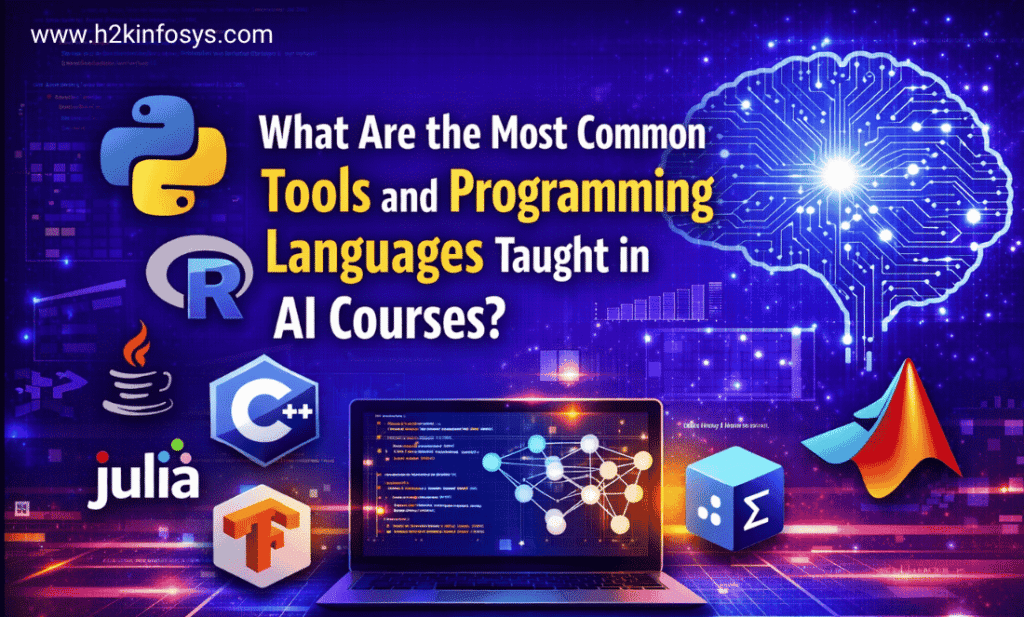
- Programming: Proficiency in programming languages such as Python or R is essential, as these languages are widely used in AI/ML development.
- Data Science and Preprocessing: The ability to collect, clean, and preprocess data is essential. This includes working with data manipulation libraries like Pandas, NumPy, and dealing with missing or noisy data.
- Machine Learning Algorithms: Understanding the core machine learning algorithms (e.g., regression, classification, clustering, and neural networks) is fundamental.
- Deep Learning: For advanced learners, deep learning with frameworks like TensorFlow or PyTorch will be important, especially for tasks involving image and speech recognition.
How Is AI and Machine Learning Used in Enterprise Environments?
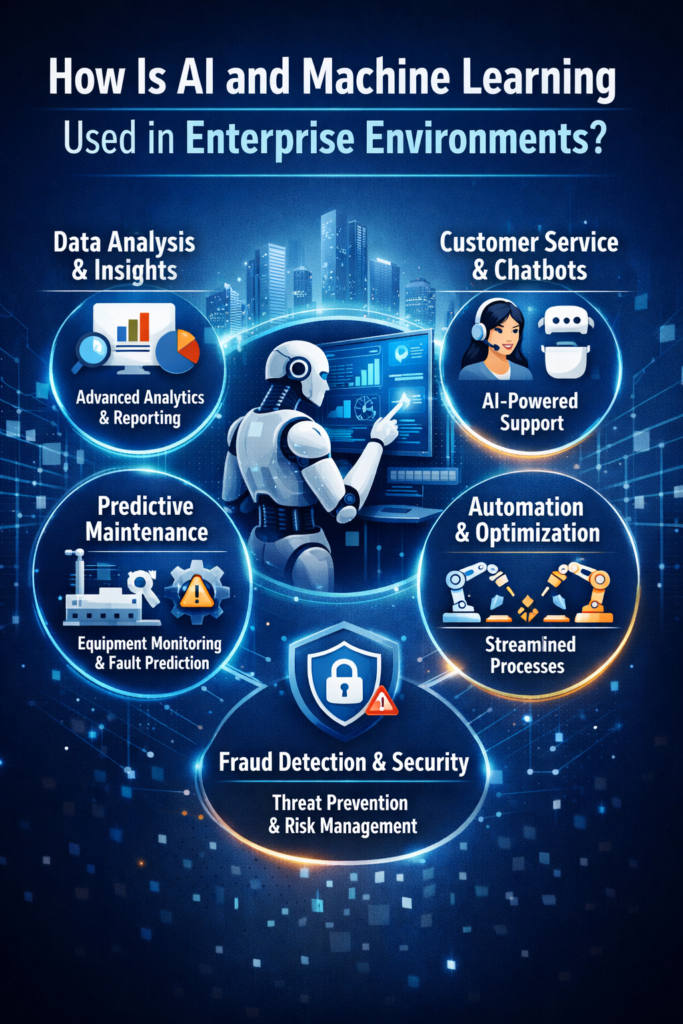
In modern enterprises, AI and ML are increasingly integrated into various departments to improve efficiency and support strategic decision-making. Here are some of the most common enterprise applications:
- Customer Service: AI-powered chatbots and virtual assistants help companies provide 24/7 support and respond to customer inquiries without human intervention.
- Predictive Analytics: ML models are used to predict customer behavior, demand forecasting, and product recommendations. These insights help businesses optimize inventory management and marketing strategies.
- Fraud Detection: In sectors like finance and insurance, AI is used to identify patterns of fraudulent activity by analyzing transaction data in real-time.
- Supply Chain Optimization: ML models can predict supply chain disruptions, optimize routes for delivery, and improve overall efficiency by analyzing historical data and external factors.
What Job Roles Use AI and Machine Learning Daily?
Several roles in IT and data-driven industries require AI/ML expertise on a daily basis. Here are some key job roles where these technologies are essential:
- Data Scientist: Responsible for building and deploying machine learning models, data scientists analyze large datasets to extract valuable insights and support business decisions.
- Machine Learning Engineer: Specializes in designing and implementing machine learning systems, with a focus on developing production-level algorithms and scalable models.
- AI Researcher: Works on the theoretical side of AI, developing new algorithms and models to improve the efficiency and capabilities of AI systems.
- Data Analyst: Uses machine learning tools to analyze data, generate reports, and offer insights that drive business strategy.
- Business Intelligence Analyst: Leverages AI tools to make sense of data and create reports that guide corporate strategy, performance metrics, and decision-making.
What Careers Are Possible After Learning AI and Machine Learning?
The demand for AI/ML professionals is growing across a wide range of industries. Some potential career paths include:
- AI Developer: Designing and developing AI-powered applications, from natural language processing systems to computer vision models.
- Machine Learning Engineer: Implementing machine learning algorithms and ensuring they function at scale in production environments.
- Data Scientist: Combining statistical analysis and machine learning to build predictive models and uncover actionable insights from data.
- AI Consultant: Helping companies integrate AI solutions into their existing workflows, providing expertise on best practices and technology choices.
- Research Scientist in AI/ML: Conducting cutting-edge research to push the boundaries of AI technologies and developing new methodologies for problem-solving.
What Tools and Frameworks Should I Learn for AI and Machine Learning?
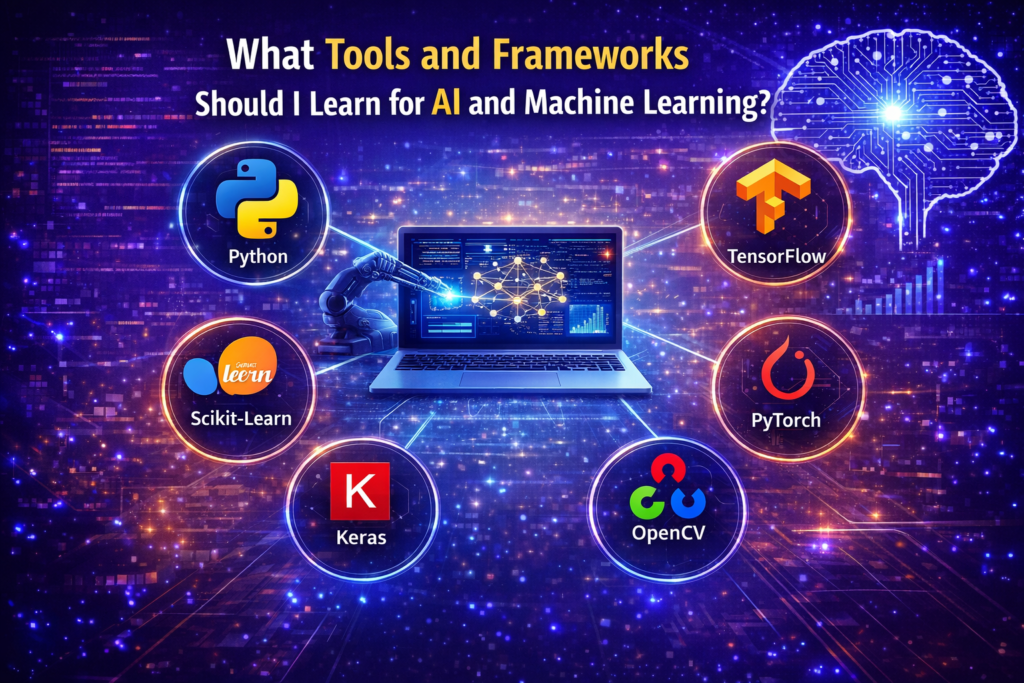
Several tools and frameworks are integral to AI and ML work. Here are some commonly used platforms:
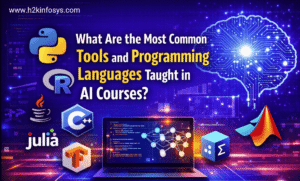
- Python: The most popular programming language for AI and ML, Python offers a variety of libraries for data analysis, machine learning, and deep learning, such as Pandas, Scikit-Learn, TensorFlow, and PyTorch.
- R: R is another language frequently used for statistical analysis and data visualization, particularly in academic and research settings.
- TensorFlow: A deep learning framework developed by Google, TensorFlow is widely used for building and deploying machine learning models, especially for neural networks.
- PyTorch: Another deep learning framework, PyTorch is popular for research applications and offers dynamic computation graphs for flexibility.
- Scikit-Learn: A Python library for traditional machine learning algorithms, Scikit-Learn offers simple and efficient tools for data mining and analysis.
FAQ: Frequently Asked Questions
What is the difference between AI and Machine Learning?
AI refers to the broader concept of creating intelligent systems that can perform tasks typically requiring human intelligence. Machine Learning is a subset of AI that focuses on creating algorithms that allow machines to learn from data without being explicitly programmed.
Can I learn AI and ML without a background in mathematics?
While a background in mathematics is helpful, it is not strictly necessary to begin learning AI and ML. However, understanding concepts like linear algebra, probability, and statistics will be beneficial as you progress.
How long does it take to learn AI and Machine Learning?
The time required to learn AI and ML varies depending on your current skill level and the depth of knowledge you wish to acquire. A beginner with no prior knowledge can expect to spend several months to a year to develop proficiency in these areas.
Is AI and Machine Learning suitable for professionals in other fields?
Yes, AI and ML are versatile and applicable in many industries, from finance and healthcare to marketing and supply chain management. Professionals in data analysis, software engineering, and business intelligence can also benefit from learning these technologies.
Key Takeaways
- AI and Machine Learning are transformative technologies with widespread applications in enterprise IT systems.
- Beginners should focus on building foundational skills in programming, mathematics, and data science.
- Learning AI/ML can lead to career advancement in roles such as data scientist, machine learning engineer, and AI consultant.
- Popular tools like Python, TensorFlow, and PyTorch are essential for developing AI/ML models.
To dive deeper into AI and Machine Learning, consider enrolling in hands-on Ai and machine learning courses at H2K Infosys to expand your knowledge and enhance your career opportunities.