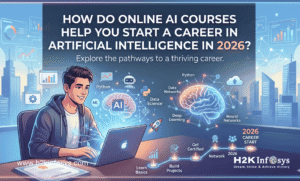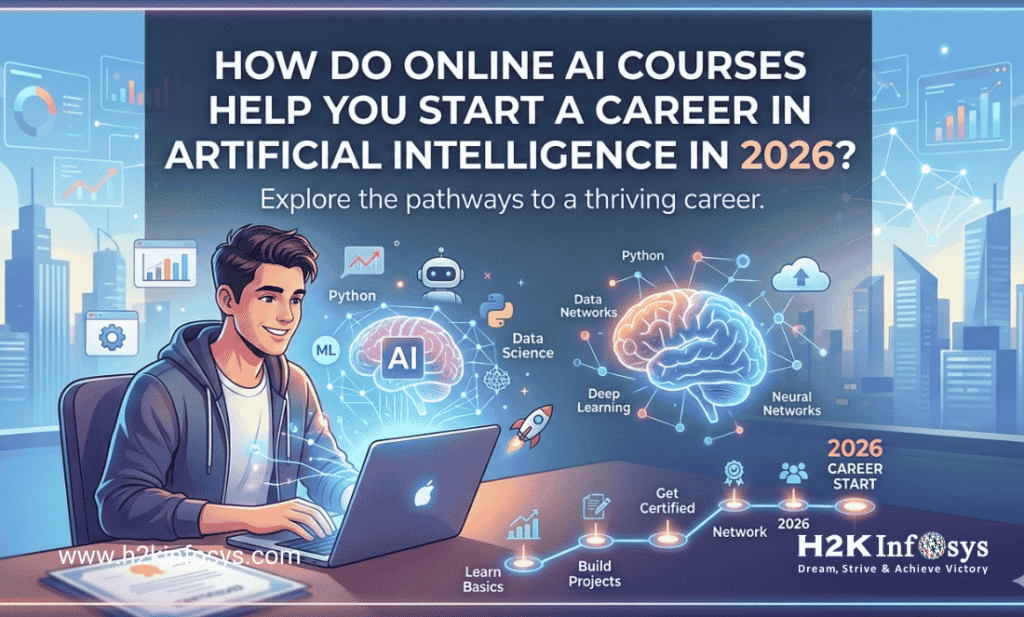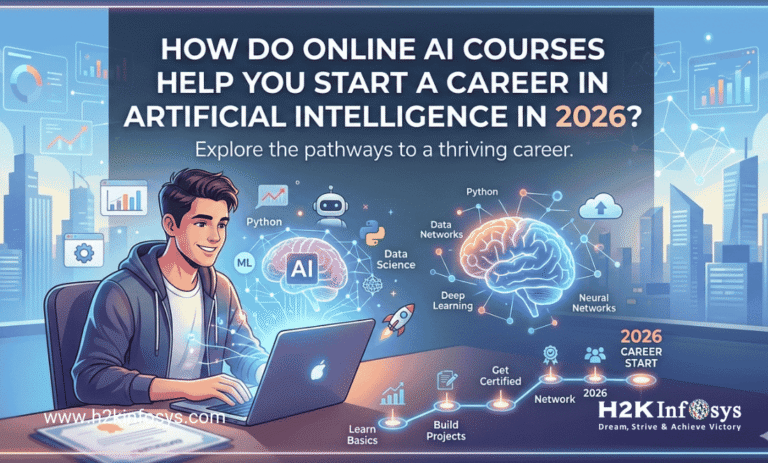
Online AI courses offered by H2K Infosys help individuals start a career in Artificial Intelligence by providing structured learning in machine learning, data analysis, programming, and real-world AI tools used in modern IT environments. These programs typically combine foundational theory with practical projects that simulate enterprise workflows. For professionals entering the field in 2026, and structured AI and Machine learning Courses offer an accessible pathway to develop job-relevant skills and understand how AI systems are implemented in production environments.
Artificial Intelligence has transitioned from a specialized research discipline into a widely adopted enterprise technology used in sectors such as finance, healthcare, retail, manufacturing, and cloud computing. As organizations integrate AI capabilities into their operations, professionals with practical knowledge of AI frameworks, data pipelines, and machine learning workflows are increasingly in demand.
Online training programs allow learners to build these competencies through guided instruction, hands-on labs, and project-based learning that reflects real IT development environments.
What is Artificial Intelligence?
Artificial Intelligence (AI) refers to the development of computer systems that can perform tasks typically requiring human intelligence. These tasks include pattern recognition, decision-making, natural language understanding, and predictive analytics.
AI systems are built using algorithms that learn patterns from data. The most widely used approach today is machine learning, where models are trained using historical datasets to make predictions or classifications.
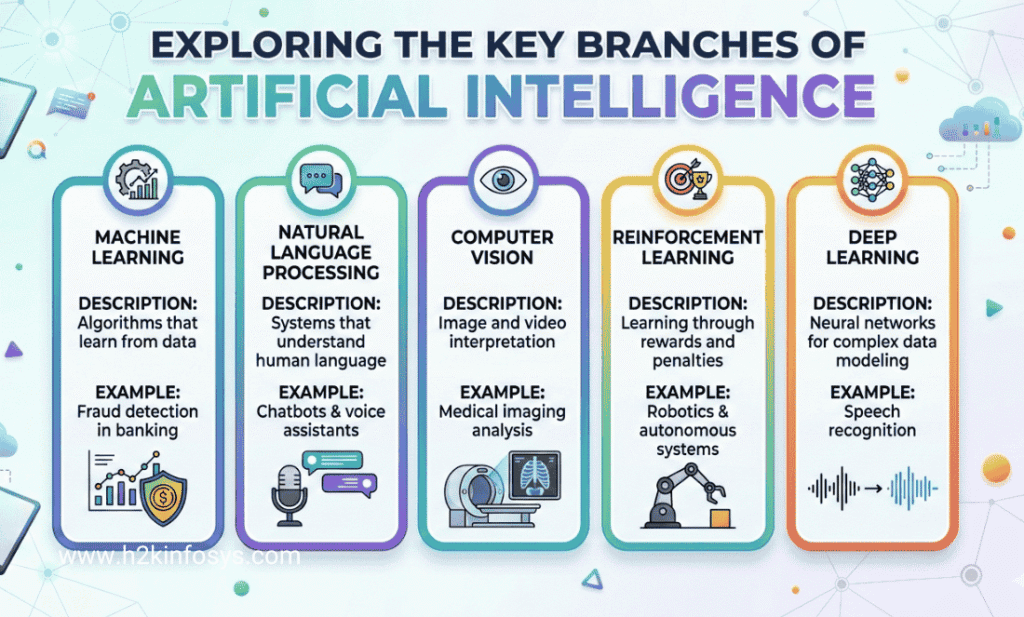
Common branches of AI include:
| AI Domain | Description | Example Use Case |
|---|---|---|
| Machine Learning | Algorithms that learn patterns from data | Fraud detection in banking |
| Natural Language Processing (NLP) | Systems that understand human language | Chatbots and voice assistants |
| Computer Vision | Image and video interpretation | Medical imaging analysis |
| Reinforcement Learning | Learning through rewards and penalties | Robotics and autonomous systems |
| Deep Learning | Neural networks for complex data modeling | Speech recognition |
AI learning for beginners usually starts with foundational programming and statistics before moving into model development and real-world applications.
Why is Artificial Intelligence important for working professionals in 2026?
Artificial Intelligence is now integrated into many enterprise IT systems. Organizations are increasingly using AI-driven solutions to automate workflows, analyze large datasets, and support decision-making processes.
For working professionals, learning AI provides several advantages:
1. Increased demand for AI-enabled skills
Many technology roles now require familiarity with AI concepts, including:
- Data engineers handling ML pipelines
- Software engineers integrating AI APIs
- Business analysts using predictive models
2. Automation and productivity improvements
AI tools help organizations automate tasks such as:
- Document classification
- Customer support automation
- Predictive maintenance in manufacturing
Professionals who understand AI systems are better positioned to manage and optimize these automated processes.
3. Integration with existing IT technologies
AI increasingly works alongside other enterprise technologies:
- Cloud computing platforms
- Big data ecosystems
- DevOps pipelines
- Cybersecurity monitoring systems
Understanding AI allows professionals to participate in cross-functional technology projects.
How do online AI courses help beginners start learning AI?
Online AI courses provide a structured pathway for individuals entering the field. Instead of learning isolated tools, these programs typically follow a progressive learning model.
Typical AI learning pathway
| Stage | Topics Covered | Tools Used |
|---|---|---|
| Foundations | Python programming, statistics | Python, NumPy |
| Data Analysis | Data cleaning and visualization | Pandas, Matplotlib |
| Machine Learning | Regression, classification, clustering | Scikit-learn |
| Deep Learning | Neural networks and model training | TensorFlow, PyTorch |
| AI Applications | NLP, computer vision, recommendation systems | Hugging Face, OpenCV |
Many AI and machine learning courses also include hands-on projects that simulate real enterprise workflows.
Examples of beginner projects may include:
- Building a spam email classifier
- Developing a product recommendation engine
- Predicting customer churn using machine learning
These exercises help learners understand the complete lifecycle of an AI solution.
How does AI work in real-world IT projects?
AI systems in enterprise environments are typically implemented through a structured workflow that includes data processing, model development, deployment, and monitoring.
Common AI development workflow
- Data collection
- Data preprocessing
- Feature engineering
- Model training
- Model evaluation
- Deployment
- Monitoring and optimization
Example enterprise AI workflow
| Stage | Description | Tools |
|---|---|---|
| Data ingestion | Collecting raw datasets from databases or APIs | SQL, Spark |
| Data preprocessing | Cleaning and transforming datasets | Python, Pandas |
| Model training | Training machine learning models | Scikit-learn, TensorFlow |
| Model deployment | Integrating models into production systems | Docker, Kubernetes |
| Monitoring | Tracking model performance over time | MLflow, Prometheus |
Online AI courses often simulate this lifecycle so learners understand how AI systems operate beyond theoretical model development.
What skills are required to learn AI and machine learning?
Learning Artificial Intelligence involves a combination of programming, mathematics, and data analysis skills.
Core technical skills
| Skill Area | Importance |
|---|---|
| Python programming | Most widely used language for AI development |
| Statistics and probability | Essential for understanding algorithms |
| Linear algebra | Foundation of neural networks |
| Data manipulation | Handling structured and unstructured datasets |
| Machine learning algorithms | Building predictive models |
Supporting tools and frameworks
Professionals learning AI commonly work with:
- Python
- Scikit-learn
- TensorFlow
- PyTorch
- Jupyter Notebook
- Apache Spark
Many AI and machine learning courses introduce these tools gradually through guided projects.
How is AI used in enterprise environments?
AI systems are widely implemented across industries to solve operational and analytical challenges.
Common enterprise AI use cases
| Industry | AI Application |
|---|---|
| Finance | Fraud detection and credit risk modeling |
| Healthcare | Medical image analysis |
| Retail | Personalized recommendations |
| Manufacturing | Predictive maintenance |
| Telecommunications | Network optimization |
Example: AI in customer support
Organizations often deploy AI models to analyze support tickets and automate responses.
Typical workflow:
- Customer submits support request
- NLP model analyzes request text
- System classifies issue category
- Automated response or routing to support agent
These systems are built using NLP frameworks and trained on historical support data.
What tools are commonly taught in AI and machine learning courses?
AI training programs typically focus on tools that are widely used in enterprise and research environments.
AI development tool ecosystem
| Category | Tools |
|---|---|
| Programming | Python |
| Data processing | Pandas, NumPy |
| Machine learning | Scikit-learn |
| Deep learning | TensorFlow, PyTorch |
| Visualization | Matplotlib, Seaborn |
| Model tracking | MLflow |
| Deployment | Docker, Kubernetes |
Learning these tools helps professionals build end-to-end AI solutions.
What job roles use AI skills daily?
Artificial Intelligence knowledge applies to several technical and analytical roles.
Common AI-related roles
| Role | Responsibilities |
|---|---|
| Machine Learning Engineer | Build and deploy ML models |
| Data Scientist | Analyze data and develop predictive models |
| AI Engineer | Integrate AI into software applications |
| Data Engineer | Build data pipelines for ML systems |
| AI Researcher | Develop new algorithms and techniques |
These roles often require experience with AI learning for beginners programs before progressing into advanced specializations.
What careers are possible after learning AI?
Learning AI can open opportunities across both technical and hybrid roles.
Entry-level roles after AI training
- Junior Data Scientist
- Machine Learning Analyst
- AI Application Developer
- Data Analyst with ML specialization
Mid-level roles with experience
- Machine Learning Engineer
- AI Solutions Architect
- Data Engineering Specialist
Career progression typically depends on experience with real-world datasets and production systems.
What challenges do beginners face when learning AI?
While AI learning is accessible through online programs, beginners commonly encounter several challenges.
1. Mathematical foundations
Understanding probability, statistics, and linear algebra can initially be difficult for learners without a strong math background.
2. Data quality issues
Real-world datasets often contain missing values, inconsistencies, and noise that must be addressed before model training.
3. Model evaluation
Selecting appropriate evaluation metrics such as:
- Accuracy
- Precision
- Recall
- F1 score
is essential for building reliable AI models.
4. Deployment complexity
Transitioning from experimental models to production systems involves additional engineering tasks such as:
- Containerization
- API integration
- Monitoring
Well-designed AI and Machine learning Courses often address these challenges through practical labs and guided exercises.
Example beginner AI project workflow
A typical beginner project might involve building a predictive model for customer churn.
Step-by-step workflow
- Import dataset into Python environment
- Clean and preprocess the data
- Perform exploratory data analysis
- Select machine learning algorithm
- Train model using training dataset
- Evaluate performance on test dataset
Example simplified pseudo-code
from sklearn.model_selection import train_test_split
from sklearn.ensemble import RandomForestClassifierX_train, X_test, y_train, y_test = train_test_split(data, labels)model = RandomForestClassifier()
model.fit(X_train, y_train)predictions = model.predict(X_test)
Projects like this help learners understand how theoretical concepts translate into real implementation.
Frequently Asked Questions (FAQ)
Are online AI courses suitable for beginners?
Yes. Many programs are designed specifically for beginners and start with fundamental concepts such as Python programming, data analysis, and basic machine learning algorithms.
How long does it take to learn AI?
The timeline varies depending on learning intensity and prior experience. Many learners complete foundational AI courses within 3 to 6 months, while advanced expertise may take several years of practical experience.
Do AI courses require programming experience?
Most AI courses require at least basic programming knowledge, typically in Python. However, beginner-focused courses often include introductory programming modules.
What is the difference between AI and machine learning?
Machine learning is a subset of Artificial Intelligence that focuses on algorithms capable of learning from data. AI is a broader field that includes machine learning, robotics, reasoning systems, and natural language processing.
Can working professionals learn AI through online training?
Online learning platforms are commonly used by working professionals because they allow flexible scheduling and remote access to course materials, labs, and projects.
Key Takeaways
- Artificial Intelligence enables computer systems to perform tasks involving prediction, pattern recognition, and decision-making.
- Online AI courses provide structured learning paths covering programming, machine learning algorithms, and real-world project workflows.
- AI skills are widely used across industries including finance, healthcare, retail, and manufacturing.
- Common AI roles include machine learning engineer, data scientist, and AI application developer.
- Beginner-focused training programs emphasize practical projects and enterprise tool usage.