Artificial Intelligence (AI) careers require a structured learning path that combines foundational theory, hands-on practice, and real-world project exposure. H2K Infosys supports career switchers by providing Machine Learning Training Courses that focus on industry tools, enterprise workflows, and job-relevant skills needed to transition into AI-related roles. These programs help learners build technical competency in data processing, model development, and deployment, which are core requirements in modern IT environments.
What is Artificial Intelligence, and why is it a career opportunity?
Artificial Intelligence refers to systems that can perform tasks typically requiring human intelligence, such as pattern recognition, decision-making, and prediction. AI systems use algorithms, data, and computing power to learn from experience and improve performance.
AI is used across industries including:
- Healthcare for disease prediction
- Finance for fraud detection
- Retail for recommendation engines
- IT operations for predictive monitoring
- Cybersecurity for threat detection
Career switchers can enter AI because many AI roles focus on practical skills such as data analysis, scripting, and model implementation rather than advanced research.
Common entry-level AI career paths include:
- AI Analyst
- Machine Learning Engineer (Junior)
- Data Analyst with AI specialization
- Automation Engineer
- QA Engineer using AI testing tools
AI training programs help learners acquire these skills systematically.
Why is AI important for working professionals and career switchers?
AI has become an integral component of enterprise IT infrastructure. Organizations use AI to automate repetitive tasks, improve accuracy, and extract insights from data.
For career switchers, AI provides several advantages:
High cross-industry applicability
AI is used in:
- Banking systems
- Enterprise applications
- Software testing automation
- Cloud computing platforms
- Cybersecurity tools
This makes AI skills transferable across roles.
Strong integration with existing IT roles
Professionals in these fields can transition to AI:
- Software testing
- Business analysis
- System administration
- Software development
- Data analysis
Increased demand for applied AI skills
Companies require professionals who can:
- Prepare data
- Build machine learning models
- Deploy AI solutions
- Monitor AI performance
Machine learning training courses help build these applied skills.
What is an AI training program, and how does it help career switchers?
An AI Training Program is a structured learning path that teaches the theory, tools, and practical workflows required to build AI systems.
Typical components include:
| Component | Purpose |
|---|---|
| Python programming | Core language used in AI development |
| Data preprocessing | Preparing raw data for training |
| Machine learning algorithms | Creating predictive models |
| Model evaluation | Measuring performance |
| Model deployment | Integrating AI into applications |
H2K Infosys AI training programs emphasize practical implementation rather than only theoretical understanding.
How does machine learning work in real-world enterprise IT environments?
Machine learning is a subset of AI that allows systems to learn patterns from data.
Enterprise machine learning workflow includes:
Step 1: Data Collection
Data sources include:
- Databases
- APIs
- Application logs
- User activity data
Example tools:
- SQL
- REST APIs
- Apache Kafka
Step 2: Data Preprocessing
Raw data is cleaned and formatted.
Tasks include:
- Removing duplicates
- Handling missing values
- Normalizing data
Example using Python:
import pandas as pd
data = pd.read_csv("customer_data.csv")
data = data.dropna()
Step 3: Model Training
Machine learning models learn patterns.
Common algorithms include:
- Linear regression
- Decision trees
- Random forests
- Neural networks
Example:
from sklearn.linear_model import LinearRegression
model = LinearRegression()
model.fit(X_train, y_train)
Step 4: Model Evaluation
Performance is measured using:
- Accuracy
- Precision
- Recall
- F1 score
Step 5: Model Deployment
Models are integrated into enterprise systems using:
- Cloud platforms (AWS, Azure)
- APIs
- Microservices
This workflow is taught in machine learning training courses.
What skills are required to learn AI and machine learning?
AI careers require both technical and analytical skills.
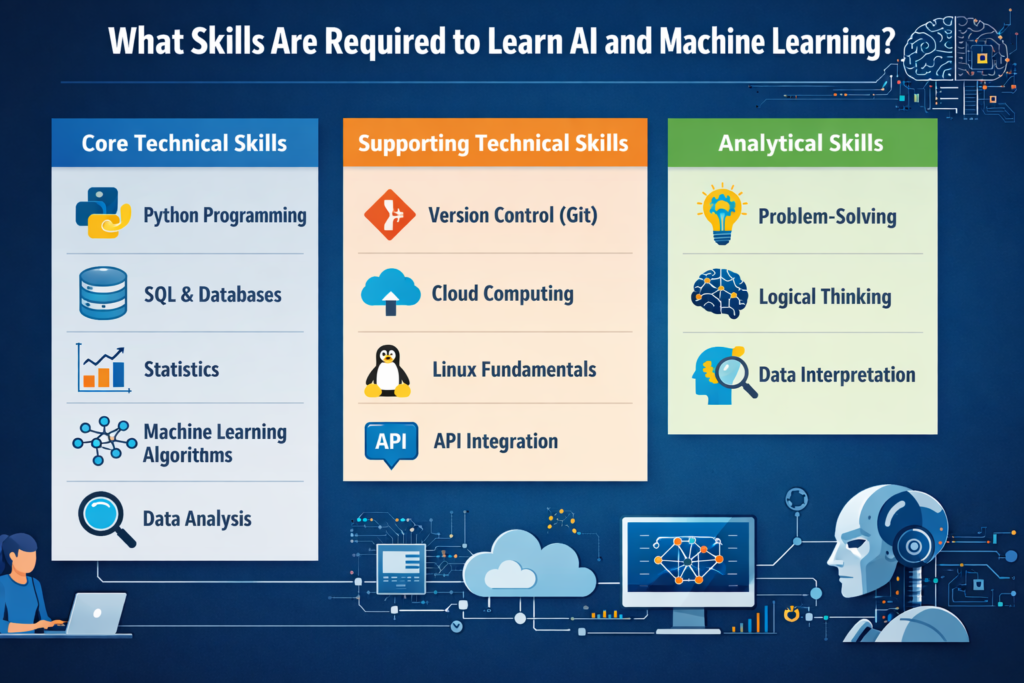
Core technical skills
| Skill | Purpose |
|---|---|
| Python | Programming language for AI |
| SQL | Database access |
| Statistics | Understanding data patterns |
| Machine learning | Building models |
| Data analysis | Extracting insights |
Supporting technical skills
- Git version control
- Cloud computing basics
- Linux fundamentals
- API integration
Analytical skills
- Problem-solving
- Logical thinking
- Data interpretation
AI training programs focus on building these skills step-by-step.
What tools are commonly used in AI training and enterprise environments?
Machine learning training courses typically cover industry-standard tools.
| Tool | Purpose |
|---|---|
| Python | Primary programming language |
| TensorFlow | Machine learning framework |
| Scikit-learn | Machine learning library |
| Pandas | Data analysis |
| NumPy | Numerical computing |
| Jupyter Notebook | Development environment |
| AWS | Cloud deployment |
| Docker | Application containerization |
These tools are widely used in enterprise environments.
How is AI used in enterprise IT projects?
AI is integrated into many real-world enterprise workflows.
Example 1: Fraud detection system
Machine learning identifies suspicious transactions.
Workflow:
- Collect transaction data
- Train fraud detection model
- Deploy model into banking application
Example 2: IT incident prediction
AI predicts system failures using:
- Server logs
- Monitoring data
Tools used:
- Python
- Monitoring tools
- Machine learning models
Example 3: AI-based software testing
AI tools automatically detect bugs.
Used in:
- Regression testing
- UI testing
- Performance testing
Machine learning training courses help professionals implement such solutions.
How does H2K Infosys help career switchers learn AI effectively?
H2K Infosys provides structured AI training programs focused on practical implementation.
Key learning components include:
Structured curriculum
Covers:
- Python fundamentals
- Machine learning concepts
- Data processing workflows
- AI model deployment
Hands-on project experience
Learners practice:
- Building machine learning models
- Analyzing real datasets
- Deploying AI solutions
Tool-based learning approach
Learners use enterprise tools such as:
- Python
- TensorFlow
- Jupyter Notebook
- Cloud platforms
Practical workflow exposure
Students learn enterprise workflows including:
- Data ingestion
- Model training
- Model deployment
- Monitoring
This aligns with real enterprise job requirements.
What job roles use AI and machine learning daily?
Machine learning training courses prepare learners for various job roles.
Common AI job roles
| Role | Responsibilities |
|---|---|
| Machine Learning Engineer | Develop ML models |
| AI Analyst | Analyze data and generate insights |
| Data Analyst | Interpret data |
| AI QA Engineer | Test AI applications |
| Automation Engineer | Implement automation systems |
Role vs skill mapping
| Role | Key Skills |
|---|---|
| ML Engineer | Python, ML algorithms |
| Data Analyst | SQL, data analysis |
| AI QA | Testing tools, AI tools |
| Automation Engineer | Python, automation frameworks |
What careers are possible after completing an AI training program?
AI training programs prepare learners for entry-level to intermediate AI roles.
Entry-level roles
- AI Analyst
- Junior ML Engineer
- Data Analyst
- AI Tester
Mid-level roles
- Machine Learning Engineer
- AI Developer
- Data Scientist
How does hands-on learning improve AI career transition success?
Hands-on learning improves skill retention and job readiness.
Practical exercises include:
- Model training
- Data analysis
- Deployment tasks
This helps learners understand enterprise workflows.
How is AI deployed in cloud environments?
Cloud deployment is essential for enterprise AI systems.
Common platforms:
- AWS
- Azure
- Google Cloud
Deployment workflow:
- Train model locally
- Upload model to cloud
- Deploy via API
- Integrate with applications
AI training programs include cloud integration fundamentals.
What challenges do career switchers face when learning AI?
Common challenges include:
Learning programming
Solution:
- Start with Python basics
Understanding machine learning concepts
Solution:
- Practice with simple projects
Understanding enterprise workflows
Solution:
- Hands-on training
Machine learning training courses help address these challenges.
FAQ: Artificial Intelligence Training and Career Switching
Can non-IT professionals learn AI?
Yes. Many AI training programs start with foundational concepts and gradually introduce advanced topics.
Is programming required for AI careers?
Yes. Python is the most commonly used programming language.
How long does it take to learn AI?
Typically:
- 3–6 months for fundamentals
- 6–12 months for job readiness
What industries use AI professionals?
Industries include:
- Finance
- Healthcare
- Retail
- Technology
What tools should beginners learn first?
Start with:
- Python
- Pandas
- Scikit-learn
Key Takeaways
- Artificial Intelligence skills are widely used across industries.
- Machine learning training courses help learners build practical job skills.
- AI training programs teach enterprise workflows.
- Hands-on projects improve job readiness.
- AI roles include Machine Learning Engineer, AI Analyst, and Data Analyst.
- Career switchers can transition into AI through structured learning.