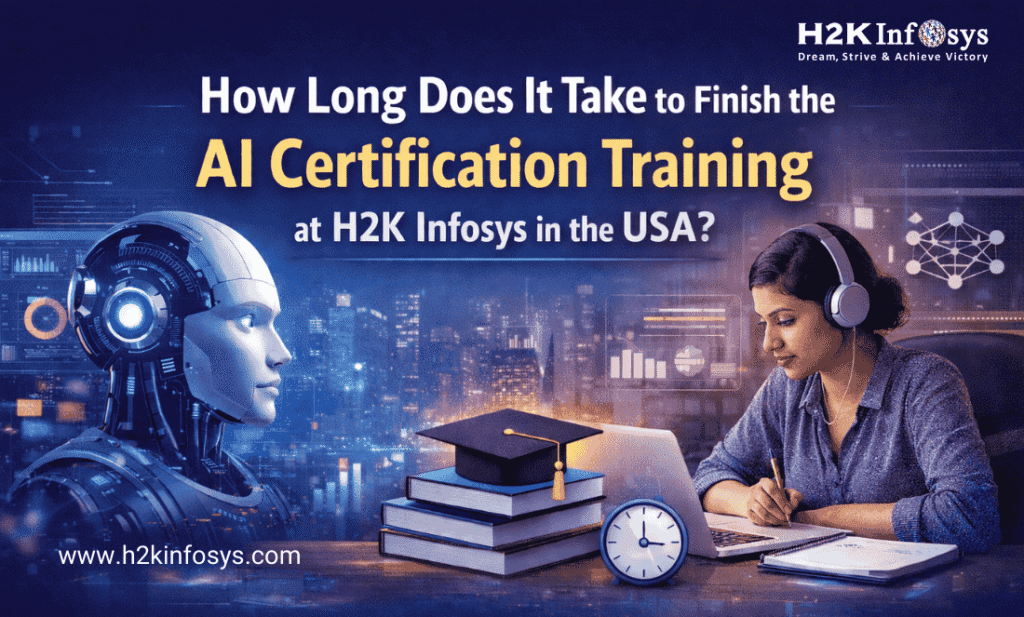
depending on the learner’s schedule, prior technical experience, and pace of study. The training is designed for working professionals and is commonly delivered through structured instructor-led sessions combined with hands-on projects and practical exercises. Learners usually attend classes part-time while practicing machine learning concepts, tools, and workflows used in real-world enterprise environments.
The duration may vary slightly depending on whether learners follow a regular weekday schedule, weekend-only sessions, or self-paced review of recorded modules.
What Is AI Certification Training?
Artificial Intelligence (AI) certification training is a structured educational program designed to teach the fundamental concepts, tools, and real-world applications of AI and machine learning used in modern IT systems.
An Artificial Intelligence Certified Course typically covers the theoretical foundations of AI as well as practical implementation using programming languages, data processing tools, and machine learning frameworks.
Key topics often included in machine learning training courses are:
- Data preprocessing and exploratory data analysis
- Supervised and unsupervised learning algorithms
- Neural networks and deep learning fundamentals
- Model evaluation and optimization
- Deployment of machine learning models in production environments
These programs aim to prepare professionals to work with AI technologies that are widely used across industries such as:
- Finance
- Healthcare
- Retail and e-commerce
- Cybersecurity
- Cloud computing platforms
In enterprise environments, AI systems are commonly integrated with data pipelines, cloud platforms, and analytics tools to automate decision-making and improve operational efficiency.
Typical Duration of AI Certification Training at H2K Infosys
AI certification programs designed for working professionals usually balance theoretical learning with hands-on implementation.
The typical timeline can be summarized as follows.
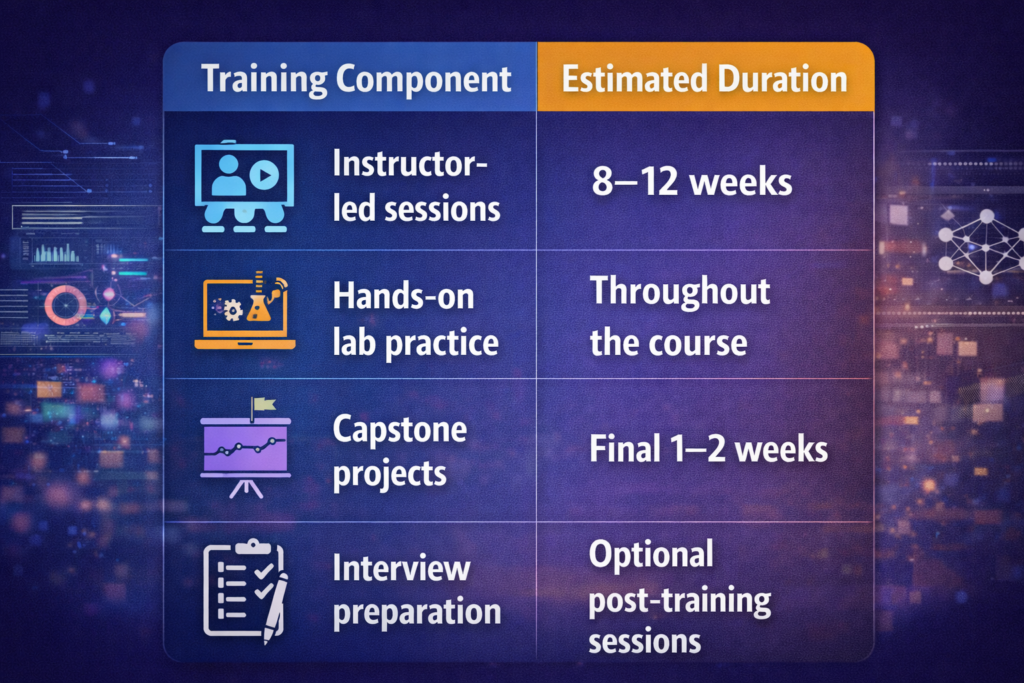
| Training Component | Estimated Duration |
|---|---|
| Instructor-led sessions | 8–12 weeks |
| Hands-on lab practice | Throughout the course |
| Capstone projects | Final 1–2 weeks |
| Interview preparation | Optional post-training sessions |
Most participants attend 2–3 live sessions per week, each lasting around 90–120 minutes.
This format allows learners to:
- Study while maintaining full-time employment
- Practice coding and model-building between sessions
- Apply concepts through guided projects
Why Is AI Certification Training Important for Working Professionals?
Artificial intelligence has become a core capability in modern enterprise systems. Many organizations now integrate AI into data analytics, predictive modeling, and automation workflows.
For working professionals, structured machine learning training courses can help build skills in areas such as:
- Data-driven decision-making
- Predictive analytics
- Intelligent automation
- AI model deployment
Common Enterprise Use Cases
AI technologies are widely used for:
| Industry | AI Application |
|---|---|
| Finance | Fraud detection models |
| Healthcare | Medical image analysis |
| Retail | Product recommendation systems |
| Manufacturing | Predictive maintenance |
| Telecommunications | Network traffic prediction |
Professionals who understand how these systems are designed and implemented can contribute to data science teams, AI engineering roles, and analytics-driven projects.
How Does Artificial Intelligence Work in Real-World IT Projects?
Artificial intelligence solutions in enterprise environments usually follow a structured lifecycle. Teams collaborate across multiple roles including data engineers, data scientists, and machine learning engineers.
Typical AI Development Workflow
- Data Collection
- Raw data gathered from databases, APIs, or event streams
- Data Preparation
- Cleaning, normalization, and feature engineering
- Model Development
- Training machine learning algorithms on prepared datasets
- Model Evaluation
- Testing accuracy using validation datasets
- Deployment
- Integrating models into production systems
- Monitoring and Maintenance
- Tracking model performance and retraining when needed
Example Enterprise Scenario
A retail company building a recommendation system might follow these steps:
- Collect purchase history and user browsing behavior
- Use collaborative filtering algorithms
- Train models using frameworks such as TensorFlow or Scikit-learn
- Deploy models through REST APIs integrated with e-commerce platforms
This workflow reflects how Machine Learning Training Courses prepare professionals to handle real project environments.
What Skills Are Required to Learn Artificial Intelligence?
While AI training programs are designed for beginners as well as experienced professionals, certain foundational skills are helpful.
Technical Prerequisites
| Skill Area | Description |
|---|---|
| Programming | Basic knowledge of Python |
| Mathematics | Linear algebra and probability basics |
| Data handling | Understanding of datasets and CSV/JSON formats |
| Statistics | Concepts like mean, variance, distributions |
Tools Commonly Used in AI Training
Professionals learning AI typically work with tools such as:
- Python
- NumPy
- Pandas
- Scikit-learn
- TensorFlow
- PyTorch
- Jupyter Notebook
Many artificial intelligence certified courses incorporate practical labs using these tools.
What Topics Are Covered in Machine Learning Training Courses?
Machine learning training courses generally follow a progressive learning structure.
Phase 1: Foundations of AI
Key topics include:
- Introduction to AI concepts
- Types of machine learning
- Data exploration techniques
- Python for data science
Phase 2: Core Machine Learning Algorithms
Students learn common algorithms such as:
- Linear regression
- Logistic regression
- Decision trees
- Random forests
- Support vector machines
- K-means clustering
Phase 3: Advanced AI Concepts
Advanced topics may include:
- Neural networks
- Deep learning fundamentals
- Natural language processing
- Model optimization techniques
Phase 4: Model Deployment
This stage focuses on practical implementation.
Typical tasks include:
- Packaging models using APIs
- Deploying models on cloud platforms
- Monitoring model performance
How Is Artificial Intelligence Used in Enterprise Environments?
In enterprise IT systems, AI models rarely operate independently. They are typically integrated into large scale data pipelines and applications.
Common Enterprise Architecture for AI Systems
A simplified architecture may include:
- Data ingestion layer
- Data storage systems
- Model training environment
- Model serving infrastructure
- Application integration layer
Example Architecture Stack
| Layer | Example Tools |
|---|---|
| Data storage | SQL databases, data lakes |
| Data processing | Apache Spark |
| Model development | Python frameworks |
| Deployment | Docker containers |
| Cloud platforms | AWS, Azure, Google Cloud |
These components are commonly explored in machine learning training courses.
What Job Roles Use Artificial Intelligence Daily?
Professionals trained through artificial intelligence certified courses may work in several technical roles.
AI-Related Job Roles
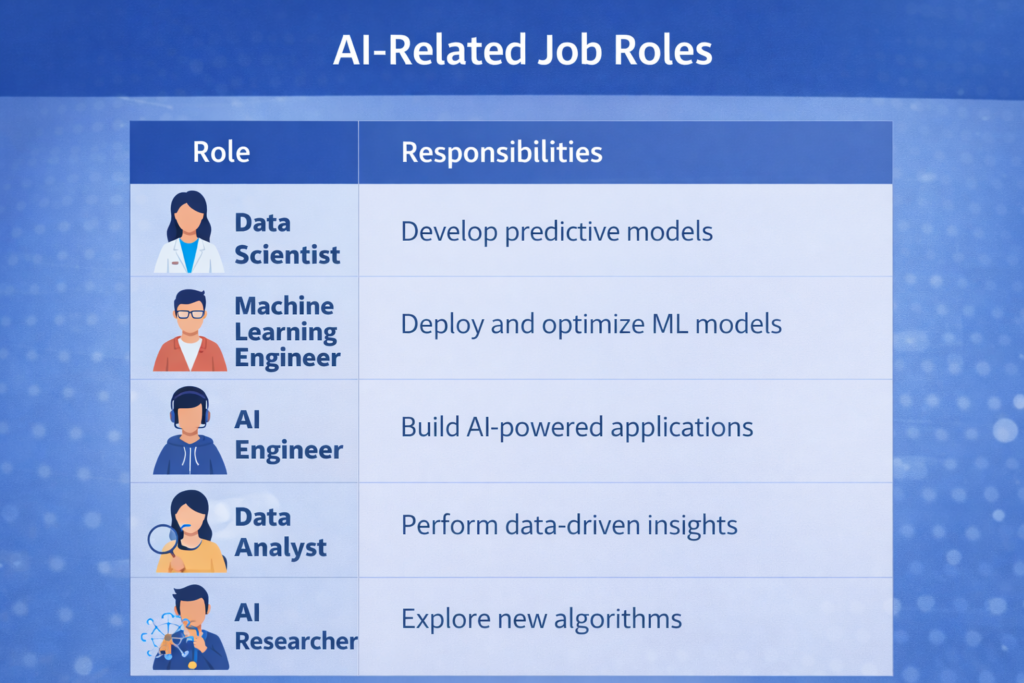
| Role | Responsibilities |
|---|---|
| Data Scientist | Develop predictive models |
| Machine Learning Engineer | Deploy and optimize ML models |
| AI Engineer | Build AI-powered applications |
| Data Analyst | Perform data-driven insights |
| AI Researcher | Explore new algorithms |
Each role requires different combinations of programming, mathematics, and domain expertise.
What Careers Are Possible After Learning AI?
Artificial intelligence skills are used across multiple sectors.
Some common career pathways include:
- Machine Learning Engineer
- Data Scientist
- AI Developer
- AI Solutions Architect
- Data Analytics Specialist
Professionals may work in industries such as:
- Financial services
- Healthcare technology
- Retail analytics
- Autonomous systems
- Cloud computing
Because AI systems rely heavily on data processing and predictive modeling, many roles combine machine learning training with broader data engineering skills.
What Learning Format Is Used in H2K Infosys AI Training?
Training programs typically combine several learning methods to support working professionals.
Instructional Methods
| Method | Purpose |
|---|---|
| Live instructor-led classes | Concept explanation |
| Hands-on labs | Practical coding experience |
| Case studies | Real-world project scenarios |
| Assignments | Skill reinforcement |
| Capstone projects | End-to-end AI implementation |
This blended approach helps learners move from theoretical understanding to practical application.
What Challenges Do Beginners Face When Learning AI?
Learning artificial intelligence involves multiple technical disciplines.
Common challenges include:
1. Understanding Mathematical Concepts
Algorithms often rely on concepts such as:
- Matrix operations
- Gradient descent
- Probability distributions
2. Data Preparation Complexity
Real-world datasets often require:
- Missing value handling
- Data normalization
- Feature engineering
3. Model Evaluation
Selecting appropriate metrics can be challenging.
Examples include:
- Accuracy
- Precision and recall
- F1 score
- ROC-AUC
Many machine learning training courses include guided exercises that demonstrate these concepts through practical examples.
Example Workflow: Building a Machine Learning Model
Below is a simplified pseudo-workflow often practiced during AI training.
1. Load dataset using Pandas
2. Perform exploratory data analysis
3. Split dataset into training and test sets
4. Train model using Scikit-learn
5. Evaluate performance metrics
6. Tune hyperparameters
7. Export trained model
This workflow mirrors real processes used by data science teams in enterprise environments.
Frequently Asked Questions (FAQ)
How long does it take to complete AI certification training at H2K Infosys?
Most learners complete the training in 8–12 weeks, depending on the class schedule and time available for practice.
Is prior programming knowledge required?
Basic familiarity with Python programming is helpful but many introductory modules review essential programming concepts before moving into machine learning topics.
What tools are taught in artificial intelligence certification courses?
Common tools include:
- Python
- Pandas
- NumPy
- Scikit-learn
- TensorFlow
- Jupyter Notebook
These tools are widely used for building and testing machine learning models.
Can working professionals attend AI training programs?
Yes. Many programs are designed with evening or weekend schedules so professionals can learn while maintaining full-time employment.
What industries use AI skills?
AI technologies are used across industries including:
- Healthcare
- Financial services
- Retail
- Manufacturing
- Telecommunications
Are projects included in machine learning training courses?
Most training programs include hands-on projects and case studies that simulate real-world AI development workflows.
Key Takeaways
- AI certification training at H2K Infosys generally takes 8–12 weeks to complete.
- The program focuses on machine learning algorithms, AI frameworks, and practical implementation.
- Training typically includes live instruction, labs, and capstone projects.
- Artificial intelligence skills are used in roles such as data scientist, machine learning engineer, and AI developer.
- Enterprise AI workflows involve data preparation, model development, deployment, and monitoring.