When people talk about AI Training Online, they’re usually referring to structured courses you can take digitally programs from providers like H2K Infosys that cover machine learning, data science, and how AI systems come together in practice.
But here’s the thing it’s not just about theory anymore. At least, it shouldn’t be.
The better programs try to mirror how things actually work in real tech environments. Not just neat examples from a slide, but messy, real-world workflows where things don’t always behave nicely.
If you’re looking at AI programs in the U.S., going with the most popular one isn’t always the best move. It’s worth slowing down a bit and asking:
What exactly are they teaching? Who’s teaching it? Are there real projects? Does it actually line up with where you want to go?
Because the good ones… they don’t just explain concepts. They show you how systems run end to end tools, pipelines, deployment, all of it.
So, what is AI training online (in simple terms)?
At a basic level, it’s a set of online courses designed to walk you through both the fundamentals and the more advanced parts of AI.
You’ll usually run into topics like:
- Machine Learning
- Deep Learning
- Natural Language Processing (NLP)
- Computer Vision
- Data Engineering (often overlooked, but honestly… pretty critical)
The format varies. Some courses are live you attend sessions at fixed times. Others are self-paced, which is helpful if your schedule is unpredictable. And some mix both.
Most solid Online Ai Programs include coding labs, exercises, and a capstone project. Because just watching videos? That rarely gets you very far.
What you actually learn
A good AI course usually covers a few key areas:
- Theory → things like supervised learning, neural networks—basically how models learn
- Tools → Python, TensorFlow, PyTorch, Scikit-learn
- Data work → cleaning data, feature engineering (this part trips people up more than expected)
- Deployment → getting models out of your notebook and into real systems
- Projects → solving real problems, not overly simplified ones
That project phase is where things either start to make sense… or feel confusing. There’s not much middle ground.
Why this kind of training actually matters
AI isn’t some niche skill anymore it’s quietly baked into almost everything.
Finance, healthcare, retail, logistics… you name it, AI is there somewhere.
For someone already working, online AI training is a pretty practical way to upskill without quitting your job.
What you really get out of it:
- You start thinking in terms of data and systems
- You open doors to AI-related roles
- You understand automation and predictions better
- You can actually contribute in discussions with data teams (instead of just nodding along)
In real companies, AI is part of a bigger pipeline. Data flows in, models process it, results go somewhere. Without that context, it all feels a bit abstract.
How AI works in real projects
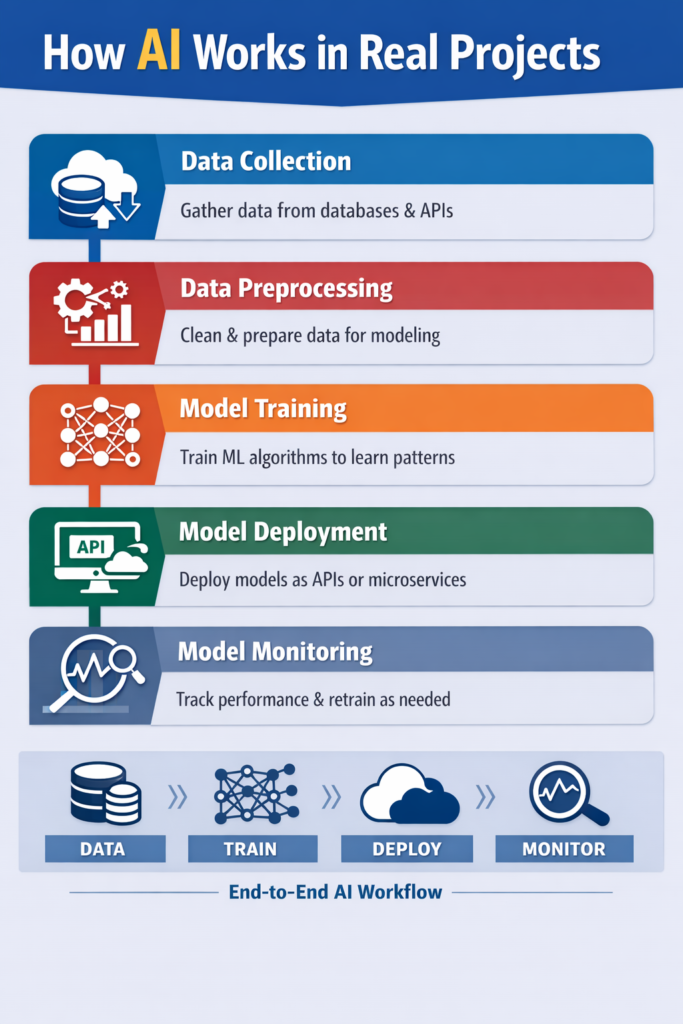
In practice, AI projects follow a workflow. It’s rarely just “train a model and you’re done.”
It usually looks something like this:
- Data collection
Pulling structured data (databases, logs) or unstructured data (text, images) - Preprocessing
Cleaning, normalizing, creating features (this takes more time than people expect) - Model selection
Picking the right algorithm not always obvious - Training & validation
Splitting data, tuning parameters, trying again… and again - Deployment
Turning the model into an API or service - Monitoring
Watching performance, retraining when things drift
Quick example: fraud detection
Take a banking system:
- Input → transaction data
- Process → analyze patterns (amount, location, frequency)
- Output → risk score
Sounds straightforward. In reality, it’s messy data issues, edge cases, constant updates.
Choosing the right AI program
Picking randomly usually doesn’t work out great.
A better way to think about it:
1. Start with your goal
Are you switching careers or just adding skills? That changes everything.
2. Look at the curriculum
Make sure it includes:
- Python
- Machine learning basics
- Deep learning
- Deployment concepts
3. Check the hands-on part
This is huge:
- Real datasets
- Projects that resemble industry work
- Labs you actually code in
4. Instructor background
Industry experience matters. A lot.
5. Flexibility
Can you realistically stick to it?
6. Support
Mentorship, doubt sessions, career guidance these help more than people expect.
7. Enrollment
Usually simple: sign up, pay, start learning.
What you should know before starting
You don’t need to be an expert, but a few basics help:
- Python fundamentals
- Basic math (linear algebra, probability)
- Some statistics
- Handling data (CSV, maybe SQL)
Nice to have:
- Basic algorithms
- Some exposure to cloud
- APIs
Tools you’ll probably use
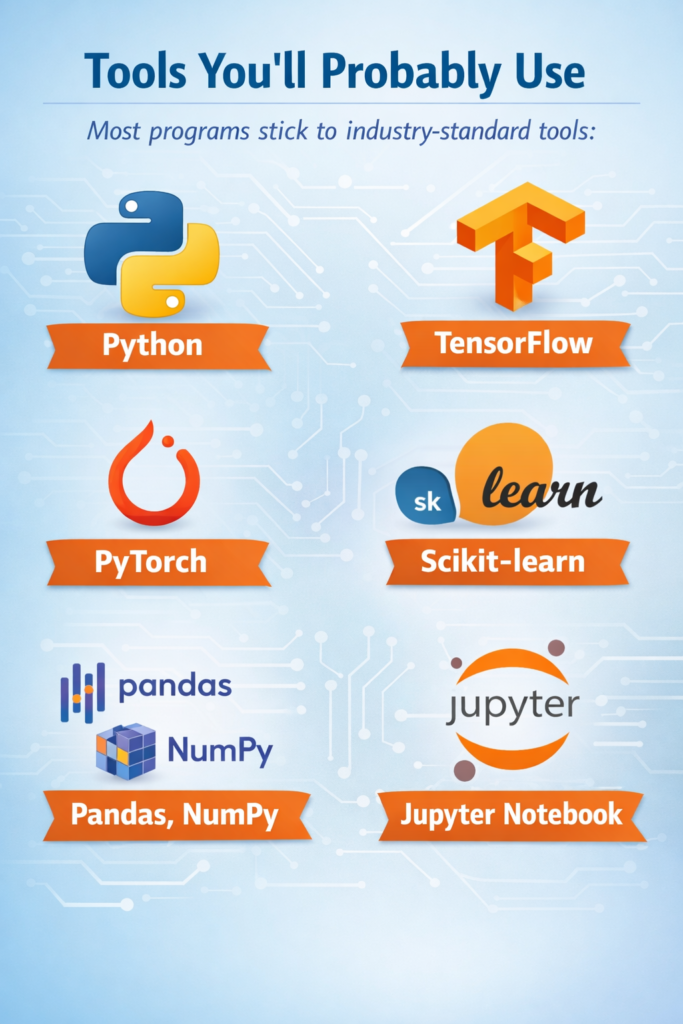
Most programs stick to industry-standard tools:
- Python
- TensorFlow
- PyTorch
- Scikit-learn
- Pandas, NumPy
- Jupyter Notebook
For deployment:
- Docker
- Kubernetes
And in real environments:
- Model versioning
- Security/compliance
- Cloud platforms (AWS, Azure, GCP)
How companies actually use AI
AI isn’t a standalone thing it’s part of business workflows.
Common use cases:
- Customer analytics (recommendations, predictions)
- Operations (forecasting, planning)
- Risk (fraud detection, credit scoring)
- Automation (chatbots, workflows)
And then there are constraints:
- Privacy laws (GDPR, HIPAA)
- Scaling issues
- Latency
- Legacy systems
Jobs that use AI regularly
Some typical roles:
- Data Scientist → modeling, analysis
- ML Engineer → building and deploying models
- AI Engineer → integrating AI into systems
- Data Analyst → reporting, dashboards
- NLP Engineer → working with language models
Career paths after learning AI
There isn’t just one path.
Entry-level:
- Junior Data Analyst
- AI Associate
Mid-level:
- Machine Learning Engineer
- Data Scientist
Advanced:
- AI Architect
- Lead Data Engineer
And these roles show up across industries—not just tech.
Comparing programs
- Basic programs → intro-level, fewer projects, limited tools
- Advanced programs → deeper content, real projects, full stack exposure, better support
What a typical learning path looks like
Not perfectly linear, but roughly:
- Foundation → Python, basic stats
- Intermediate → ML models, preprocessing
- Advanced → deep learning, NLP, CV
- Deployment → APIs, cloud
Challenges people don’t always mention
Some of this gets glossed over:
Technical:
- Math can be tough
- Debugging models is frustrating
- Large datasets slow things down
Practical:
- Lack of real-world context
- Not enough hands-on work
- Hard to connect theory to business use
What helps:
- Work with real datasets
- Build projects regularly
- Talk to others (forums, peers—it makes a difference)
FAQs
How long does it take?
Usually 3–9 months.
Can beginners start?
Yes—most courses begin from basics.
Are projects included?
Good ones include them. This matters a lot.
Is coding required?
Yes mainly Python.
AI vs ML?
ML is a subset of AI focused on learning from data.
Do certifications matter?
Somewhat but projects matter more.
Can this help switch careers?
Yes, many people do exactly that.
Key takeaways
- AI training online is a structured way to learn ML, deep learning, and data skills
- The best programs focus on building things, not just explaining them
- Choosing the right course takes a bit of thought don’t rush it
- AI skills are useful across industries
- Career paths range from entry-level roles to advanced engineering positions