Starting a Salesforce Career in 2026 is absolutely achievable if you combine the right certifications, hands-on practice, and smart networking and organizations like H2kinfosys can help you map that path early. The demand is real, the salaries are strong, and companies across the United States are still hiring skilled Salesforce professionals despite economic shifts.
I’ve watched people from accounting, retail, nursing, and even hospitality successfully build a Salesforce Career in the United States over the past few years. The tech layoffs you’ve seen in the news? They didn’t slow Salesforce hiring the way they slowed some other roles. Businesses still need CRM systems, automation, reporting, and AI-driven customer insights. That’s not going away.
But here’s the thing most blogs won’t tell you: before you jump into Salesforce CRM Certification Courses, you need to understand what a Salesforce Career actually looks like day to day.
What Does a Salesforce Career Actually Involve in 2026?
At its core, Salesforce is a cloud-based CRM platform built by Salesforce. But in 2026, it’s more than just contact management. We’re talking AI-powered automation (Einstein AI enhancements have become more practical), industry clouds, advanced analytics, and deep integrations with tools like Slack and Tableau.
When you build a long-term Salesforce Career, you’re usually stepping into one of these roles:
- Salesforce Administrator
- Business Analyst
- Salesforce Developer
- Consultant
- Architect
Most beginners start with admin roles. And honestly? That’s a smart move.
Because a Salesforce Career isn’t about coding first it’s about understanding business processes. How does a sales team work? How does customer support track cases? How do marketing teams measure campaigns? If you can answer those questions and configure Salesforce to support them, you’re already valuable.
I’ve seen junior admins land $85K–$100K roles simply because they could translate business problems into Salesforce solutions. That’s the skill.
That’s how a Salesforce Career gains momentum.
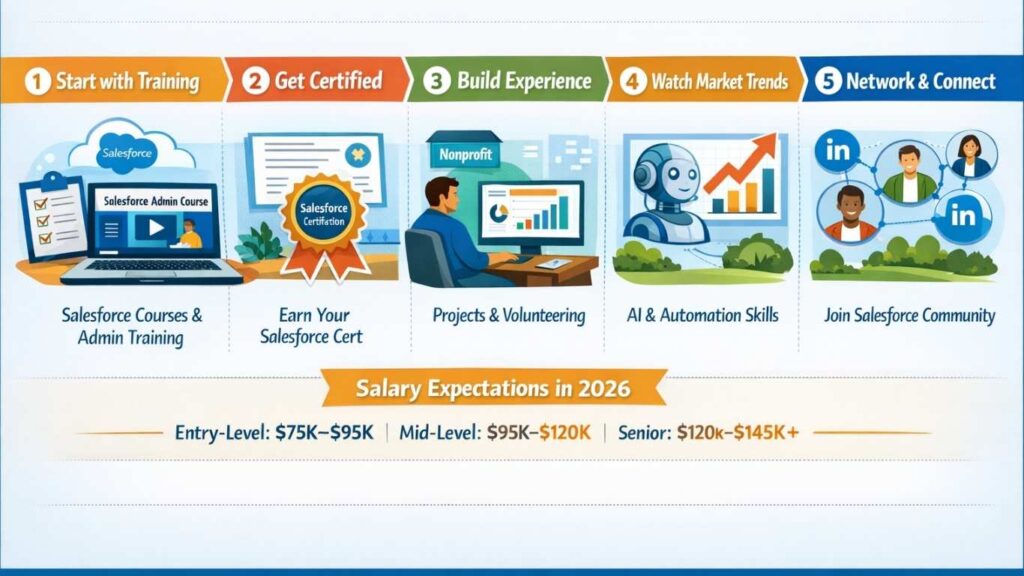
Step 1: Start with the Right Training (Not Just Random YouTube Videos)
The first real step into a Salesforce Career is structured learning. Yes, free resources help. But at some point, you need direction.
Look for:
- Salesforce Admin Training that includes live projects
- Salesforce training online with sandbox access
- Salesforce administrator classes that cover real-world scenarios
- Updated Salesforce certification courses aligned with 2026 exam formats
One mistake I see constantly? People study just to pass the exam. That won’t accelerate your Salesforce Career.
Instead, practice building:
- Custom objects
- Reports & dashboards
- Flows (Flow automation is huge in 2026)
- Security models
- User profiles & roles
If you can explain why you configured something not just how you’ll stand out immediately in interviews.
Step 2: Get Certified (But Be Strategic)
To break into a Salesforce Career, the Salesforce Certified Administrator credential is still the gold standard starting point.
But here’s what’s changed recently: employers now expect applied knowledge, not just badges.
I recently mentored someone who passed the admin exam but couldn’t explain sharing rules in a real scenario. Interviews didn’t go well. Once we practiced business case discussions, she landed a role within six weeks.
So yes, take salesforce crm certification courses. But treat them as part of your Salesforce Career foundation, not the entire strategy.
Step 3: Build Real Experience (Even Before You’re Hired)
This is where many people stall.
If you’re serious about treating your Salesforce Career like a long game, build experience before someone gives you a job title.
Here’s how:
- Volunteer to configure Salesforce for a nonprofit
- Offer to help a small business clean up their CRM
- Create mock business scenarios in your sandbox
- Document everything in a portfolio
Recruiters in 2026 love candidates who can show screen recordings or project breakdowns. It makes your Salesforce Career future-proof.
Step 4: Understand the Market Trends in 2026
Another reality about a Salesforce Career right now? AI integration is no longer optional.
Companies are actively looking for admins who understand:
- AI-driven forecasting
- Prompt building within Salesforce
- Automation with Flow + AI suggestions
- Data hygiene for AI accuracy
In fact, Salesforce’s AI enhancements over the past year have made automation skills even more valuable than basic configuration skills. If you position yourself as someone who understands both CRM logic and AI workflows, you instantly stabilize your Salesforce Career.
Step 5: Network Like It’s Part of the Job
I’ll be blunt networking speeds up a Salesforce Career more than almost anything else.
Join:
- Local Salesforce user groups
- LinkedIn communities
- Trailblazer events
- Virtual admin meetups
One of my former colleagues switched from HR into tech by attending two virtual Salesforce events and connecting with hiring managers directly. Within three months, she was switching into a Salesforce Career full-time.
In 2026, referrals still win.
Salary Expectations in 2026
Here’s what I’m seeing across the U.S. market:
- Entry-level Admin: $75K–$95K
- Mid-Level Admin: $95K–$120K
- Senior Admin / Consultant: $120K–$145K+
Of course, location matters. Remote roles are competitive, but hybrid positions are widely available.
The good news? Demand is steady because companies rely heavily on CRM data to drive revenue decisions. That makes protecting your Salesforce Career from automation surprisingly realistic especially if you stay skilled.
Common Mistakes That Slow Down a Salesforce Career
Let me save you some time.
- Collecting certifications without practice
- Avoiding networking
- Ignoring business fundamentals
- Not learning Flow deeply
- Waiting for “perfect timing”
If you map out your Salesforce Career with milestones certification, first project, networking target, job applications, you’ll move faster.
My Honest Advice (From Experience)
When I invested in my own Salesforce Career years ago, the turning point wasn’t passing the exam. It was building something real and talking confidently about it.
That confidence comes from repetition.
If you take your Salesforce Career seriously, treat it like a professional craft. Study consistently. Practice weekly. Engage with the community. Follow release updates. Salesforce rolls out major platform updates three times a year, staying current matters.
And yes, structured Salesforce Admin Training can shorten your learning curve significantly if it includes hands-on labs and mentorship.
Is 2026 a Good Time to Start?
Absolutely.
Digital transformation is still accelerating. CRM data is central to revenue growth. AI is increasing, not decreasing, the need for skilled administrators who understand business logic.
You Do Not Need to Chase Hype for a Sustainable Salesforce Career. Instead, it’s about addressing actual business challenges leveraging a powerful platform.
So if you are ready to work hard, learn skills more than just theories, and meet the right people, starting your Salesforce Career in 2026 can be one of the best decisions you will make this decade.
And honestly? It’s one of the few tech paths where non-tech backgrounds are still genuinely welcome.
If you want, I can also outline a 90-day roadmap to launch your Salesforce journey step by step.