

Yes, an AI course is definitely worth it in 2026, and honestly, probably more than it was a few years ago. Everything from regular office workflows to big enterprise systems is getting wrapped around H2K Infosys AI Course in some way, and it’s happening faster than most people expected. Even a beginner-level understanding helps you stay relevant and avoid feeling lost when new tools or processes show up at work. You don’t need to become a hardcore data scientist; just knowing how AI fits into real projects, how to use it responsibly, and how to make it work for you already puts you ahead of a lot of folks. So if you’re thinking about enrolling, the timing is actually spot-on.
More organizations search for professionals who comprehend design, training war-rooming, system model validation and production systems AI integration. Professionals often compare the top Best online courses for artificial intelligence to develop structured, industry-relevant learning that matches real job needs.
What Is an AI Course in 2026?
AI in the year 2026 is a course that generally addresses the theory, tools, and techniques to build and deploy intelligent systems in practice. Unlike in the early days of AI education when it was math-centric, training now concentrates on practical enterprise applications.
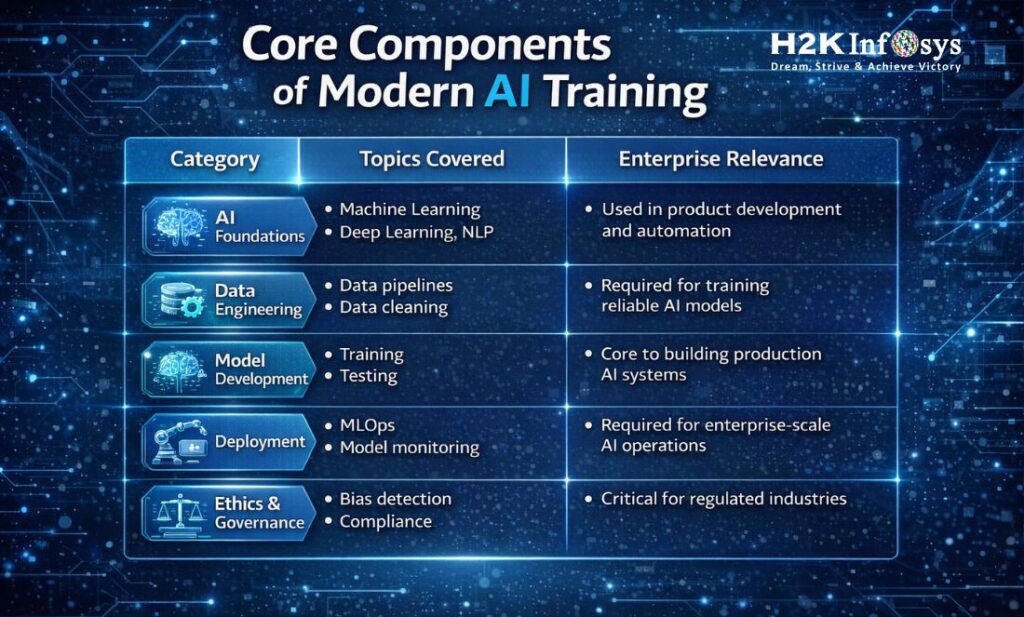
Components of Contemporary AI Education
| Category | Topics Covered | Enterprise Relevance |
|---|---|---|
| AI Foundations | Machine Learning, Deep Learning, NLP | Used in product development and automation |
| Data Engineering | Data pipelines, data cleaning | Required for training reliable AI models |
| Model Development | Training, testing, validation | Core to building production AI systems |
| Deployment | MLOps, model monitoring | Required for enterprise-scale AI operations |
| Ethics & Governance | Bias detection, compliance | Critical for regulated industries |
Education about AI today is more in line with production than solely academic knowledge.
How AI Is Used In Practical IT Operations?
AI in enterprises usually sit within larger software landscapes. AI models seldom operate in isolation — they work with data platforms, cloud resources and application services.
Typical Enterprise AI Workflow
Data Collection
Data is collected from apps, sensors, logs or business systems.
Data Preparation
Data engineers would cleanse, normalize and process the raw data.
Model Training
Machine learning engineers use frameworks to train models.
Model Evaluation
Accuracy, bias and performance stability are tested by teams.
Deployment
APIs or cloud services are used to run models.
Monitoring
Performance drift is monitored by teams who retrain models when appropriate.
Example Real-World Scenario
- Use Case: Customer Support Automation
- Input: Customer chat or email
- AI Task: Intent detection + This work would be further improved with a more complex response generation model to controller output.
- Output: Automatic ticket resolution or routing
Such workflow finds its application in SaaS applications and e-commerce system and financial services.
Why Should a Working Professional Learn AI Course in 2026?
AI isn’t just for research labs anymore. From factories to hospitals, it’s already working in operational systems of all kinds.
Key Reasons Professionals Learn AI
Cross-Industry Demand
- AI is used in:
- Healthcare diagnostics
- Financial fraud detection
- Cybersecurity threat detection
- Supply chain forecasting
- Marketing personalization
Automation and Productivity
- AI tools reduce manual workloads:
- Log analysis automation
- Document classification
- Code generation assistance
- Customer service automation
Career Adaptability
AI-skilled professionals can transfer to new roles like data analyst, automation engineer or AI product specialist.
What skills do you need to learn for an AI Course certification?
The contemporary AI learning paths are for individuals who switched over from IT, QA, or analytics.
Industry Tools Commonly Used
- Python
- TensorFlow / PyTorch
- Scikit-learn
- SQL
- Cloud AI services
The majority of best online courses for artificial intelligence has an emphasis on theory merged with labs that work mainly based on tool.
How Does AI Work in Enterprise?
AI can also be imbedded as a feature of business systems and applications.
Enterprise AI Implementation Areas
Cybersecurity
- Threat detection using anomaly models
- Malware classification
Software Testing
- Test case prediction
- Defect classification
Cloud Operations
- Resource usage prediction
- Cost optimization models
Business Intelligence
- Customer churn prediction
- Sales forecasting
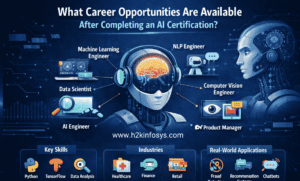
What Job Roles Use AI Daily?
Core AI Roles
| Role | Responsibilities |
|---|---|
| Machine Learning Engineer | Builds and deploys models |
| AI Developer | Integrates AI into applications |
| Data Scientist | Analyzes data and builds models |
| MLOps Engineer | Maintains production AI systems |
Hybrid Roles Using AI
| Role | AI Usage |
|---|---|
| QA Engineer | Test automation with AI tools |
| Cybersecurity Analyst | Threat detection models |
| Business Analyst | Predictive business insights |
| Cloud Engineer | AI service integration |
What Are the Possible Career Paths After Learning AI?
Entry-Level Transition Roles
- Data Analyst with AI tools
- Automation Tester using AI frameworks
- AI Support Engineer
Mid-Level Roles
- Machine Learning Engineer
- AI Product Analyst
- AI Integration Developer
Advanced Roles
- AI Architect
- Research Scientist
- AI Platform Engineer
Curriculum of AI Professional in 2026
| Stage | Focus |
|---|---|
| Beginner | Python + Data Basics |
| Intermediate | Machine Learning Models |
| Advanced | Deep Learning + MLOps |
| Expert | AI Architecture + Optimization |
Typical difficulties teams encounter in adopting AI
Data Quality Problems
“Garbage in, garbage out” is one of the consequences.
Model Drift
The patterns in the data change over time, which leads to model degradation.
Infrastructure Complexity
🔬 It’s going to take c loud orchestration to scale AI systems.
Governance Requirements
AI models have to be regulatory compliant.
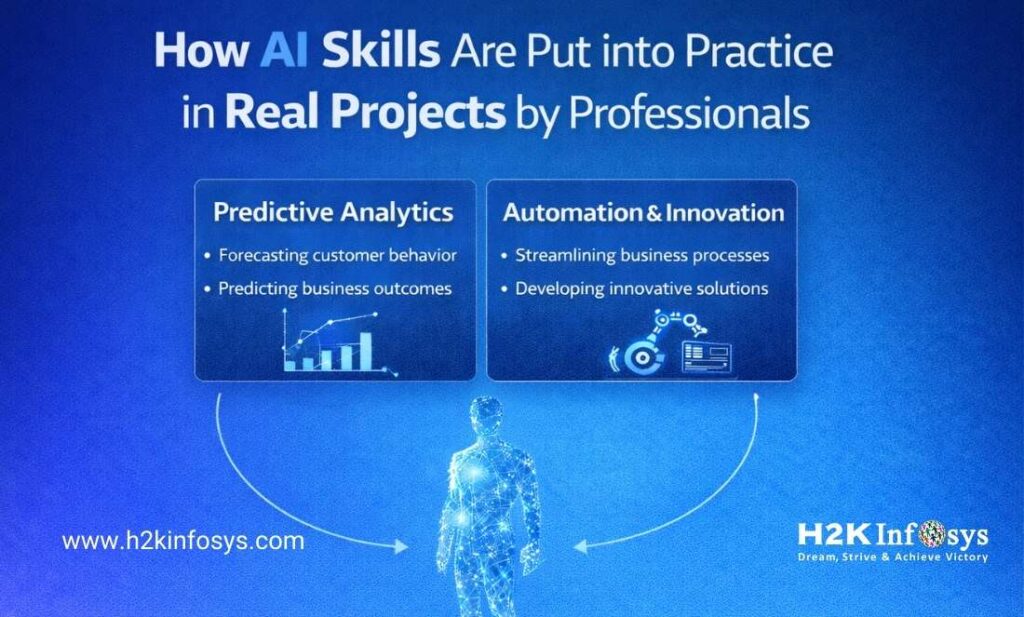
How AI Skills Are Put into Practice in Real Projects by Professionals
Example: Fraud Detection System
Steps:
- Collect transaction data
- Train anomaly detection model
- Deploy model via API
Monitor fraud prediction accuracy
Tool Comparison for AI Learning
| Tool | Use Case | Learning Difficulty |
|---|---|---|
| Python | Core AI programming | Medium |
| TensorFlow | Deep learning | High |
| Scikit-learn | ML basics | Medium |
| Cloud AI Services | Deployment | Medium |
Will AI Be A Saturated Career in 2026?
Our view is that AI is not so much saturated as stratifying.
Employers are seeking professionals with a mix of AI and domain knowledge, including:
- Cybersecurity + AI
- Cloud + AI
- QA Automation + AI
- Data Analytics + AI
FAQ: AI Course Certification and Career Value
Is a certification in AI course enough for a job?
Certification is proof of the structured learning but should be backed by project based experience.
Do I need advanced mathematics?
For most industry jobs, basic stats and prob suffice.
How long does it take to learn artificial intelligence?
Usually 6 to 12 months for intermediate job readiness level.
Is AI replacing jobs?
AI is automating routine tasks but generating new technical jobs.
What background is ideal for AI?
IT, Data Analytics, QA Coding and Software Development roles translate nicely.
Best Online Courses for Artificial Intelligence – How to Choose
Look for programs that include:
- Hands-on projects
- Real enterprise tools
- Cloud AI exposure
- Model deployment practice
- MLOps introduction
Long-Term Career Growth Projection for AI Professionals
2026–2030 Trends
- AI in all enterprise platforms
- Growth in AI governance roles
- Rise in adoption of AI automation in IT operations
- Expansion of AI-powered decision systems
AI is being treated as a fundamental technology in the same way that cloud computing was during the last decade.
Key Takeaways
- AI capabilities are emerging as foundational technical skills for IT roles.
- AI courses certs serve the role of validating structured knowledge and tool exposure.
- The top Ai course certification for mastering AI and best combinations of theory, tools, practice and real problem solving.
- Career growth in AI is about fusing AI with domain.
- Applied projects are necessary for employability.











One Response
I agree with the point that AI knowledge is now essential for more than just software developers. Data scientists, cybersecurity experts, and even business analysts can significantly benefit from AI courses, especially when learning how to integrate AI into real-world applications.